Why Your Demos Don't Convert (5 Questions You're Not Asking)
Sales demos fail because you're not setting them up for success. Ask these 5 critical questions before every demo to customize, engage prospects, and actually convert.
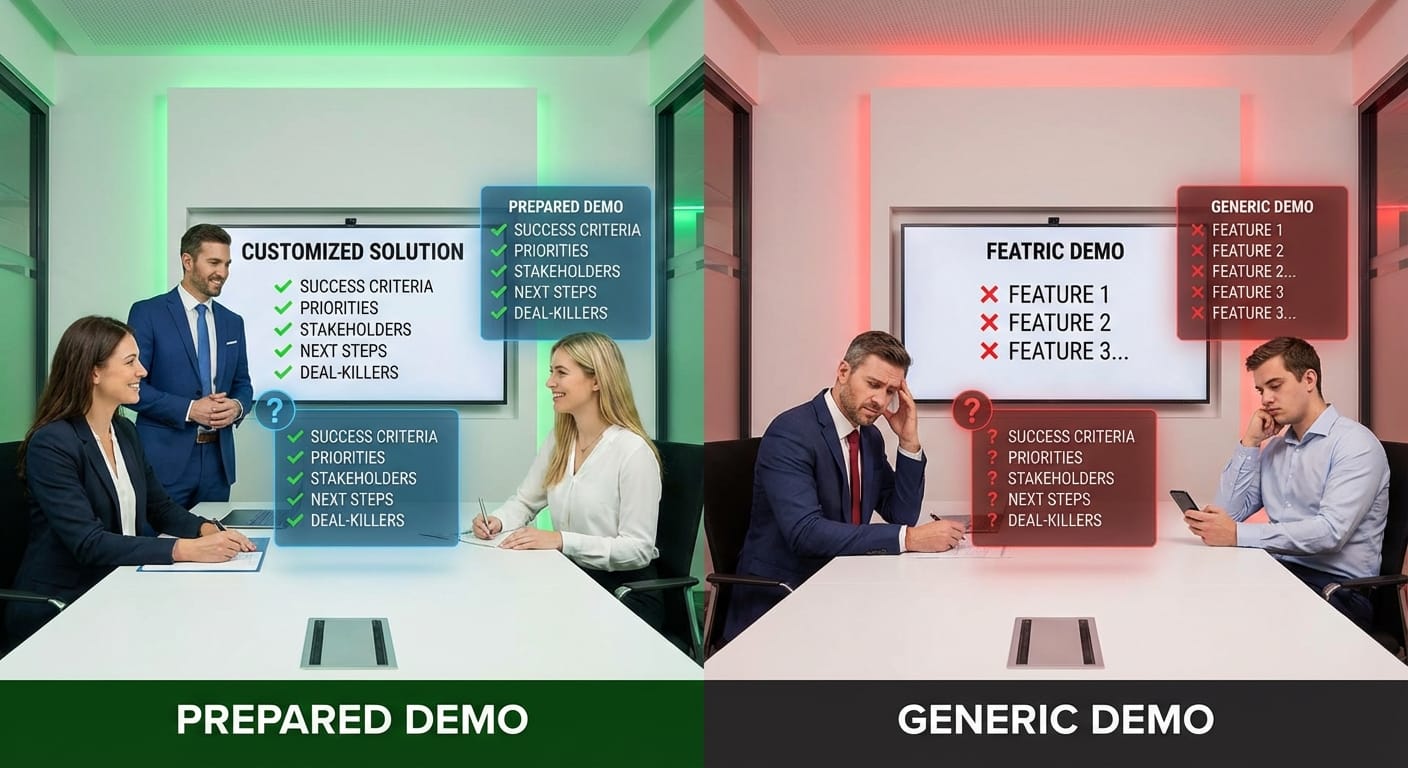
Most sales demos fail because reps don't set them up for success. You're jumping straight into feature tours instead of asking 5 critical questions that make demos relevant, focused, and conversion-worthy.
Your demos aren't converting because you're doing them wrong.
Not the demo itself - the problem starts before you even share your screen. You're jumping into product walkthroughs without understanding what prospects actually need to see, who needs to be there, or what happens if the demo goes well.
The result? Generic feature tours that bore prospects and don't move deals forward.
The fix isn't better demo skills - it's asking 5 questions BEFORE your demo that set it up for success.
Why Most Demos Fail
You're Giving Product Tours, Not Solving Problems: Showing every feature instead of what matters to them specifically.
Wrong People in the Room: Decision-makers missing, or people without authority wasting your time.
No Clear Next Steps: Demo ends with "let us know if you have questions" instead of advancing the deal.
Prospects Aren't Engaged: They're checking email because you're showing irrelevant features.
No Context: You don't know their pain, priorities, or decision criteria before diving in.
The 5 Questions to Ask Before Every Demo
Question 1: "What does success look like for you in this demo?"
What This Reveals:
- What they actually care about seeing
- Whether they've thought through what they need
- If they're serious or just browsing
Example Exchange: Rep: "Before we dive in, what does success look like for you in this demo?" Prospect: "I need to see how your solution handles [specific workflow] and integrates with [their system]." Rep: "Perfect - I'll focus there. Anything else critical to cover?"
What This Does: Lets you customize demo to their priorities instead of guessing or showing everything.
Red Flag Response: "Just show me what you've got" = They haven't thought it through, demo will be generic and waste time.
Question 2: "What specifically should we spend time on vs. what can we skip?"
What This Reveals:
- Their actual priorities vs. nice-to-haves
- What they already understand vs. what needs explanation
- Time constraints
Example Exchange: Rep: "To make best use of our 30 minutes, what should we spend most time on?" Prospect: "We're comfortable with basic features - focus on advanced analytics and custom reporting. That's what we're missing." Rep: "Got it. I'll skip basics and go deep on analytics and reporting capabilities."
What This Does: Prevents wasting time on irrelevant features while ensuring you cover what matters.
Red Flag Response: "Cover everything" = Demo will be scattered and superficial.
Question 3: "Who else should be in this demo and what do they care about?"
What This Reveals:
- If decision-makers are attending
- Different stakeholder priorities
- Whether this is real evaluation or fact-finding
Example Exchange: Rep: "Who else should join this demo?" Prospect: "Our VP of Sales and head of operations." Rep: "Great - what's most important to each of them?" Prospect: "VP cares about adoption and ROI. Operations wants to understand implementation complexity." Rep: "Perfect - I'll make sure to address both."
What This Does: Ensures right people attend and you address all stakeholder concerns in one session.
Red Flag Response: "Just me" when they're not the decision-maker = You're demoing to the wrong person.
Question 4: "What happens after this demo if it goes well?"
What This Reveals:
- Decision process and timeline
- Next steps and stakeholders
- Whether they have real buying process or just exploring
Example Exchange: Rep: "If this demo addresses what you need, what's the next step?" Prospect: "I'd present to our executive team next week, then we'd move to technical validation with IT." Rep: "Got it. Would it help if I provided materials for your executive presentation?" Prospect: "Yes, that would be helpful."
What This Does: Sets clear next steps and reveals decision process before you invest demo time.
Red Flag Response: "We'll see how it goes" or "I'll let you know" = No clear buying process, deal will stall.
Question 5: "What would make this a waste of your time?"
What This Reveals:
- Their concerns and potential deal-killers
- What NOT to focus on
- Whether they have unrealistic expectations
Example Exchange: Rep: "What would make this demo a waste of your time?" Prospect: "If it can't handle our volume or integrate with Salesforce, there's no point." Rep: "Good to know upfront - we handle [volume] easily and have native Salesforce integration. I'll show you both."
What This Does: Surfaces deal-killers early so you can address them or qualify out before wasting time.
Alternative Framing: "What concerns or requirements would make this not a fit?"
What to Do Based on Their Answers
Green Light (Proceed with Demo):
✅ Clear success criteria defined ✅ Decision-makers attending or involved ✅ Specific priorities identified ✅ Next steps mapped out ✅ No immediate deal-killers
Action: Customize demo to their answers, focus on what matters, address stakeholder concerns.
Yellow Light (Qualify Further First):
⚠️ Vague about what they want to see ⚠️ Wrong people attending (no decision-makers) ⚠️ Unclear next steps ⚠️ May have unrealistic expectations
Action: "Before we dive into demo, let's make sure we're aligned on [specific gap]. Would 15 minutes to discuss that make sense first?"
Red Light (Reschedule or Qualify Out):
🚫 "Just show me everything" 🚫 No decision-makers available 🚫 No clear next steps or buying process 🚫 Obvious deal-killers you can't address
Action: "Based on what you've shared, I want to make sure a demo is valuable right now. Here's my concern: [specific issue]. Would it make more sense to [reschedule with right people / address concerns first / reconnect when timing is better]?"
Demo Success Checklist
Before Every Demo:
- Asked what success looks like for them
- Identified what to focus on vs. skip
- Confirmed right stakeholders attending
- Mapped next steps if demo goes well
- Surfaced potential deal-killers
- Customized demo agenda based on answers
If You Can't Check All Boxes: Reschedule with proper setup rather than winging a generic demo.
The Demo Setup Framework
Old Approach: Schedule demo → Show up → Feature tour → "Any questions?" → Hope they move forward
New Approach: Ask 5 questions → Customize demo to answers → Focus on what matters → Address concerns → Advance to clear next step
Result:
- Higher conversion rates
- Better engagement during demos
- Clearer next steps
- Less time wasted on unqualified prospects
Common Mistakes
Mistake 1: Skipping Setup Questions "They asked for a demo, let's just show it" ❌ Result: Generic tour that doesn't address their needs.
Mistake 2: Asking Questions During Demo Trying to qualify while demoing ❌ Result: Scattered demo that jumps around, loses flow.
Mistake 3: Accepting Wrong Attendees Demoing to non-decision-makers without path to decision-makers ❌ Result: "Looks interesting, let me talk to my boss" and deal dies.
Mistake 4: No Clear Next Steps Ending with "reach out if you have questions" ❌ Result: You lose control, deal stalls.
Why This Works
Customization: Demo becomes relevant conversation about their needs, not generic product tour.
Engagement: Prospects pay attention when you're showing what they asked to see.
Credibility: Asking intelligent setup questions positions you as consultant, not vendor.
Efficiency: Stop wasting time on demos that won't convert. Qualify or customize before investing time.
Control: You maintain deal momentum with clear next steps established before demo ends.
Conclusion
Your demos fail because you're not setting them up for success. These 5 questions transform demos from generic feature tours into focused, relevant conversations that actually move deals forward.
Ask them before every demo. The prospects who give good answers are serious buyers worth your time. The ones who don't reveal themselves as tire-kickers you can qualify out or reschedule when they're ready.
Stop wasting demos. Start converting them.
Ready to practice demo setup and qualification? Book a demo with the Sellible team and work with AI prospects who test your pre-demo qualification skills.