What Is SPIN Selling? Complete 2026 Guide for B2B Sales
SPIN Selling is a proven B2B questioning framework using Situation, Problem, Implication, and Need-Payoff questions. Complete guide with 25+ examples and how to apply it effectively.
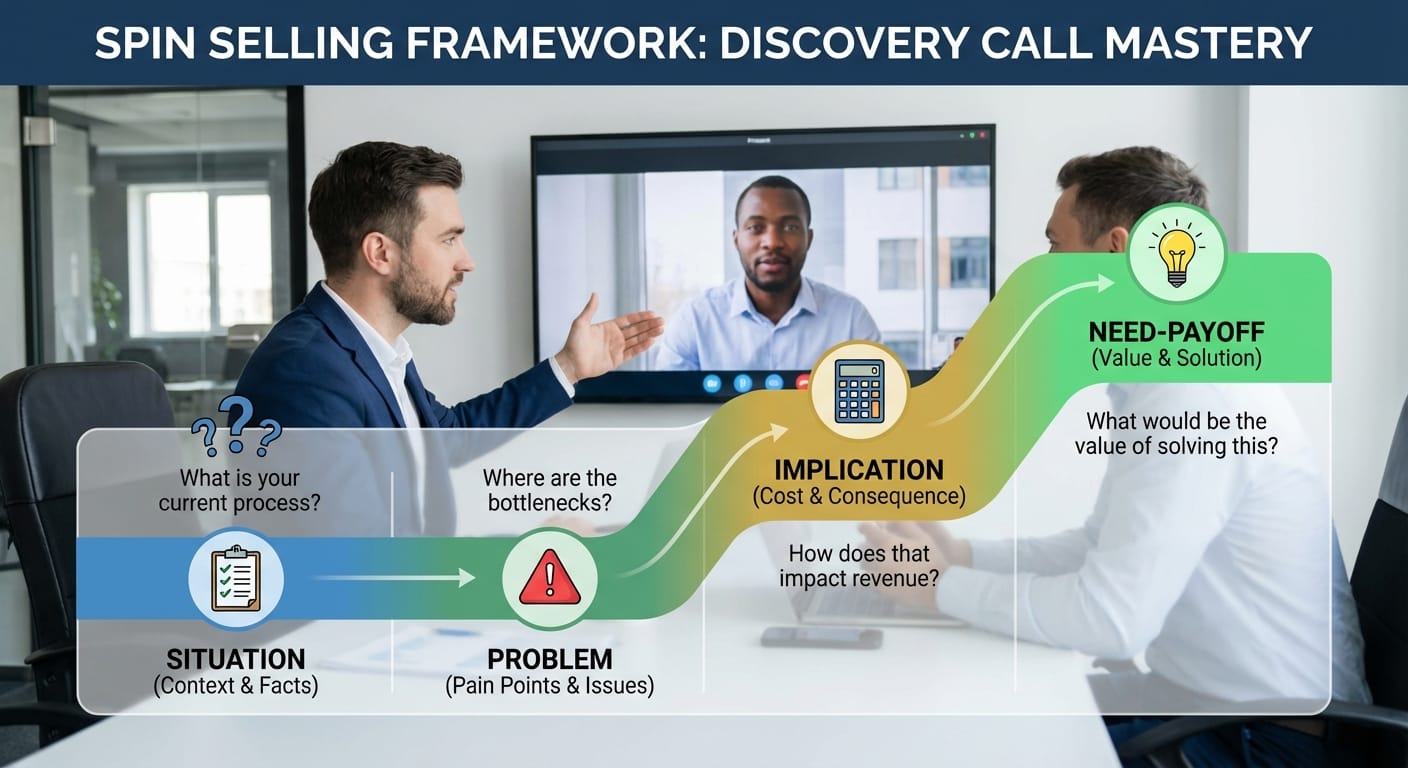
SPIN Selling is a proven questioning framework for complex B2B sales. Developed by Neil Rackham after analyzing 35,000 sales calls, SPIN helps sales reps uncover pain through Situation, Problem, Implication, and Need-Payoff questions - leading to higher win rates and larger deals.
If you're in B2B sales, you've heard of SPIN Selling. But most reps struggle to apply it effectively because they don't understand what makes each question type powerful or how to sequence them naturally.
This complete guide explains what SPIN Selling is, why it works, how to use each question type, and includes 25+ real examples you can use immediately.
What Is SPIN Selling?
SPIN Selling is a sales questioning methodology created by Neil Rackham in 1988 after researching 35,000 sales calls over 12 years. The research identified that top-performing sales reps in complex B2B sales use a specific questioning pattern that consistently uncovers buyer pain and creates urgency.
SPIN is an acronym for four question types:
- Situation Questions
- Problem Questions
- Implication Questions
- Need-Payoff Questions
The Core Insight: Average reps focus on features and benefits. Top performers ask questions that make buyers realize the true cost of their problems and articulate the value of solving them.
What Makes SPIN Different: Traditional sales training teaches "ask discovery questions." SPIN provides a specific sequence that moves buyers from describing their situation to actively wanting your solution.
Why SPIN Selling Works for B2B Sales
Research-Backed Results:
Neil Rackham's research across industries found:
- 33% higher success rate in major sales
- Larger deal sizes when SPIN used effectively
- Stronger buyer commitment vs. traditional pitching
Why It's Effective:
For Complex B2B Sales: SPIN works best for consultative selling with long sales cycles, multiple decision-makers, and high-value deals. It struggles in transactional sales where speed matters more than discovery depth.
Buyer Psychology: SPIN makes buyers convince themselves through their own answers rather than you convincing them through pitching. People believe their own conclusions more than sales pitches.
Creates Urgency: Implication Questions specifically make buyers realize problems are more serious than they thought, creating urgency to solve them.
The Four SPIN Question Types (With Examples)
S - Situation Questions
Purpose: Understand the buyer's current state, context, and environment.
What They Uncover:
- How things work currently
- What systems/processes they use
- Who's involved
- Current metrics and baselines
When to Use: Early in discovery to establish context before exploring problems.
Critical Mistake: Asking too many Situation Questions. Buyers get bored answering fact-based questions. Use 3-5 maximum, then move to Problem Questions.
Example Situation Questions:
- "How many sales reps do you have currently?"
- "What's your current sales process from lead to close?"
- "What CRM or sales tools does your team use?"
- "How long have you been using your current approach?"
- "Who's involved in sales training and onboarding?"
Pro Tip: Research answers to obvious Situation Questions before the call. Use precious call time on Problem and Implication Questions, not gathering basic facts.
P - Problem Questions
Purpose: Uncover difficulties, dissatisfactions, and challenges with the current situation.
What They Uncover:
- What's not working well
- Pain points and frustrations
- Inefficiencies and bottlenecks
- Gaps between current and desired state
When to Use: After establishing situation context. Most discovery time should focus here and on Implication Questions.
Example Problem Questions:
- "What challenges are you facing with your current sales training approach?"
- "Where do new reps struggle most during onboarding?"
- "What's frustrating about your current ramp time?"
- "How consistent is messaging across your sales team?"
- "What prevents your team from hitting quota?"
- "Where do you see the biggest skill gaps in your team?"
- "What takes more time or resources than it should?"
Why These Work: Problem Questions make buyers voice their own pain. Once they say it out loud, they own it and want to solve it.
I - Implication Questions
Purpose: Explore the consequences and broader impact of problems to create urgency.
What They Uncover:
- Cost of the problem (financial, time, opportunity)
- Downstream effects on other areas
- Risks if problem continues
- Impact on strategic goals
When to Use: After identifying problems. This is where deals are won - making buyers realize problems are more serious than they thought.
The Power of Implication Questions: This is SPIN's secret weapon. Implication Questions take a problem the buyer might tolerate and reveal its true cost, creating urgency to solve it NOW.
Example Implication Questions:
- "If new reps take 6 months to ramp, what does that cost in lost pipeline capacity?"
- "How does inconsistent messaging affect your win rates?"
- "What happens to your revenue targets if ramp time doesn't improve?"
- "If your best reps spend 40% of time on admin vs. selling, what's the opportunity cost?"
- "How does long ramp time affect your ability to scale the sales team?"
- "What would missing quota this year mean for the business?"
- "If this continues another quarter, what impact does that have?"
Formula: "If [Problem] continues, what happens to [Business Goal/Metric]?"
Why These Are Powerful: You're not telling them the problem is serious - you're making them calculate the cost themselves. Self-discovered urgency is far more compelling than sales-imposed urgency.
N - Need-Payoff Questions
Purpose: Get buyers to articulate the value and benefits of solving their problems.
What They Uncover:
- How solution would help them
- Value of solving the problem
- Benefits they'd experience
- Why it matters to them specifically
When to Use: After Implication Questions create urgency. This is where buyers start selling themselves.
Example Need-Payoff Questions:
- "If you could cut ramp time from 6 months to 3 months, what would that mean for your revenue capacity?"
- "How would consistent messaging across your team impact close rates?"
- "What would faster onboarding allow you to do that you can't do now?"
- "If reps spent 70% of time selling instead of 40%, what would that be worth?"
- "How would solving this affect your ability to hit annual targets?"
- "What would be different if your team could ramp new hires in half the time?"
Why These Work: Buyers articulate value in their own words. When they tell you how valuable solving the problem is, they've convinced themselves to buy.
The SPIN Selling Sequence in Practice
Example Discovery Call Using SPIN:
Situation Questions (Opening): Rep: "How many sales reps are on your team currently?" Prospect: "We have 20 reps, growing to 30 this year."
Rep: "What's your typical onboarding process for new reps?" Prospect: "Two weeks of training, then they start calling prospects."
Problem Questions (Uncover Pain): Rep: "What challenges do you see with that approach?" Prospect: "New reps struggle - takes them 6 months before they're productive."
Rep: "Where specifically do they struggle most?" Prospect: "Discovery calls. They ask surface questions and don't uncover real pain."
Implication Questions (Create Urgency): Rep: "If you're hiring 10 new reps this year and each takes 6 months to ramp, what does that cost in lost pipeline?" Prospect: "Probably $2M in capacity we're not capturing."
Rep: "How does that affect your ability to hit growth targets?" Prospect: "We'll miss our number by 15% if we can't ramp faster."
Need-Payoff Questions (Get Them to Articulate Value): Rep: "If you could cut ramp time from 6 months to 3 months, what would that mean for the business?" Prospect: "We'd recapture that $2M in capacity and hit our growth targets. Plus we'd have confidence to hire more aggressively."
Result: Prospect has self-discovered that the problem costs $2M annually and solving it enables their growth strategy. They want a solution.
Common SPIN Selling Mistakes
Mistake 1: Too Many Situation Questions
❌ Spending 20 minutes on background questions
✅ Research basics beforehand, use 3-5 Situation Questions max
Mistake 2: Weak Problem Questions
❌ "Are there any problems with your current approach?"
✅ "What's not working as well as you'd like with [specific area]?"
Mistake 3: Skipping Implication Questions
❌ Problem → Need-Payoff (missing the urgency creator)
✅ Problem → Implication (create urgency) → Need-Payoff
Mistake 4: Asking Implication Questions Like Feature Questions
❌ "Wouldn't it be great if this was faster?"
✅ "If this continues, what happens to [business goal]?"
Mistake 5: Pitching Too Early
❌ One Problem Question → "Let me show you our solution!"
✅ Problem → Multiple Implications → Need-Payoff → THEN solution
How to Practice SPIN Selling
The Challenge:
SPIN looks simple on paper but requires practice to execute naturally. Most reps either:
- Sound scripted and robotic
- Ask questions in wrong sequence
- Can't improvise Implication Questions based on answers
- Pitch too early before creating urgency
Traditional Practice Problems:
Role-Playing with Colleagues:
- Limited volume (can't practice 50+ conversations)
- Unrealistic responses (colleagues give simple answers)
- No pressure simulation
Practicing on Real Prospects:
- Expensive mistakes while learning
- Can't experiment freely
- Limited opportunities
How Sellible Solves This:
- Unlimited SPIN practice: 50+ discovery conversations with AI prospects
- Realistic responses: AI gives complex, nuanced answers requiring follow-up
- Immediate feedback: See where you used Situation vs. Implication Questions
- Safe environment: Make mistakes and try different approaches without burning prospects
Example: Rep practices discovery with AI prospect who describes surface-level problem. AI pushes back when Implication Questions are weak: "I don't see how that's a big deal." Forces rep to dig deeper and quantify impact until AI prospect sees urgency.
SPIN Selling Quick Reference
Discovery Call Structure:
Opening (5 min):
- 3-5 Situation Questions to establish context
Problem Discovery (15 min):
- 5-8 Problem Questions uncovering difficulties
- Listen for pain signals to explore deeper
Create Urgency (15 min):
- 4-6 Implication Questions revealing true cost
- Quantify financial, time, and opportunity impact
Value Articulation (10 min):
- 3-5 Need-Payoff Questions where buyer describes benefits
- Let them convince themselves
Bridge to Solution (5 min):
- Now that pain is clear and urgent, introduce how you solve it
When SPIN Selling Works Best
Ideal For:
✅ Complex B2B sales with long cycles ✅ High-value deals ($50K+) ✅ Multiple decision-makers ✅ Solutions requiring behavior change ✅ Consultative selling requiring deep discovery
Less Effective For:
❌ Transactional sales (low consideration) ❌ Commodity products (price-driven) ❌ Self-service SaaS (no sales conversation) ❌ Short sales cycles (need speed over depth)
Conclusion
SPIN Selling works because it's based on what top performers actually do, not theory. The framework guides buyers to discover their own pain, calculate the cost, and articulate the value of solving it.
The key isn't memorizing questions - it's understanding the psychology behind each question type and practicing until the sequence feels natural.
Most reps read about SPIN and try it once or twice. Top performers practice 50+ times until asking Implication Questions and Need-Payoff Questions becomes automatic.
Start with the 25 example questions in this guide. Adapt them to your product and market. Practice until they flow naturally. Your win rates and deal sizes will thank you.
Ready to master SPIN Selling through practice? Book a demo with the Sellible team and practice discovery conversations with AI prospects that respond like real buyers.
Frequently Asked Questions
Q: How long does it take to master SPIN Selling? A: Reading the framework takes hours. Executing it naturally takes 20-50 practice conversations. Most reps see improvement in win rates within 4-6 weeks of consistent practice.
Q: Can SPIN work for shorter sales cycles? A: SPIN is designed for complex sales. For shorter cycles, use abbreviated version: 1-2 Situation, 2-3 Problem, 2 Implication, 1-2 Need-Payoff questions.
Q: What if prospects don't answer my questions? A: Build rapport first. Explain why you're asking: "To make sure I understand your situation and don't waste your time showing irrelevant features, would you mind if I ask a few questions about your current approach?"
Q: Should I use SPIN in every sales call? A: SPIN is for discovery. Use it in initial conversations to uncover pain. Later calls focus on presenting solutions, handling objections, and closing.
Q: How do I know if I'm using SPIN correctly? A: Track these signals: Buyers talk more than you (70/30 ratio), they volunteer information, they calculate problem costs themselves, they ask how you solve it (vs. you pitching).