Top 10 Objections in Cold Calls (And How to Handle Them)
Master the 10 most common cold call objections with proven response frameworks. From "I'm busy" to "send me information" - handle objections confidently and keep conversations moving.
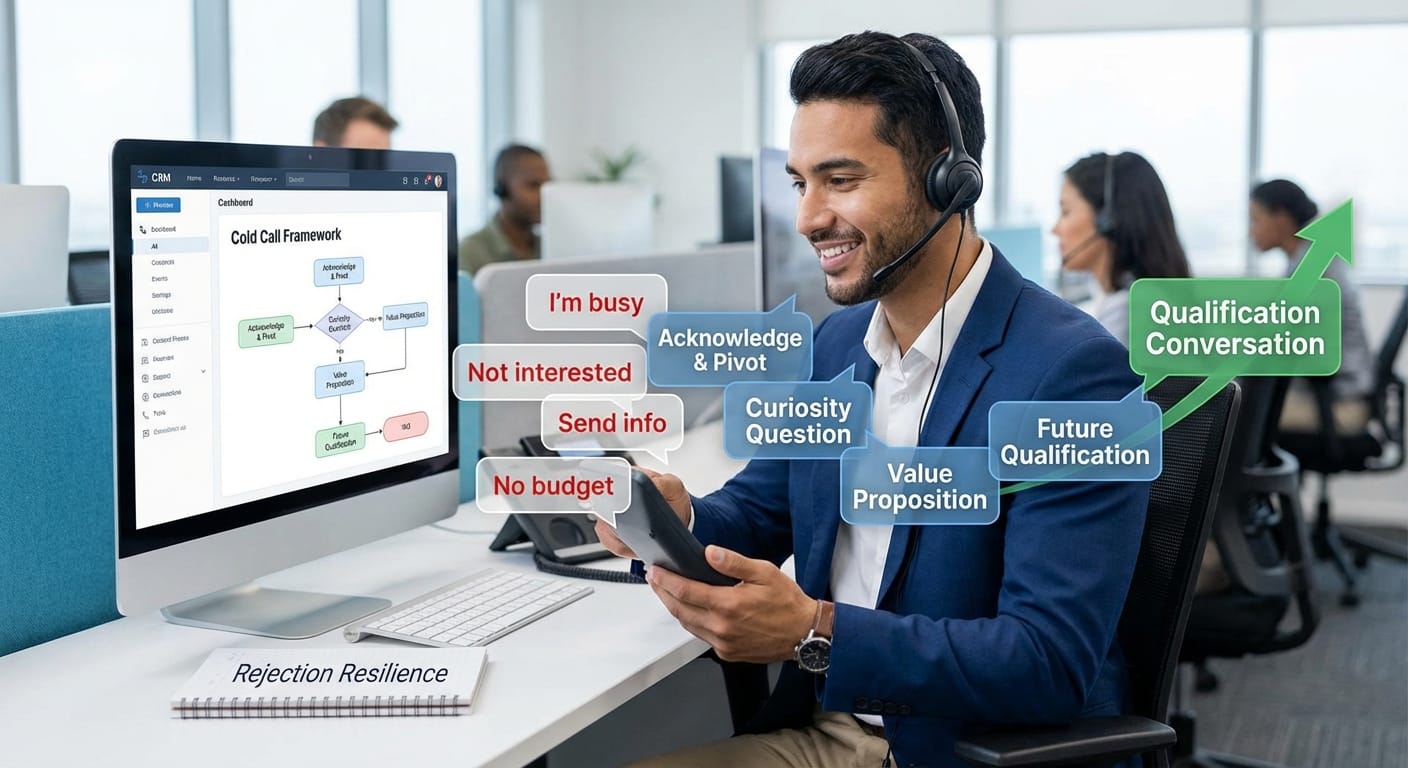
Cold calling generates predictable objections. Here are the 10 most common cold call objections with proven response frameworks - plus how to practice until handling them becomes automatic.
Cold calling is hard because prospects don't want to talk. They're busy, they get 20 calls daily, and they've developed default objections to end conversations quickly.
Most reps fumble objections because they're caught off-guard or sound defensive. The solution isn't better scripts - it's knowing the 10 objections you'll hear repeatedly and having practiced, confident responses.
This guide gives you proven frameworks for the most common cold call objections, from "I'm busy" to "send me information" to "we're all set."
The 10 Most Common Cold Call Objections
1. "I'm Busy Right Now"
What It Means: "I don't want to talk" or genuinely poor timing.
Weak Response: "I'll be quick..." (They hang up)
Strong Response: "I understand - I caught you at a bad time. Quick question: would [specific day] at [specific time] be better? Takes 3 minutes to see if there's a fit."
Why This Works: Acknowledges timing, asks for specific callback, frames short time commitment.
Alternative: "Totally understand. Is this a bad-timing busy or a not-interested busy? Because if it's timing, I'm happy to call back [specific time]."
2. "Send Me Information"
What It Means: Polite brush-off. They won't read it.
Weak Response: "Sure, what's your email?" (Deal dies)
Strong Response: "Happy to send something relevant. Quick question first - what specifically about [your solution category] would be most valuable to see? That way I send what actually matters."
Why This Works: Turns email request into qualification conversation.
If They Persist: "I will send something. Before I do, 30 seconds to understand your situation so I send the right information?"
Then Ask One Qualifying Question: "Are you currently using [competitor/solution] or handling [problem] another way?"
3. "We're All Set / We're Happy with Current Solution"
What It Means: They have solution and don't see reason to change.
Weak Response: "Are you sure?" (Sounds desperate)
Strong Response: "That's great you have something working. Out of curiosity, what are you using for [specific function]?"
Then Challenge Status Quo: "Most companies using [their solution] love it until they see [specific limitation or hidden cost]. For example, [brief insight]. Does that resonate or are you avoiding that issue?"
Why This Works: Acknowledges their solution while introducing doubt about hidden costs.
4. "Not Interested"
What It Means: Default rejection without knowing what you offer.
Weak Response: "Can I tell you why you should be interested?" (They hang up)
Strong Response: "I totally get it - I haven't given you enough information for you to be interested yet. Let me be direct about why I called: companies like [their company type] usually face [specific problem] that costs [quantified impact]. Does that apply to your situation, or are you somehow avoiding that issue?"
Why This Works: Takes responsibility for their lack of interest, builds trust by being transparent, then creates curiosity with specific problem/impact.
Alternative: "Fair enough - I called you out of the blue, so that makes sense. 30 seconds to see if there's a mutual fit? If not, I'll let you go."
If They Give You 30 Seconds: "Companies your size typically struggle with [problem]. We help [solve it] which usually means [outcome]. Does that problem exist for you?"
5. "We Don't Have Budget"
What It Means: Could be true, or default excuse.
Weak Response: "When will you have budget?" (Sounds like you accept defeat)
Strong Response: "I totally understand budget constraints. Quick question - is this a 'no budget allocated for this' situation, or 'we have budget but it's allocated elsewhere'?"
Then: "Most companies we work with didn't have budget allocated until they saw [specific ROI/outcome]. Would it be worth a 5-minute conversation to see if that applies to your situation?"
Why This Works: Separates real budget constraints from excuse, offers value-based conversation.
6. "Call Me Back in [Timeframe]"
What It Means: Polite delay or genuine timing issue.
Weak Response: "Sure, I'll call back." (No context set, they forget)
Strong Response: "Happy to call back. Quick question before I do - when I call in [timeframe], what will be different that makes this a priority? Just want to make sure timing makes sense."
Then Get Specific: "And just to confirm - [specific day/time] works, or should I reach out a different time?"
Why This Works: Qualifies if callback is real or brush-off, sets specific time.
7. "I Need to Talk to My Boss/Team First"
What It Means: They're not decision maker or avoiding commitment.
Weak Response: "Okay, let me know what they say." (You lose control)
Strong Response: "Makes sense to involve the right people. Quick question - when you discuss with them, what's the main concern or question they'll have?"
Then: "Would it make sense for me to join that conversation to address questions directly? Or would you prefer to discuss first and then we can set up a call?"
Why This Works: Uncovers decision process, offers to help rather than wait passively.
8. "We Just Signed a Contract with [Competitor]"
What It Means: Recently committed to competitor.
Weak Response: "Oh, okay. Call you next year?" (Gives up)
Strong Response: "Got it - what made you choose [competitor]? And when does that contract come up for renewal?"
Then Plant Seeds: "I'll make a note to reach out [before renewal]. In the meantime, if there's anything about [competitor] that doesn't work as expected, I'm here. Fair?"
Why This Works: Gathers competitive intel, sets renewal timeline, leaves door open for problems.
9. "How Did You Get My Number?"
What It Means: Questioning legitimacy or irritated about being called.
Weak Response: "Um, from a list..." (Sounds sketchy)
Strong Response: "I called your main line and asked for the person handling [responsibility]. They directed me to you. Are you the right person for [specific area]?"
Or: "I found you through [LinkedIn/company website/industry directory]. I call companies in [industry] that typically face [problem]. Does that apply to your situation?"
Why This Works: Direct, professional answer that pivots back to qualification.
10. "We're Not Looking for That Right Now"
What It Means: No active need or priority.
Weak Response: "When will you be looking?" (Sounds pushy)
Strong Response: "Fair enough - I'm not calling because you're looking. I'm calling because companies your size typically don't realize [specific problem] is costing them [quantified impact]. For example, [brief example]. Does that resonate, or are you somehow avoiding that issue?"
Why This Works: Reframes from what they're looking for to problem they might not realize exists.
Cold Call Objection Response Framework
Step 1: Acknowledge Never argue with or dismiss objection. Brief acknowledgment shows you heard them.
Step 2: Pivot with Question Turn objection into qualification conversation with "Quick question..."
Step 3: Create Value/Curiosity Share brief insight, example, or problem others face to create interest.
Step 4: Advance or Qualify Out Either get commitment to next step or qualify out cleanly.
What NOT to Do
❌ Get Defensive: "Are you sure you're not interested?" ❌ Argue: "But you haven't even heard what we do!" ❌ Sound Desperate: "Please just give me 2 minutes..." ❌ Give Up Immediately: "Okay, thanks anyway." ❌ Keep Talking: Talking over objection makes it worse
✅ Do This Instead:
- Acknowledge briefly
- Ask qualifying question
- Share insight to create curiosity
- Advance with specific next step or qualify out
Tone Matters More Than Words
How you say responses matters as much as what you say:
Confident, Not Desperate: "I understand you're busy" (confident) vs. "I know you're busy but..." (desperate)
Curious, Not Pushy: "Quick question - what are you using now?" (curious) vs. "You need to hear this!" (pushy)
Professional, Not Scripted: Natural conversation flow vs. robotic script reading
Direct, Not Aggressive: "Are you the right person for this?" (direct) vs. "I need to talk to the decision maker!" (aggressive)
Practice Makes Perfect
Cold call objection handling requires skills that only develop through repetition:
Automatic Responses: Knowing what to say instantly without thinking or scrambling
Confident Delivery: Saying responses naturally without sounding scripted or nervous
Tone Control: Staying confident and curious when rejected repeatedly
Pattern Recognition: Hearing which objections are real vs. reflexive brush-offs
The Practice Problem
Colleagues Won't Object Realistically: Role play partners don't brush you off like real prospects do.
No Volume: Can't make 100 practice calls to colleagues to build muscle memory.
No Pressure: Practice without real rejection pressure doesn't build resilience.
How Sellible Masters Cold Call Practice
Realistic Objections: AI prospects use actual brush-offs and objections cold callers face daily.
Volume Practice: Make 50+ practice cold calls in an hour, building automatic responses.
Pressure Simulation: AI hangs up, cuts you off, and rejects like real prospects - building resilience.
Objection Variety: Experience all 10 objections in different combinations until handling them becomes automatic.
Cold Call Objection Checklist
Before Calling:
- Know your top 3 likely objections for this prospect
- Have responses ready but not scripted
- Prepare one qualifying question to ask
- Set mindset: objections are normal, not failure
During Calls:
- Acknowledge objection briefly
- Pivot to qualifying question
- Share insight/create curiosity
- Advance or qualify out cleanly
- Stay confident regardless of rejection
After Call Sessions:
- Note which objections came up most
- Identify which responses worked vs. fell flat
- Practice responses that felt weak
- Refine approach based on patterns
Conclusion
Cold call objections are predictable. These 10 objections represent 90% of what you'll hear. Having practiced, confident responses transforms cold calling from dreaded activity to systematic process.
The frameworks in this guide work - but only when delivered with confidence and natural tone that comes from repetition. You can't become great at handling objections by reading frameworks. You must practice until responses become automatic.
Sellible provides realistic cold call practice with AI prospects who object like real buyers - building the muscle memory and resilience that makes cold calling successful.
Ready to master cold call objections? Book a demo with the Sellible team and practice with AI that rejects like real prospects.
FAQ
Q: Should I memorize exact responses? A: No - internalize the framework and key points, then deliver naturally. Scripted sounds robotic.
Q: What if they hang up immediately? A: It happens. Move to next call. Not everyone will talk. Focus on those who engage.
Q: How many objections should I prepare for? A: These 10 cover 90% of situations. Know them cold and you'll be ready for most calls.
Q: What's success rate for cold calling? A: Realistic: 2-5% book meetings. Focus on quality conversations with those who engage, not total calls made.
Q: How do I stay confident after constant rejection? A: Expect objections as normal. Track small wins (conversations, not just meetings). Practice builds immunity to rejection.