Top 10 Objections in B2B SaaS Sales (And How to Handle Them)
Master the 10 most common B2B SaaS objections with proven response frameworks. From subscription pricing to implementation concerns to build vs. buy - handle SaaS objections confidently.
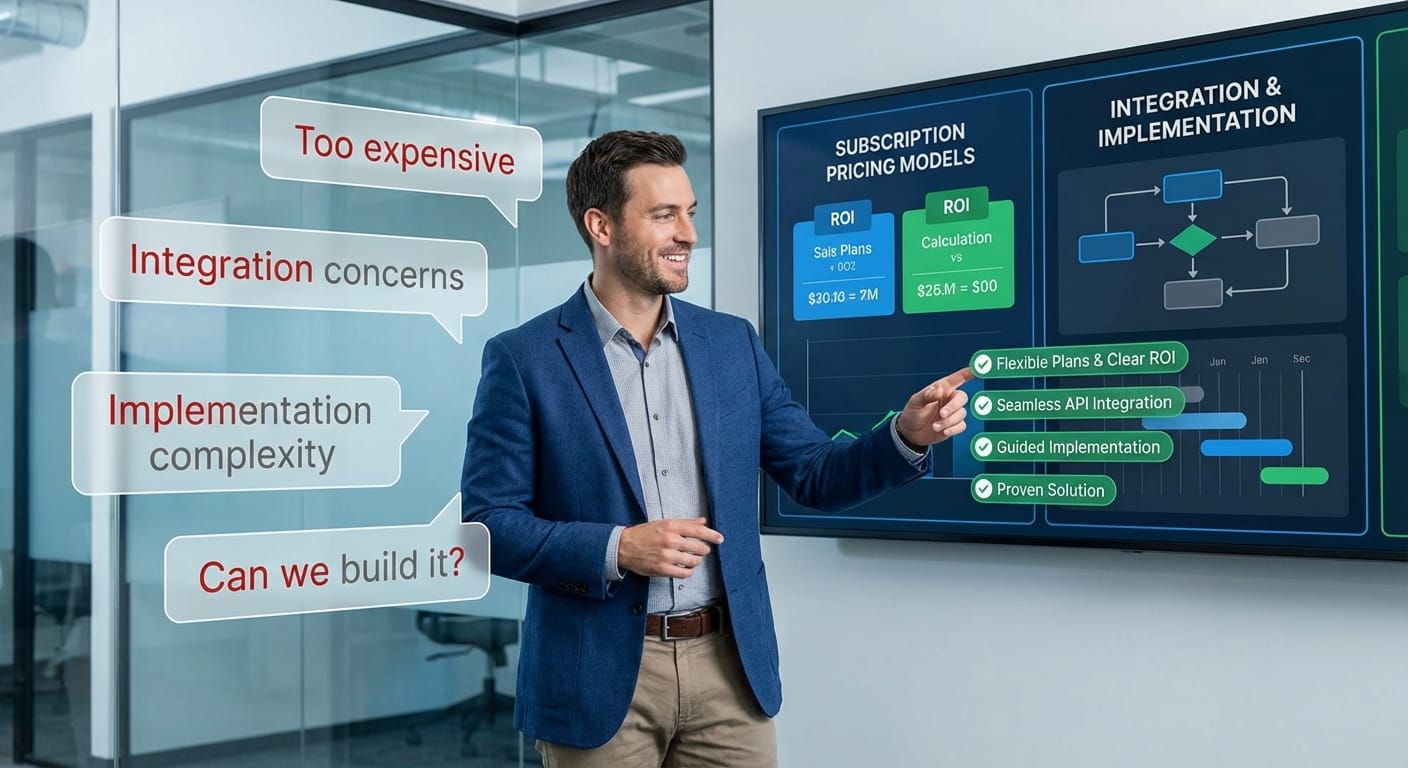
B2B SaaS sales face unique objections around subscription pricing, implementation complexity, integration challenges, and ROI measurement. Here are the 10 most common SaaS objections with proven response frameworks - plus how to practice until handling them becomes automatic.
B2B SaaS objections are different from product sales. Prospects aren't just evaluating features - they're committing to ongoing subscription costs, worrying about implementation disruption, questioning integration complexity, and measuring intangible ROI.
Most SaaS reps fumble objections because they defend features instead of addressing underlying concerns about risk, change, and value. The solution isn't better product pitches - it's understanding the real fears behind SaaS objections and having practiced responses.
This guide gives you proven frameworks for the 10 most common B2B SaaS objections, from subscription pricing to implementation concerns to "we can build this ourselves."
The 10 Most Common B2B SaaS Objections
1. "Your Subscription Pricing is Too Expensive"
What It Means: Comparing monthly/annual costs without considering total value or cost of alternatives.
Weak Response: "But look at all the features you get!" (Misses the point)
Stronger Response: "I understand price is a consideration. Let me reframe this around value rather than cost. Based on what you've shared about [their specific problem], companies similar to yours typically see [specific ROI metric] within [timeframe]. That means this investment pays for itself in [calculation], and everything after that is pure value. Would walking through an ROI analysis based on your specific numbers be helpful?"
Example: "I understand. Let me reframe this around value. Based on what you shared about losing 15% of deals to competitor response time, improving that would mean approximately $2.3M in additional revenue annually. Our solution at $180K per year would pay for itself in the first month, with $2.1M in additional value annually. Would seeing that calculation based on your exact metrics help?"
Why This Works: Shifts from subscription price to total cost of ownership and ROI.
Alternative Response: "Let's compare what you're evaluating. Are you comparing our subscription to: doing nothing, building internally, or other vendors? Each comparison has different context that matters for understanding true cost."
2. "Implementation Seems Too Complex and Disruptive"
What It Means: Fear of change, team disruption, and implementation failure.
Weak Response: "Implementation is easy, don't worry!" (Dismisses legitimate concern)
Stronger Response: "Implementation complexity is a valid concern - I'd rather address it directly than minimize it. Here's our approach: [phased rollout, dedicated implementation team, training plan, timeline]. For companies your size, typical implementation is [timeframe] with minimal disruption because [specific approach]. We also [success metrics, milestone-based rollout, rollback plan]. What specifically about implementation concerns you most - timeline, team bandwidth, or something else?"
Why This Works: Acknowledges concern, provides specific mitigation plan, and uncovers real fear.
Risk Reversal if Needed: "We can start with pilot for [specific team/department] to prove value before full rollout. That way you validate approach with minimal risk."
3. "We Need to See ROI Before Committing"
What It Means: Uncertainty about measuring intangible value and justifying ongoing costs.
Weak Response: "Our customers see great ROI!" (No specifics)
Stronger Response: "I agree with you, ROI measurement is critical. Here's how we approach it: We establish baseline metrics before implementation - [current efficiency, conversion rate, time spent]. Then we track improvement against those baselines monthly. For companies in similar situations, we typically see [specific metric improvement] translating to [$X value]. Would creating a specific ROI framework for your situation address this concern?"
Why This Works: Provides concrete ROI measurement approach, not vague promises.
Offer Proof: "Let me share how [similar company] measured ROI: [before metrics, after metrics, calculated value]. We can create similar framework for your business."
4. "How Does This Integrate with Our Existing Stack?"
What It Means: Fear of integration complexity, technical debt, and disconnected systems.
Weak Response: "We integrate with everything!" (Overpromise)
Stronger Response: "Integration complexity is one of the most important technical considerations. What systems does this need to integrate with? [Listen to list]. Here's our integration approach: [native integrations, API capabilities, pre-built connectors]. For [systems they mentioned], we have [specific integration approach]. For anything without native integration, we can [API options, Zapier, custom integration]. Would having our technical team walk through specific integration architecture address this?"
Why This Works: Gets specific about their stack, provides realistic integration options.
Technical Validation: "Let's schedule technical deep-dive with our solutions architect and your IT team to validate integration feasibility before you commit."
5. "We Can Build This Ourselves"
What It Means: Underestimating build complexity and ongoing maintenance costs.
Weak Response: "Building is harder than you think!" (Sounds defensive)
Stronger Response: "Building internally is absolutely an option worth evaluating. Here's what other tech companies discovered: building takes [time/cost] that could go to your core product, plus ongoing maintenance costs of [estimate]. [Similar company] initially planned to build but chose us because [specific reason]. Would comparing total cost of building vs. our solution over 3 years be valuable?"
Why This Works: Helps them think through total cost realistically without dismissing their option.
Challenge the Assumption: "I'm curious - would building this be your engineering team's top priority, or would it compete with core product development? Because opportunity cost of engineering time often exceeds SaaS subscription cost."
6. "What Happens to Our Data if We Cancel?"
What It Means: Fear of vendor lock-in and data portability.
Weak Response: "You won't want to cancel!" (Dodges concern)
Strong Response: "Data portability is important. Here's our approach: [data export formats, migration assistance, retention period after cancellation]. You can export your data anytime in [formats] including [standard formats]. If you cancel, you have [timeframe] to export everything before deletion. We also provide [migration support, API access for data transfer]. Does having complete data control address this concern?"
Why This Works: Provides specific data portability details, showing confidence in product.
Build Trust: "We want you to stay because you're getting value, not because your data is trapped. Complete data portability is part of our commitment."
7. "We Just Signed a Contract with [Competitor]"
What It Means: Recently committed to alternative, but might be in early implementation or experiencing issues.
Weak Response: "Oh well, call us if it doesn't work out." (Gives up)
Strong Response: "Got it - appreciate the transparency. I'm curious what made you choose [competitor] over alternatives? [Listen]. And when does that contract come up for renewal? [Get date]. Here's what I'd suggest: Let's stay in touch during your implementation and first few months. If [competitor] delivers everything you need, great. If you run into challenges around [common competitor weaknesses], I'm here to help. Fair?"
Why This Works: Gathers competitive intel, plants seeds for switching, stays engaged.
Plant Doubt: "One thing we hear from companies switching from [competitor] to us is [specific limitation or issue]. If you experience that, let's talk."
8. "We Need User Adoption Guarantees"
What It Means: Fear of paying for software nobody uses.
Weak Response: "Our software is so easy, adoption will be automatic!" (Unrealistic)
Stronger Response: "User adoption is the real measure of our success. Here's how we drive adoption: [onboarding process, training program, change management support, usage monitoring]. We track adoption metrics and intervene when usage drops. For companies your size, we typically see [adoption percentage] within [timeframe]. Would having success metrics built into our agreement address this concern?"
Why This Works: Acknowledges adoption challenge, provides specific enablement plan, offers pilot.
Risk Mitigation: "We can structure this with success milestones - if adoption doesn't hit [target] by [timeframe], we'll [adjust approach, reduce scope, provide additional training]."
9. "What if You Go Out of Business?"
What It Means: Vendor viability concern, especially with newer SaaS companies.
Weak Response: "We're not going anywhere!" (No proof)
Stronger Response: "Vendor viability is a legitimate concern for any business relationship. Here's our situation: [funding status, revenue metrics, customer count, years in business]. We're [profitable/well-funded/growing X%] with [customer retention rate]. For additional security, we [escrow source code, maintain business continuity plan, provide data export capabilities]. Would understanding our business model and trajectory address this concern?"
Why This Works: Provides concrete viability indicators and risk mitigation.
Build Confidence: "We have [number] enterprise customers including [notable names] who evaluated our viability thoroughly. I can connect you with [similar customer] to discuss their vendor evaluation process."
10. "We're Not Ready to Make a Decision Yet"
What It Means: Hidden concerns, missing stakeholders, or lack of urgency.
Weak Response: "No problem, let me know when you're ready." (Loses control)
Stronger Response: "I appreciate you being direct. Help me understand what 'not ready' means specifically. Is this: [lack of budget allocation, need stakeholder buy-in, uncertainty about fit, timing issue, or something else]? Because how we proceed depends on what's driving the delay."
Follow-Up Based on Response:
- If stakeholder buy-in: "Who needs to be involved, and how can I help you get their buy-in?"
- If budget: "When does budget get allocated, and what's the process for securing it?"
- If uncertainty: "What questions or concerns remain that we haven't addressed?"
- If timing: "What makes [future timeframe] better than now, and what's the cost of waiting?"
Why This Works: Uncovers real issue instead of accepting vague delay.
Create Urgency:"I understand timing matters. One thing to consider: you identified [problem] costing [X monthly]. Every month you wait costs [X monthly]. Over [timeframe you're delaying], that's [$total cost]. Is that delay worth the cost?"
SaaS Objection Response Framework
Step 1: Acknowledge Legitimacy SaaS objections are usually legitimate concerns (pricing model, integration, adoption). Don't dismiss them.
Step 2: Uncover Specific Concern "Help me understand specifically..." gets to real issue behind objection.
Step 3: Provide Concrete Response Use data, examples, and specific mitigation approaches - not vague reassurances.
Step 4: Offer Risk Mitigation Pilots, phased rollouts, success milestones, and proof points reduce perceived risk.
What Makes SaaS Objections Different
Ongoing Financial Commitment: Subscription creates multi-year cost relationship, not one-time purchase.
Implementation Risk: Change management and integration complexity create legitimate fear.
Intangible ROI: Hard to measure value of efficiency, collaboration, or insights vs. tangible products.
Vendor Dependency: Critical systems create switching costs and vendor lock-in concerns.
User Adoption Uncertainty: Paying for software nobody uses is unique SaaS risk.
Common SaaS Objection Handling Mistakes
Mistake 1: Defending Features vs. Addressing Concerns ❌ "But we have 50 integrations!" when they're worried about their specific stack ✅ "Which systems specifically do you need to integrate with?"
Mistake 2: Minimizing Implementation Complexity ❌ "Implementation is super easy, only takes a day!" ✅ "Implementation is [realistic timeline] with [specific support]. Here's the plan..."
Mistake 3: Vague ROI Claims ❌ "Our customers see amazing ROI!" ✅ "Companies your size typically see [specific metric improvement] worth [$X]"
Mistake 4: Not Offering Risk Mitigation ❌ Pushing for full commitment immediately ✅ "Let's start with pilot for [team] to prove value first"
Mistake 5: Accepting "Not Ready" Without Probing ❌ "Okay, I'll follow up later" ✅ "Help me understand what specifically you're not ready for..."
Why Practicing SaaS Objections Is Critical
SaaS objection handling requires skills specific to subscription sales:
ROI Articulation: Explaining intangible value and measuring it convincingly
Risk Mitigation: Offering pilots, phased approaches, and success milestones naturally
Technical Credibility: Discussing integrations, implementation, and architecture confidently
Subscription Value Defense: Reframing ongoing costs as investment, not expense
How Sellible Masters SaaS Objection Practice
SaaS-Specific Scenarios: Practice with AI prospects who raise subscription pricing, integration, implementation, and adoption concerns typical of B2B SaaS.
Technical Objections: Work with AI that questions integrations, security, and technical architecture - building credible responses.
Build vs. Buy Challenges: Experience prospects who seriously consider building internally, forcing strong total cost arguments.
Risk Mitigation Offering: Practice proposing pilots, phased rollouts, and success milestones until it becomes natural.
B2B SaaS Objection Checklist
Before Sales Conversations:
- Know your integration capabilities for common systems
- Have ROI examples from similar customers
- Prepare implementation timeline and plan
- Understand total cost of ownership vs. alternatives
- Have pilot/phased rollout options ready
During Objection Handling:
- Acknowledge legitimacy of SaaS-specific concerns
- Get specific about their situation (stack, timeline, concerns)
- Provide concrete responses with data and examples
- Offer risk mitigation (pilots, success milestones)
- Address underlying fear, not just surface objection
After Conversations:
- Document which objections come up most
- Note which responses worked vs. fell flat
- Gather customer data to strengthen ROI claims
- Refine risk mitigation offers based on patterns
Conclusion
B2B SaaS objections center on subscription economics, implementation risk, integration complexity, and ROI measurement. Successfully handling these objections requires addressing legitimate concerns with concrete plans, not dismissing fears or over-promising.
The frameworks in this guide work when delivered with credibility that comes from understanding SaaS business models, implementation realities, and customer success metrics.
That understanding develops through practice. You need realistic scenarios with prospects who raise SaaS-specific objections, forcing you to build convincing responses.
Sellible provides that practice. Work with AI SaaS buyers who question subscription value, implementation complexity, and integration feasibility until handling SaaS objections becomes your strength.
Ready to master SaaS objections? Book a demo with the Sellible team and practice with AI prospects who raise B2B SaaS objections.
FAQ
Q: How do I justify subscription pricing vs. perpetual licenses? A: Focus on total value delivered, continuous updates/improvements, and reduced upfront cost. Subscription includes ongoing innovation that perpetual licenses don't.
Q: What if they really can build it themselves cheaper? A: Help them calculate true cost including engineering time, opportunity cost, ongoing maintenance, and feature development. Most underestimate by 3-5x.
Q: How do I handle integration concerns for systems we don't natively integrate with? A: Be honest about native vs. API vs. custom integration. Offer technical validation call. Don't overpromise integration that doesn't exist.
Q: Should I offer discounts to overcome pricing objections? A: Defend value first. If genuine budget constraint, explore payment terms, phased implementation, or reduced scope before discounting.
Q: How do I create urgency for SaaS purchases? A: Quantify cost of delay (monthly problem cost × months waiting). Show competitive risk or opportunity cost of not solving problem now.