Objection Handling Playbook for Tech Sales
Complete tech sales objection handling playbook with proven responses for technical specifications, security concerns, integration challenges, and build-vs-buy objections specific to technology sales.
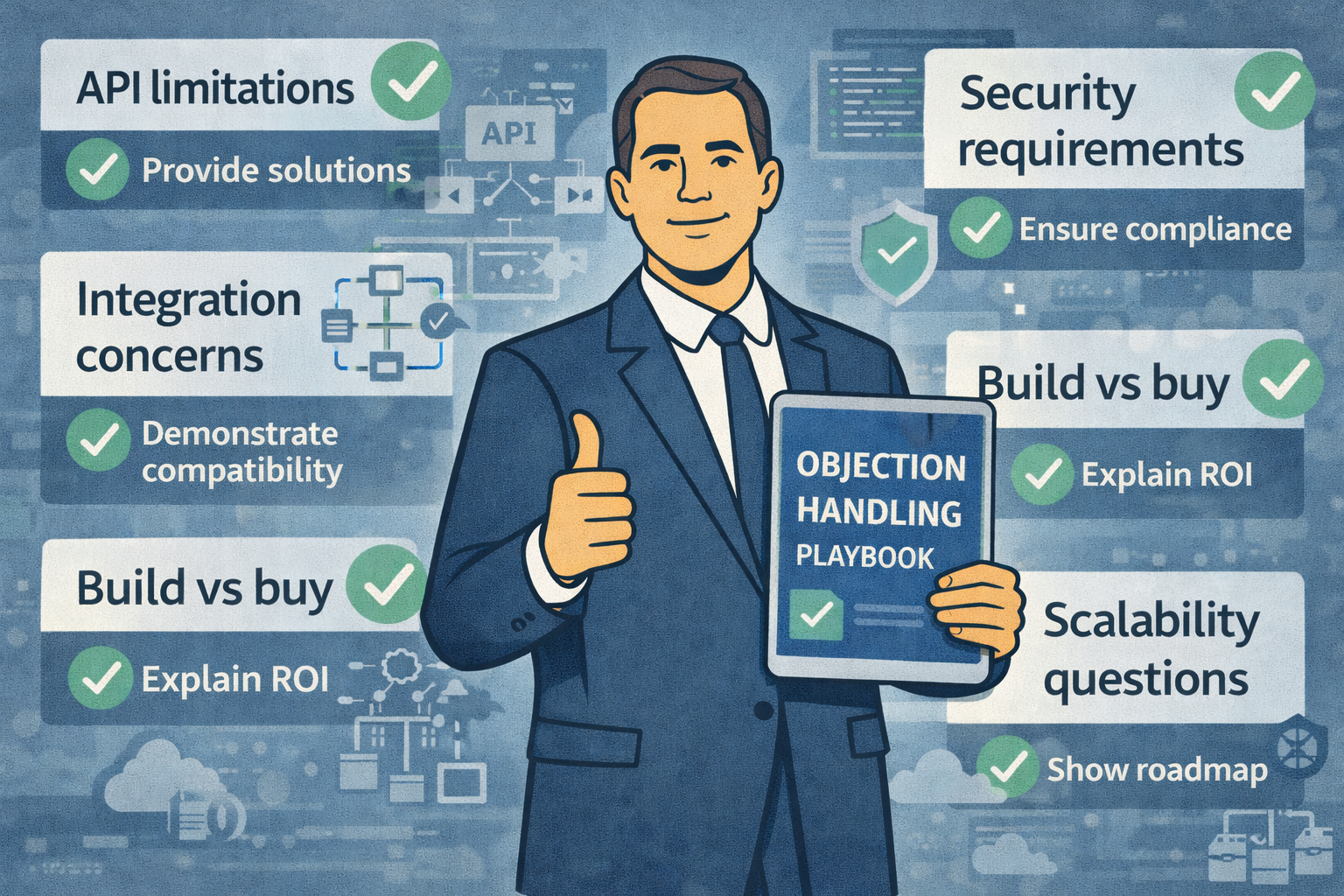
Tech sales face unique objections around technical specifications, security concerns, and integration complexity. Here's your complete playbook for handling tech-specific objections - plus how to practice until your responses become natural and confident.
Tech sales objections are different. Your prospects aren't just evaluating features and price - they're assessing technical architecture, security frameworks, scalability, integration complexity, and whether your solution will still be relevant in three years.
Traditional objection handling frameworks miss the tech-specific concerns that actually kill deals: API limitations, security certifications, technical debt, vendor lock-in fears, and the "our engineers can build this" objection that only tech buyers raise.
This playbook gives you proven response frameworks for every major tech sales objection, from technical specifications to security requirements to integration challenges.
Why Tech Sales Objections Are Different
Technical Depth Required: Tech buyers ask detailed questions about architecture, APIs, security protocols, and performance that require real technical knowledge to address.
Multiple Technical Stakeholders: Deals involve engineers, IT security, DevOps, and technical architects - each with different technical concerns and objection patterns.
Rapid Technology Change: Tech buyers worry about investing in solutions that become obsolete, creating future-proofing and roadmap objections unique to technology.
Build vs. Buy Culture: Tech companies have engineering resources and often consider building solutions internally - an objection rare outside technology sales.
Integration Complexity: Every tech purchase requires integration with existing systems, creating technical objections about APIs, data flow, and system compatibility.
Tech-Specific Objections and Response Templates
Category 1: Technical Specification and Capability Objections
Objection: "Your solution doesn't support [specific technical requirement]."
Response: "Let me understand the requirement better - what problem does [technical requirement] solve for you, and how critical is it to your overall needs? Here's how our customers typically handle that: [alternative approach or roadmap]. While we don't support that exact specification, our solution delivers [relevant outcome] through [different technical method]. Would seeing how that works address your underlying need?"
Objection: "We need on-premise deployment, not cloud."
Response: "Deployment architecture is an important technical decision. Can you help me understand what's driving the on-premise requirement - is it data sovereignty, security policies, existing infrastructure, or something else? Here's what's interesting: companies with similar requirements initially insisted on on-premise but found [specific cloud advantage] addressed their concerns. We also offer [hybrid or private cloud options]. Would exploring deployment options that meet your requirements be valuable?"
Objection: "Your API doesn't have the functionality we need."
Response: "API capabilities are critical for technical integration. What specific API functionality are you looking for, and what would you use it for? Our current API supports [capabilities], and here's what customers in similar situations do: [specific approach]. We also have [API roadmap item] planned for [timeframe]. Would connecting with our technical team to review your specific API needs and explore options make sense?"
Objection: "What about performance and scalability at our volume?"
Response: "Performance at scale is absolutely critical. What volume levels are we talking about - [specific metrics: requests/second, data volume, concurrent users]? Our platform currently handles [performance benchmarks] for customers like [large customer example]. Here's our technical architecture for scaling: [specific scalability approach]. Would a performance test or proof of concept at your expected volumes give you the confidence you need?"
Category 2: Security and Compliance Objections
Objection: "We have strict security requirements you may not meet."
Response: "Security requirements are non-negotiable, especially for companies in [their industry]. What specific security standards or certifications do you require? Here's our security posture: [SOC 2, ISO 27001, specific certifications]. We're also compliant with [relevant regulations]. Companies like [similar customer] had equally strict requirements - would reviewing our security documentation and doing a security assessment be the right next step?"
Objection: "How do you handle data privacy and GDPR/compliance?"
Response: "Data privacy and regulatory compliance are critical. We're [specific compliance status - GDPR compliant, HIPAA certified, etc.]. Here's how we handle data: [data residency, encryption, privacy controls]. For companies in [their jurisdiction], we specifically provide [relevant compliance features]. Would having our compliance team walk through our exact approach for your requirements be helpful?"
Objection: "Our security team needs to do a full audit first."
Response: "Security audits are absolutely standard for enterprise tech purchases. Here's what we typically provide for security reviews: [security documentation, audit reports, penetration test results]. The average security review takes [timeframe], and here's how we support that process: [specific approach]. Would connecting our security team with yours to begin the audit process make sense?"
Objection: "What about vulnerability management and patching?"
Response: "Vulnerability management is part of our core security practice. Here's our approach: [patch cycle, vulnerability disclosure policy, security monitoring]. Our average time to patch critical vulnerabilities is [timeframe]. We also provide [specific security features]. Would reviewing our complete vulnerability management process address this concern?"
Category 3: Integration and Interoperability Objections
Objection: "We use [specific technology stack] - will this integrate?"
Response: "Integration with your existing stack is critical. For your specific technologies - [their stack] - here's how integration works: [native integrations, API connections, middleware options]. We currently integrate with [relevant technologies], and companies using [similar stack] typically implement integration through [specific method]. Would having our solutions architect review your complete environment and design an integration approach be valuable?"
Objection: "What if we need custom integrations?"
Response: "Custom integration flexibility is important for companies with unique requirements. Our platform supports custom integrations through [API, webhooks, SDK]. We've built custom integrations for companies like [example] to connect with [systems]. Here's our typical approach: [custom integration process]. Would scoping out your specific custom integration needs with our technical team make sense?"
Objection: "How do you handle data synchronization and consistency?"
Response: "Data synchronization is critical for integrated systems. Here's our approach to data consistency: [real-time sync, batch processing, conflict resolution]. For your use case involving [their scenario], we'd implement [specific data sync strategy]. Companies like [similar customer] had similar concerns and here's how we addressed them: [specific example]. Would a technical deep-dive on data architecture be helpful?"
Category 4: Vendor and Product Viability Objections
Objection: "What's your product roadmap and future direction?"
Response: "Product direction matters for long-term technology investments. Here's where we're heading: [relevant roadmap items that address their needs]. We invest [percentage/amount] in R&D annually, and our customer advisory board - which includes companies like yours - influences roadmap priorities. Would reviewing our detailed roadmap and potentially joining our advisory board be valuable?"
Objection: "What if you get acquired or go out of business?"
Response: "Company viability is a legitimate concern for enterprise tech purchases. Here's our situation: [funding status, revenue growth, customer base]. We also provide [source code escrow, data portability guarantees, transition support]. Our [customer retention rate] and [customer growth metric] suggest market confidence in our stability. Would understanding our business fundamentals and customer trajectory address this concern?"
Objection: "We're concerned about vendor lock-in."
Response: "Vendor lock-in is a valid concern for technology decisions. Here's how we prevent that: [data portability, standard formats, export capabilities, open APIs]. You own your data and can export it in [formats] at any time. We also support [interoperability standards]. Companies choose to stay with us because of value, not because they're locked in. Would reviewing our data portability and migration support address this?"
Category 5: Build vs. Buy and Internal Development Objections
Objection: "Our engineering team thinks they can build this."
Response: "Build vs. buy is a common consideration for companies with engineering resources. Let's look at the actual costs: building requires [estimated engineering time], ongoing maintenance of [estimated hours/month], plus opportunity cost of engineers not building your core product. Companies like [similar tech company] initially planned to build but chose us because [specific reason: time to market, ongoing innovation, total cost]. Would comparing total cost and time of building vs. buying over 2-3 years be valuable?"
Objection: "We prefer to control our own technology stack."
Response: "Technical control is important for engineering-driven companies. Here's what's interesting: using our platform actually gives you more control because [specific flexibility: APIs, extensibility, customization]. You control [specific aspects] while we handle [infrastructure/maintenance]. Companies like [example] maintain control over [critical elements] while leveraging our platform. Would seeing how much control and customization is possible address this?"
Objection: "Building internally aligns better with our tech stack."
Response: "Stack alignment makes sense for technical consistency. Here's what to consider: our solution integrates with [their stack technologies] using [integration methods], which means it fits into your architecture without creating inconsistency. The hidden cost of building is maintaining alignment as your stack evolves - we invest [amount/percentage] in keeping current with technology changes. Would comparing integration complexity of our solution vs. building internally be helpful?"
Category 6: Implementation and Technical Support Objections
Objection: "How complex is implementation and how long does it take?"
Response: "Implementation complexity and timeline matter for technical projects. For companies your size with [their environment], typical implementation is [timeframe] and involves [implementation phases]. We accelerate this through [specific methods: automated setup, migration tools, technical support]. Here's a detailed implementation plan for your specific situation: [overview]. Would reviewing a complete technical implementation roadmap be valuable?"
Objection: "What level of technical support do you provide?"
Response: "Technical support quality directly impacts uptime and team productivity. Here's our support model: [SLA details, response times, support channels, escalation process]. For technical issues, you'd have access to [support tier: engineers, solutions architects]. Our average resolution time for critical issues is [metric]. Would reviewing our complete support SLA and escalation procedures give you confidence?"
Objection: "Do you provide technical training and documentation?"
Response: "Technical enablement is critical for successful implementation. We provide [technical training programs, documentation portal, API docs, sandbox environments]. For your team specifically, we'd recommend [training approach based on their needs]. Our developer documentation includes [specific resources]. Would reviewing our complete technical enablement program be helpful?"
Category 7: Performance and Reliability Objections
Objection: "What are your uptime and reliability guarantees?"
Response: "Uptime is critical for business-critical systems. Our SLA guarantees [uptime percentage], and our actual uptime over the past [period] was [metric]. We achieve this through [technical architecture: redundancy, failover, monitoring]. For your use case, we'd implement [specific reliability approach]. Would reviewing our uptime history and technical architecture for reliability address this?"
Objection: "How do you handle disaster recovery and business continuity?"
Response: "DR and business continuity are essential for enterprise technology. Here's our approach: [backup frequency, recovery time objectives, recovery point objectives, geographic redundancy]. We test disaster recovery [frequency] and our worst-case recovery time is [metric]. Would reviewing our complete DR plan and testing results give you confidence?"
Objection: "What about performance degradation under load?"
Response: "Performance under load is critical for scaling businesses. Our architecture handles load through [specific scaling approach: auto-scaling, load balancing]. At your projected volume of [metrics], here's the performance you'd see: [specific benchmarks]. We also provide [performance monitoring, alerts]. Would running a load test at your expected volumes be valuable?"
Why Practice Transforms Tech Sales Objection Handling
Tech objections require technical knowledge and confidence to address effectively. Practice develops the fluency to discuss complex technical topics naturally.
The Tech Sales Practice Challenge
Technical Depth Required: Tech objections involve APIs, security protocols, architecture, and integration details that require confident, knowledgeable responses.
Multi-Stakeholder Technical Concerns: Engineers, security teams, DevOps, and architects each raise different technical objections requiring tailored responses.
Credibility Under Technical Scrutiny: Tech buyers test your technical knowledge - hesitation or uncertainty destroys credibility instantly.
What Effective Practice Develops
Technical Fluency: Building comfort discussing architecture, APIs, security, and integration without sounding uncertain or reading from scripts.
Confident Escalation: Knowing when you have sufficient technical knowledge to respond vs. when to involve technical resources.
Multi-Objection Scenarios: Developing ability to handle security, performance, and integration objections in single technical conversations.
How Sellible Masters Tech Sales Objection Practice
Tech-Specific Scenarios: Practice with AI prospects who raise API questions, security concerns, and integration challenges just like real technical buyers.
Technical Pushback: Work with AI that challenges your technical claims, asks detailed architecture questions, and tests your technical credibility.
Multi-Stakeholder Technical Objections: Handle scenarios where different AI stakeholders raise different technical concerns - engineers question architecture while security raises compliance concerns.
Realistic Technical Conversations: Practice complete tech sales conversations where technical objections arise naturally, building confidence for real technical buyer interactions.
Tech Sales Objection Handling Checklist
Before Technical Sales Conversations:
- Review prospect's tech stack and infrastructure
- Prepare for likely technical objections (security, integration, scalability)
- Understand technical details you might be questioned on
- Have technical resources available for deep-dive questions
During Objection Handling:
- Listen for underlying technical or architectural concerns
- Acknowledge technical complexity and requirements
- Explore whether objection is technical, financial, or political
- Respond with technical specifics and relevant examples
- Know when to escalate to technical team vs. handle yourself
After Conversations:
- Document technical objections encountered
- Identify which technical responses worked vs. fell flat
- Practice technical topics that felt weak
- Update objection playbook with tech learnings
Conclusion
Tech sales objection handling requires more than generic frameworks. You must address technical specifications, security requirements, integration complexity, and architectural concerns with confidence and credibility.
This playbook gives you proven tech-specific response frameworks. But frameworks alone don't win tech deals. You must practice until you can discuss APIs, explain security architecture, and address integration concerns with the natural technical confidence that wins technology deals.
Sellible provides tech-specific practice. Work with AI prospects who raise integration objections, question security claims, and push back on technical specifications - building the confidence that closes tech deals.
Ready to master tech sales objection handling? Book a demo with the Sellible team and practice with AI prospects who challenge like real technical buyers.
Frequently Asked Questions
Q: How technical do I need to be to handle tech sales objections? A: You need enough understanding to discuss architecture, integrations, and security confidently. Know when to involve technical resources for deep architecture or security questions while maintaining credibility.
Q: What if I get a technical question I can't answer? A: Never fake technical knowledge. Say "That's a great technical question - let me connect you with our [solutions architect/technical team] who can address that in detail." This shows honesty and proper escalation.
Q: How do I handle the "we'll build it ourselves" objection? A: Quantify total cost of building (engineering time, ongoing maintenance, opportunity cost) vs. your solution. Most build vs. buy objections disappear when full costs and timelines are compared objectively.
Q: Should I learn to code to sell tech products? A: Understanding code concepts helps but isn't required. Focus on understanding technical architecture, integration patterns, and being able to discuss technical benefits confidently.
Q: How do I compete against open source alternatives? A: Emphasize total cost of ownership (setup, maintenance, support, security), time to value, and ongoing innovation vs. managing open source yourself. Frame as "build vs. buy" decision.