Objection Handling Playbook for Enterprise Sales
Complete enterprise objection handling playbook with proven response frameworks for budget, timing, risk, competition, technical, and ROI objections. Includes practice strategies for C-level conversations.
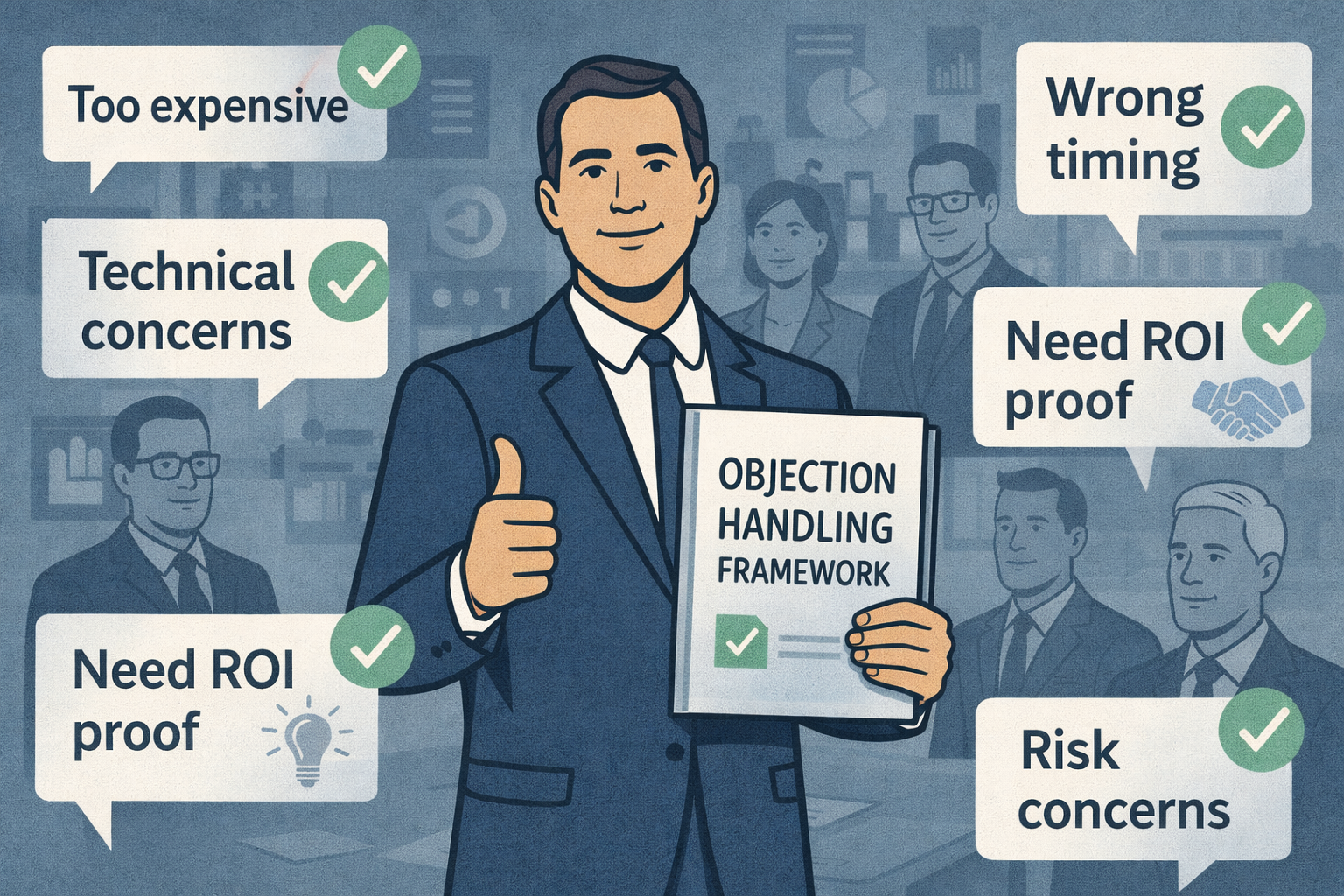
Enterprise sales reps lose more deals to objections than any other factor. Not because they don't know how to respond - most reps can recite objection handling frameworks in their sleep. They lose because when a CFO challenges their ROI assumptions or a CTO questions their security architecture, they freeze, stumble, or deliver unconvincing responses.
The difference between winning and losing enterprise deals isn't knowing what to say when objections arise. It's being so prepared and practiced that you can deliver compelling responses under pressure, with confidence, while maintaining credibility with senior executives.
This playbook gives you the complete framework for enterprise objection handling: common objection categories, proven response templates, industry-specific variations, and most importantly, how to practice until your responses become second nature.
Why Enterprise Objections Require a Playbook
Enterprise Objections Are Different:
- Multi-layered complexity - Single objection masks multiple underlying concerns
- High-stakes consequences - Poor response can kill 6-7 figure deals instantly
- Senior executive scrutiny - C-level buyers test your expertise and credibility
- Long consideration periods - Objections resurface multiple times across sales cycle
- Multiple stakeholder variations - Different objections from finance, IT, operations, legal
Traditional Objection Training Fails Because:
- Generic responses don't address enterprise-specific concerns
- Scripts sound robotic when delivered to sophisticated buyers
- No practice under realistic pressure and pushback
- Missing industry-specific objection variations
- Doesn't account for multi-stakeholder objection coordination
The Enterprise Objection Framework
Phase 1: Anticipate (Before the Meeting)
Research-Based Anticipation:
- Review prospect's financial situation and budget constraints
- Analyze their competitive landscape and market pressures
- Understand their current technology stack and incumbent relationships
- Identify regulatory or compliance concerns in their industry
- Map stakeholder roles and likely objection sources
Common Enterprise Objection Categories:
- Budget and Financial Objections
- Timing and Priority Objections
- Risk and Change Management Objections
- Competition and Status Quo Objections
- Technical and Integration Objections
- ROI and Value Objections
- Authority and Decision Process Objections
Stakeholder-Specific Objections:
- CFO: ROI, budget, financial risk
- CTO/CIO: Technical integration, security, scalability
- COO: Operational disruption, implementation timeline
- CEO: Strategic fit, competitive advantage
- Legal: Contract terms, liability, compliance
- Procurement: Vendor management, pricing, terms
Phase 2: Prepare (Response Development)
Response Framework: LAER Model
L - Listen
- Let them complete their full objection
- Don't interrupt or jump to defend
- Listen for underlying concerns beyond stated objection
- Note their tone, emotion, and specific language
A - Acknowledge
- Validate their concern as legitimate
- Show you understand their perspective
- Demonstrate empathy without agreeing objection is insurmountable
E - Explore
- Ask clarifying questions to understand root concern
- Uncover whether objection is real dealbreaker or negotiable
- Determine if objection is theirs or from another stakeholder
- Identify what resolution would look like
R - Respond
- Address the core concern directly
- Provide evidence, data, or examples
- Reframe objection as solvable challenge
- Offer specific next steps or solutions
Phase 3: Practice (Skill Development)
Why Practice Matters:
- Knowing responses intellectually ≠ delivering them convincingly
- Enterprise buyers detect hesitation and lack of confidence instantly
- Pressure of high-stakes meetings causes even prepared reps to fumble
- Muscle memory through repetition enables natural, confident delivery
What to Practice:
- Delivering responses without sounding scripted
- Handling aggressive pushback and follow-up challenges
- Maintaining composure when objection catches you off-guard
- Transitioning smoothly from objection response to value discussion
Phase 4: Execute (In-Meeting Response)
Delivery Principles:
- Stay calm and confident regardless of objection severity
- Match their communication style and energy
- Use data and examples, not just assertions
- Check for understanding before moving forward
- Don't over-explain or sound defensive
Enterprise Objection Response Templates
Category 1: Budget and Financial Objections
Objection: "Your solution is too expensive."
Listen & Acknowledge: "I appreciate you being direct about budget concerns. Cost is always an important consideration for enterprise investments."
Explore: "Help me understand - when you say 'too expensive,' are you comparing to a specific budget allocation, or to competitive alternatives you're evaluating?"
Respond: "Let me reframe this around value rather than price. Companies similar to yours typically see [specific ROI] within [timeframe], which means the investment pays for itself in [period]. Would it be helpful to walk through a customized ROI analysis based on your specific situation?"
Objection: "We don't have budget for this right now."
Listen & Acknowledge: "I understand budget constraints are real, especially in [their fiscal situation/current environment]."
Explore: "Can I ask - is this a matter of budget not being allocated yet, or budget being allocated to other priorities? Understanding the distinction helps me know whether timing or prioritization is the core issue."
Respond: "Many of our enterprise clients faced similar budget situations. What they found was that the cost of not solving [their problem] actually exceeded the investment required. Let me share how [similar company] approached this from a budget planning perspective..."
Objection: "We need to see more ROI justification."
Listen & Acknowledge: "Absolutely - ROI justification is critical for enterprise technology investments of this scale."
Explore: "What specific ROI metrics matter most to your organization? Are you focused on hard cost savings, revenue impact, efficiency gains, or risk mitigation value?"
Respond: "Based on what you've shared about [their situation], here's how we calculate ROI for similar organizations: [specific framework]. For your scenario, conservative estimates suggest [specific return] within [timeframe]. Would you like me to work with your finance team on a detailed analysis?"
Category 2: Timing and Priority Objections
Objection: "This isn't a priority right now."
Listen & Acknowledge: "I understand you have multiple priorities competing for attention and resources."
Explore: "Can I ask what's currently taking precedence? And what would need to change for this to become a higher priority?"
Respond: "I appreciate the honest prioritization discussion. Let me share what we're seeing with companies in similar situations. The organizations that delayed addressing [their problem] faced [specific consequence] that actually made their other priorities harder to achieve. Is that a risk you're comfortable with, or should we explore how to address this without disrupting current priorities?"
Objection: "We need to wait until next quarter/year."
Listen & Acknowledge: "I understand timing considerations, especially around [budget cycles/planning periods/etc]."
Explore: "Help me understand the driver for that timeline - is it budget cycle related, resource availability, or something else?"
Respond: "Let's think about timing from a different angle. Every quarter you wait costs you [quantified impact]. If we started planning now for [their timeline], you'd actually be able to [benefit] sooner than waiting to begin the conversation next quarter. Would exploring a phased approach that aligns with your timeline make sense?"
Category 3: Risk and Change Management Objections
Objection: "We're concerned about implementation disruption."
Listen & Acknowledge: "Operational continuity is absolutely critical, especially for an organization of your scale and complexity."
Explore: "What specific operations or processes are you most concerned about disrupting? And what would an acceptable implementation approach look like from a risk perspective?"
Respond: "This is precisely why our enterprise implementation methodology focuses on [specific approach]. Companies like [similar organization] had the same concerns and we implemented in a way that [minimal disruption example]. We can customize the rollout to match your risk tolerance and operational requirements. Would seeing a detailed implementation plan addressing your specific concerns be valuable?"
Objection: "Our team is risk-averse and resistant to change."
Listen & Acknowledge: "Change management is one of the biggest challenges in enterprise technology adoption, and having a risk-aware culture is actually a strength."
Explore: "Tell me more about past changes that didn't go well. What made those challenging, and what would make this different?"
Respond: "The organizations we work with that have risk-averse cultures actually see the highest long-term success because they're thoughtful about change. We've developed specific change management approaches for risk-conscious enterprises that include [specific methods]. This isn't about forcing change - it's about managing it in a way your team will embrace."
Category 4: Competition and Status Quo Objections
Objection: "We're already talking to [Competitor]."
Listen & Acknowledge: "It makes sense you're evaluating multiple options for a decision of this importance."
Explore: "What do you like about their approach? And what questions or concerns do you have about their solution?"
Respond: "I'm glad you're doing thorough evaluation. Let me highlight where we differ in ways that matter for organizations like yours: [specific differentiation]. The companies that choose us over [competitor] typically do so because [key advantage]. Would it be helpful to do a direct comparison on the criteria most important to you?"
Objection: "We're happy with our current solution/process."
Listen & Acknowledge: "Having a solution that works is valuable, and I respect that you've invested in your current approach."
Explore: "What specifically works well about your current setup? And if you could improve one thing about it, what would that be?"
Respond: "Many of our best clients were satisfied with their previous solution - until they saw what they were missing. The difference isn't that your current approach is failing, it's that [new capability/outcome] creates [specific advantage] you can't achieve otherwise. Would you be open to seeing what that looks like in your specific situation?"
Category 5: Technical and Integration Objections
Objection: "We're concerned about integration with our existing systems."
Listen & Acknowledge: "Integration complexity is one of the most important technical considerations in enterprise software decisions."
Explore: "What systems are most critical to integrate with? And what integration challenges have you experienced with past implementations?"
Respond: "Integration is exactly why we built [specific integration capability]. We currently integrate with [their systems] for companies like [similar organization]. Our technical team can provide detailed integration architecture, and we'd be happy to do a technical assessment of your specific environment. Would connecting our technical teams to review integration feasibility be a valuable next step?"
Objection: "Our IT team has concerns about [security/scalability/performance]."
Listen & Acknowledge: "IT's technical concerns are absolutely critical, especially for enterprise deployments."
Explore: "What specific concerns has your IT team raised? And what would they need to see to feel confident about [security/scalability/performance]?"
Respond: "These are exactly the questions sophisticated IT teams should ask. Here's how we address [specific concern]: [technical details]. We also have [certifications/validation] from organizations like yours. Would it make sense to arrange a technical deep-dive with your IT team where we can address their specific concerns in detail?"
Category 6: ROI and Value Objections
Objection: "We're not sure this will deliver the value you're claiming."
Listen & Acknowledge: "Healthy skepticism about ROI claims is smart, especially given how many technology investments don't deliver promised returns."
Explore: "What would you need to see to have confidence in the value? And how do you typically validate ROI for technology investments?"
Respond: "Let's ground this in specifics rather than claims. Based on what you've shared about [their metrics], here's how we calculate value: [specific methodology]. We can also connect you with [similar customer] who had similar skepticism and saw [specific results]. Would a detailed ROI model based on your actual numbers, plus customer validation, address the confidence gap?"
Objection: "How do we know this will work in our specific situation?"
Listen & Acknowledge: "Every organization is unique, and what works elsewhere doesn't automatically translate to your environment."
Explore: "What aspects of your situation do you think are most unique or challenging for a solution like this?"
Respond: "You're right that your situation has specific characteristics. That's why we don't do one-size-fits-all deployments. Here's how we've customized for organizations with [similar unique factors]: [specific examples]. We can also do a proof of concept focused specifically on your unique requirements. Would that level of validation make sense?"
Category 7: Authority and Decision Process Objections
Objection: "I need to discuss this with [other stakeholders] first."
Listen & Acknowledge: "Of course - enterprise decisions should involve all key stakeholders."
Explore: "Who else needs to be part of this decision? And what are their primary concerns likely to be?"
Respond: "Let me make that stakeholder conversation easier. I can provide materials tailored to each stakeholder's concerns - technical specs for IT, ROI analysis for finance, implementation plans for operations. Would it be helpful if I joined those discussions to address questions directly, or would you prefer to have initial conversations first?"
Objection: "We have a formal vendor evaluation process that takes [long time]."
Listen & Acknowledge: "Thorough evaluation processes are important for enterprise decisions of this scale."
Explore: "Walk me through your evaluation process - what are the key stages and who's involved at each point?"
Respond: "Understanding your process helps me support it effectively. I can provide information structured around your evaluation criteria and timeline. In similar situations, we've found that proactive engagement with each evaluation stage actually accelerates the process by addressing questions before they become blockers. How can I best support your evaluation process?"
Why Practice Is Essential for Enterprise Objection Handling
You now have comprehensive objection response templates. But here's the truth: knowing these responses intellectually and delivering them convincingly under pressure are completely different skills.
The Practice Gap
What Happens Without Practice:
- You freeze when unexpected objections arise
- Responses sound scripted and unconvincing
- You over-explain or sound defensive under pressure
- C-level executives detect lack of confidence
- You miss opportunities to turn objections into value discussions
What Practice Develops:
- Automatic, natural response delivery
- Confidence that comes through in tone and body language
- Ability to handle aggressive pushback and follow-up challenges
- Smooth transitions from objection to value conversation
- Composure under high-stakes pressure
The Traditional Practice Problem
Role-Play with Colleagues Doesn't Work:
- Colleagues don't give realistic enterprise-level pushback
- Practice scenarios lack the pressure of actual high-stakes meetings
- Feedback focuses on what you said, not how convincingly you said it
- No exposure to the variety of objection combinations you'll face
Self-Practice Has Limitations:
- Can't simulate realistic back-and-forth dialogue
- No unexpected objections to test adaptability
- No pressure to maintain composure
- No feedback on delivery effectiveness
How Sellible Masters Enterprise Objection Practice
AI Prospects That Challenge Like Real Executives
C-Level Pushback Sellible's AI responds like actual CFOs, CTOs, and CEOs - challenging your assumptions, asking tough follow-up questions, and testing your expertise just like real enterprise buyers.
Realistic Objection Combinations Practice handling multiple objections in single conversations - budget concerns combined with technical questions and timing objections, just like real enterprise deals.
Industry-Specific Resistance Work with AI prospects who raise objections specific to their industry - regulatory concerns in finance, clinical workflow in healthcare, production impact in manufacturing.
Pressure Training for High-Stakes Situations
Aggressive Pushback Scenarios Practice with AI that doesn't accept your first response - forcing you to defend ROI calculations, address technical concerns in depth, and handle skeptical executives.
Multi-Stakeholder Objection Coordination Handle scenarios where different AI stakeholders raise contradicting objections - IT says too complex, finance says too expensive, operations says wrong timing.
Confidence Building Through Repetition Practice the same objection multiple times with different prospects and scenarios until responses become automatic and natural.
Real-Time Coaching and Improvement
Response Quality Analysis Get immediate feedback on whether your responses addressed the core concern, sounded confident, and advanced the conversation effectively.
Delivery Assessment Receive coaching on tone, pacing, and confidence levels - elements that matter as much as content in enterprise objection handling.
Pattern Recognition Learn to identify objection patterns and underlying concerns across different scenarios, improving your ability to anticipate and prepare.
Enterprise Objection Handling Checklist
Before Every Enterprise Meeting:
- Researched prospect's likely objection sources
- Prepared responses for top 5 probable objections
- Practiced responses with realistic scenarios
- Reviewed industry-specific objection variations
- Identified stakeholder-specific concerns
- Prepared supporting materials (ROI models, case studies, technical specs)
- Rehearsed LAER framework execution
- Built confidence through repetition
During Objection Handling:
- Listened completely without interrupting
- Acknowledged concern as legitimate
- Explored underlying issues with questions
- Responded with data and examples
- Checked for understanding before moving forward
- Transitioned smoothly to value discussion
- Maintained calm, confident demeanor
After Meeting:
- Documented objections encountered
- Evaluated response effectiveness
- Identified improvement opportunities
- Updated objection playbook with learnings
- Practiced better responses for next time
Conclusion
Enterprise objection handling separates average sales reps from top performers. The difference isn't product knowledge or relationship skills - it's the ability to handle sophisticated objections from senior executives with confidence and credibility.
This playbook gives you proven response frameworks for every enterprise objection category. But frameworks alone won't win deals. You must practice until responses become natural, confident, and convincing under the pressure of high-stakes enterprise conversations.
Traditional practice methods can't replicate the pressure, complexity, and pushback of real enterprise objections. You need realistic practice with AI that challenges like actual C-level executives, raises combinations of objections, and forces you to defend your responses.
Sellible provides that practice environment. Work with AI prospects who object like real enterprise buyers, push back on your responses, and help you build the confidence that comes through when handling actual objections.
Your competitors are winging objection handling and losing deals. When you prepare systematically with this playbook and practice realistically with Sellible, you'll handle objections with confidence and credibility that wins enterprise deals.
Ready to master enterprise objection handling? Book a demo with the Sellible team and practice with AI prospects who challenge like real C-level executives.
Frequently Asked Questions
Q: How many objections should I prepare for before an enterprise meeting? A: Prepare responses for the 5-7 most likely objections based on prospect research and stakeholder analysis. Have general frameworks ready for unexpected objections.
Q: What if I get an objection I've never heard before? A: Use the LAER framework: Listen fully, acknowledge the concern, explore with questions to understand it better, then respond based on similar objections you've handled. Don't pretend to have an answer you don't have.
Q: How do I practice objection handling without sounding robotic? A: Practice responses enough times that you internalize the structure and key points, then deliver them conversationally rather than word-for-word. Focus on the message, not memorizing scripts.
Q: Should I address objections before they're raised? A: Address obvious concerns proactively (pricing structure, implementation timeline) but don't introduce objections prospects haven't thought of. Let them raise concerns first.
Q: How long should objection handling practice take weekly? A: 15-20 minutes daily (75-100 minutes weekly) maintains sharp objection handling skills. Increase to 30+ minutes before major enterprise presentations or negotiations.