Objection Handling Playbook for Business Lending (Term Loans & Lines of Credit)
Complete business lending objection playbook with proven responses for rate concerns, approval requirements, personal guarantees, and trust objections specific to SMB term loans and lines of credit.
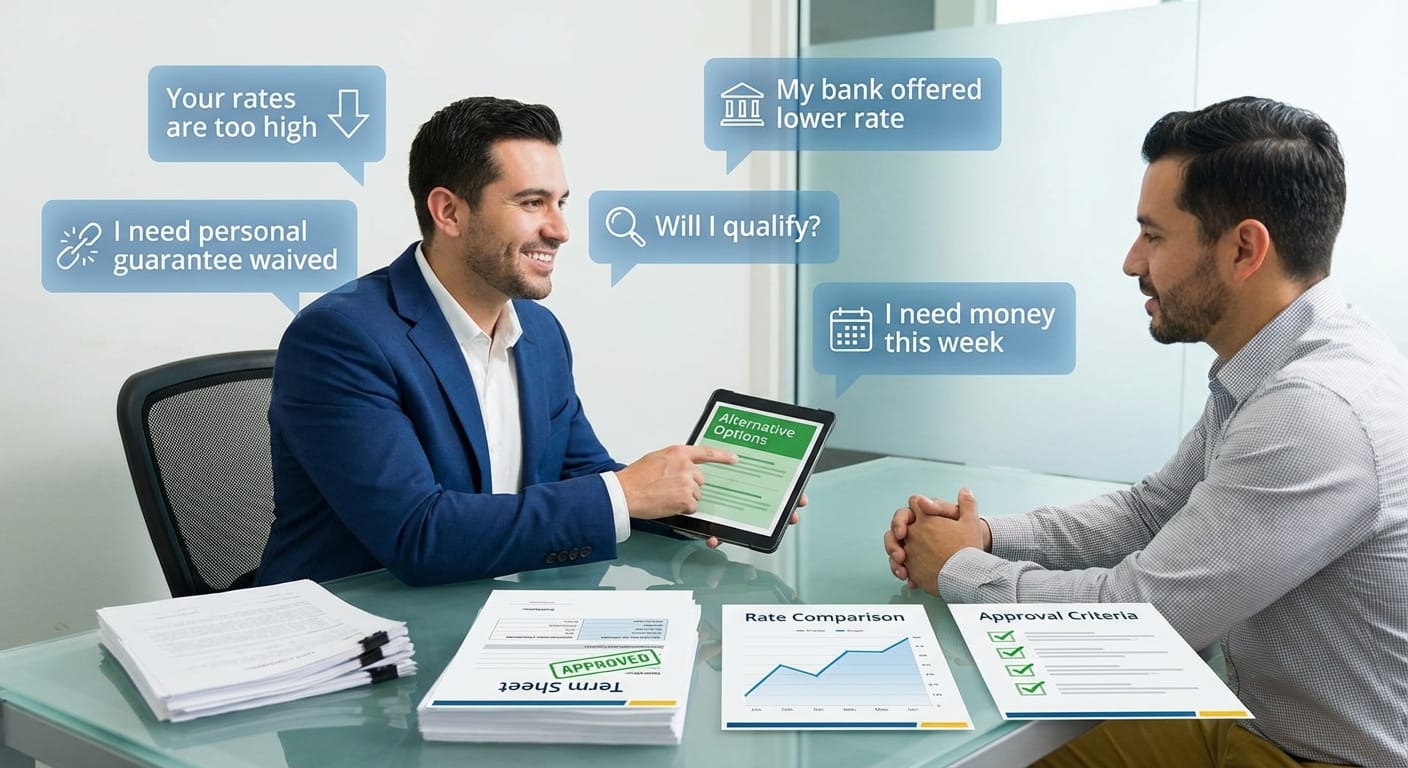
Selling term loans and lines of credit to SMBs requires handling objections around rates, approval requirements, and lender trust. Here's your complete playbook for financial services lending objections - plus how to practice until your responses become natural and confident.
Business lending objections are unique. Your SMB prospects aren't just evaluating rates - they're making high-stakes financial decisions that affect cash flow, personal guarantees, and business survival. One wrong answer about rates, terms, or approval requirements can kill deals worth hundreds of thousands.
Traditional objection frameworks miss the lending-specific concerns that actually prevent closings: "Your rates are higher than my bank," "I don't want a personal guarantee," "What if I don't qualify?" and "I need funding tomorrow, not in two weeks."
This playbook gives you proven response frameworks for every major business lending objection, from competitive rates to approval requirements to speed and flexibility concerns.
Why Business Lending Objections Are Different
High-Stakes Financial Decisions: Business owners are personally liable through guarantees and the capital affects their company's survival. Fear and risk aversion drive many objections.
Rate Sensitivity: Unlike software where value justifies premium pricing, lending is commoditized. Small rate differences matter significantly over loan terms.
Approval Uncertainty: Prospects fear wasting time on applications they won't get approved for, creating objections around qualification requirements.
Relationship and Trust: Business owners have existing banking relationships and worry about new lenders' reliability, hidden fees, and service quality.
Speed Requirements: SMBs often need capital quickly for time-sensitive opportunities or emergencies, making speed a critical decision factor.
Lending-Specific Objections and Response Templates
Category 1: Rate and Pricing Objections
Objection: "Your rates are higher than my bank quoted me."
Response: "I appreciate the comparison. Let me ask - did your bank actually approve you at that rate, or is that just a quoted range? What we typically see is banks quote low rates initially but the actual approved rate is higher, or approval takes 45-60 days with extensive requirements. Our rate reflects [speed to funding, approval likelihood, flexibility]. For your situation needing [$X] by [timeline], would comparing total cost and certainty of approval be more valuable than just rate comparison?"
Why This Works: Challenges whether bank rate is real approval and reframes to total value beyond rate.
Objection: "I can get a lower rate with [online lender/competitor]."
Response: "Let's look at total cost and terms. [Competitor's] lower rate often comes with [origination fees, prepayment penalties, shorter terms requiring refinancing]. When you calculate total interest plus fees over the full term, the difference is often minimal or reversed. More importantly, our approval rate for businesses like yours is [percentage] vs. their [lower rate] because [specific reason]. Would you rather have a slightly lower rate you might not get approved for, or competitive pricing you're highly likely to close?"
Why This Works: Reveals hidden costs and positions your higher approval likelihood as value.
Objection: "The rate seems high for the amount I'm borrowing."
Response: "Let me explain how business lending pricing works. Rates reflect [credit profile, time in business, revenue consistency, collateral]. For your situation - [$X revenue], [X years in business], [credit score range] - this rate is actually [competitive/standard] in the market. Banks can offer lower rates but only approve [very strong credits/established businesses]. We approve more businesses by pricing for actual risk. Would understanding how your specific situation affects pricing help?"
Why This Works: Educates on pricing factors and positions rate as fair for their risk profile.
Objection: "Can you match [competitor's] rate?"
Response: "I want to be direct - we price based on your specific risk profile and our cost of capital. I can't arbitrarily match rates without understanding their complete offer. Let me ask: what are [competitor's] complete terms - fees, personal guarantee requirements, funding timeline, prepayment terms? Often what looks like a better rate comes with trade-offs. Would comparing complete offers - rate, terms, approval likelihood, and speed - make sense rather than just matching one number?"
Why This Works: Avoids rate-matching trap while exposing competitor's complete terms for fair comparison.
Category 2: Approval and Qualification Objections
Objection: "I don't think I'll qualify - my credit isn't perfect."
Response: "Credit matters but isn't the only factor. We look at [complete picture: revenue, time in business, cash flow, industry]. I've approved businesses with [credit range] when they have [strong revenue, consistent deposits, growth trajectory]. Rather than guessing, let me ask a few questions about your situation: [revenue, time in business, etc.]. Based on that, I can tell you honestly whether you're likely to qualify. Would getting real assessment be more valuable than assuming you won't qualify?"
Why This Works: Positions you as approving businesses others reject and offers real assessment vs. assumption.
Objection: "I can't provide [specific document/requirement] you're asking for."
Response: "I understand that's challenging. Let me ask - is it that you don't have [document] or that it would take time to get? Because we can [work with alternative documentation, give you time to obtain it, etc.]. For example, if you can't provide [specific doc], we can often use [alternative]. The key information we need is [core requirement]. Would exploring documentation alternatives work?"
Why This Works: Offers flexibility and alternatives rather than treating requirement as deal-breaker.
Objection: "How do I know I'll get approved before I spend time on the application?"
Response: "Great question - no one wants to waste time. Here's our process: [quick pre-qualification based on basic info], then we give you [clear yes/no or approval likelihood] before you do full application. Our pre-qualification approval rate is [high percentage] - meaning if we pre-qualify you, you're highly likely to close. Would spending [10 minutes] on pre-qualification to know if it's worth pursuing make sense?"
Why This Works: Offers low-risk first step that doesn't waste their time without commitment.
Objection: "I was declined by [bank/lender] before - why would you approve me?"
Response: "Let me understand what happened. Who declined you and what reason did they give? Because banks decline businesses for [specific reasons: new business, industry, credit events] that we often can approve. We specialize in [your niche: newer businesses, specific industries, recovering credit]. What specifically led to the decline, and has anything improved since then?"
Why This Works: Uncovers decline reason and positions your different underwriting criteria as advantage.
Category 3: Personal Guarantee and Collateral Objections
Objection: "I don't want to give a personal guarantee."
Response: "I understand the concern - no one wants personal liability. Here's the reality in business lending: personal guarantees are standard for [loan size, business age, credit profile] because [risk mitigation for lender]. The alternative is [SBA loans requiring same thing, or significantly higher rates for unsecured]. That said, the guarantee is a backup - it only matters if the business can't pay. Given your [strong revenue, growth, track record], the likelihood of ever needing to use it is low. Is the concern the guarantee itself, or worry about business ability to repay?"
Why This Works: Explains industry standard while addressing underlying fear of business failure.
Objection: "What collateral do you need? I don't want to pledge my house."
Response:"Let me be clear about collateral requirements for your situation. For [X amount], we typically secure with [business assets, equipment, receivables − not personal real-estate] unless you′re borrowing over[threshold]. Personal real estate pledges are only for [larger amounts or specific situations]. For your [loan size], we'd look at [specific business collateral]. Does that address the concern, or is there specific collateral you're worried about pledging?"
Why This Works: Clarifies actual collateral requirements and separates business from personal assets.
Objection: "The UCC filing will affect my ability to get other financing."
Response: "Valid concern if you're planning additional financing. Here's how UCC filings work: [explanation of subordination, specific vs. blanket liens]. We file UCC on [specific collateral] which doesn't prevent [other types of financing]. If you need [working capital line, equipment financing] later, lenders can [subordinate or work around our lien]. Would understanding exactly what we're filing against and how it affects future financing help?"
Why This Works: Educates on UCC reality and shows it doesn't block all future financing.
Category 4: Timeline and Speed Objections
Objection: "I need money this week - can you do that?"
Response: "Let me be direct about timeline. Our fastest approvals are [realistic timeframe: 3-5 business days] with [all documentation ready, clean credit, straightforward deal]. To hit your timeline, here's what we'd need: [specific requirements and quick turnaround items]. If that's realistic, we can move fast. If not, let's talk about [bridge options or realistic timeline]. What's driving the urgency, and is [our realistic timeline] workable?"
Why This Works: Sets realistic expectations while exploring urgency and offering solutions.
Objection: "Your process seems slower than [online lender] who promises same-day approval."
Response: "You're right that some online lenders promise faster decisions. Here's what we've seen: their 'same-day approval' is often [conditional approval pending documentation] that takes just as long ultimately, or they [decline more often, have higher rates, require ACH daily payments]. Our timeline is [realistic timeframe] but our [approval rate, flexibility, terms] are better. Would you rather have a fast 'maybe' or a slightly longer 'yes' with better terms?"
Why This Works: Exposes fast approval claims while positioning realistic timeline as more valuable.
Objection: "By the time I get approved, I'll miss the opportunity."
Response: "Tell me about the opportunity and timeline. If it's truly time-critical, let me see what's possible: [rush processing, partial advance, bridge solution]. We've accelerated deals when [genuine urgency with complete documentation]. That said, if timeline is impossible to meet, I'd rather tell you now and help you find [alternative] than make promises we can't keep. What's the absolute deadline, and what's driving it?"
Why This Works: Shows willingness to help while being honest about realistic possibilities.
Category 5: Terms and Flexibility Objections
Objection: "The term is too short - I need longer to repay."
Response:"Let me understand the concern. Is it that monthly payments are too high, or you want to minimize interest cost over time? Because [longer terms mean lower payments but higher total interest, shorter terms mean higher payments but less total cost]. For your cash flow situation generating [X monthly], [proposed term] creates payments of [ X monthly], which is [percentage] of revenue. Would that work, or do we need to adjust the term to fit cash flow better?"
Why This Works: Uncovers real concern (payment size vs. total cost) and offers term adjustment if needed.
Objection: "I don't like the prepayment penalty."
Response: "I understand prepayment flexibility matters. Here's why prepayment terms exist: [lender needs to earn minimum return to justify loan]. That said, we structure it as [declining penalty over time, or penalty only in first X months]. Most businesses don't actually prepay early, but if you anticipate paying off early, we can [structure differently with slightly higher rate, or remove penalty for additional cost]. Would understanding the specific penalty terms and when they apply help?"
Why This Works: Explains reasoning while offering flexibility options and clarifying terms.
Objection: "What if my business has a slow month and I can't make the payment?"
Response: "Cash flow concerns are legitimate for any business. Here's our approach: [flexibility for temporary issues, payment modification process, communication importance]. We've worked with borrowers through [slow seasons, temporary setbacks] by [specific accommodations]. The key is communication - if issues arise, talking to us early allows [options]. We'd rather work with you than create problems. Does knowing we're flexible when issues arise address the concern?"
Why This Works: Shows lender flexibility and partnership approach vs. rigid enforcement.
Category 6: Trust and Lender Relationship Objections
Objection: "I've worked with my bank for 20 years - why should I switch?"
Response: "Banking relationships have real value - loyalty matters. The question is whether your bank is actually serving this need. You reached out to us because [they declined you, can't meet timeline, don't offer this product]. We're not asking you to abandon your bank - keep that relationship for [banking services]. Use us for [this specific capital need] where we can serve you better. Many clients maintain banking relationships while using us for [financing]. Does that make sense?"
Why This Works: Respects existing relationship while positioning you as complementary, not replacement.
Objection: "How do I know you're legitimate and won't scam me?"
Response: "That's a smart question in an industry with bad actors. Here's how you verify we're legitimate: [licensing information, regulatory oversight, BBB rating, years in business, client references]. You can also check [specific verifiable facts]. We're [licensed in X states, funded $X in loans, member of X associations]. Would connecting you with [similar client reference] or showing our [credentials] give you confidence?"
Why This Works: Provides verifiable proof and respects their due diligence.
Objection: "What are the hidden fees you're not telling me about?"
Response: "I appreciate the direct question. Here are ALL the fees: [complete list with amounts: origination, wire, etc.]. Total fees are [$X or X%] which brings your all-in cost to [APR]. There are no other fees - no early payoff penalties beyond what I mentioned, no monthly servicing fees, no surprise charges. Everything is in the [term sheet/agreement] in black and white. Would reviewing the complete fee breakdown line by line make sense?"
Why This Works: Complete transparency builds trust and differentiates from lenders who hide fees.
Category 7: Use of Funds and Business Situation Objections
Objection: "I need this for [purpose you typically don't fund]."
Response: "Let me be direct - we typically don't fund [that purpose] because [specific reason: risk, regulatory, past experience]. That said, help me understand the situation more. Sometimes what looks like [un-fundable purpose] is actually [fundable alternative]. Or we might be able to structure this differently. What are you specifically trying to accomplish, and is there flexibility in how it's structured?"
Why This Works: Explains limitation while exploring if creative structuring could work.
Objection: "My business partner and I disagree about taking on debt."
Response: "That's important to resolve before moving forward. What's your partner's concern - the debt itself, the terms, or something else? Often concerns come from [misunderstanding terms, fear of obligation, past bad experience]. Would having a three-way conversation where I explain exactly what you're committing to help align you both? Taking on financing when partners aren't aligned creates problems - let's make sure you're both comfortable."
Why This Works: Addresses partnership issue directly and offers to help align rather than pushing deal.
Why Practicing Lending Objections Is Critical
Business lending objections involve financial fear, personal guarantee anxiety, and rate scrutiny that require confident, empathetic responses.
The Lending Practice Challenge
Financial Fear Management: Prospects are anxious about debt, rates, and personal liability. Managing their fear while moving deals forward requires practiced emotional intelligence.
Rate Defense Confidence: Defending higher rates against bank or competitor comparisons requires absolute confidence in value proposition.
Approval Uncertainty: Navigating qualification discussions without over-promising or discouraging requires calibrated communication.
What Practice Develops
Empathetic Confidence: Acknowledging financial anxiety while confidently explaining terms and value.
Rate Justification Fluency: Natural ability to reframe rate discussions to approval likelihood, speed, and total value.
Objection Anticipation: Recognizing when prospects will question rates, guarantees, or approval before they raise concerns.
How Sellible Masters Lending Objection Practice
Financial Services Scenarios: Practice with AI prospects who raise rate concerns, personal guarantee anxiety, and approval uncertainty specific to business lending.
Regulatory Awareness: AI prospects reflect real lending conversations including compliance-appropriate responses and TILA/Reg Z awareness.
Competitive Pressure: Work with AI that mentions specific competitors, bank quotes, and online lender alternatives requiring competitive response.
Anxiety and Skepticism: Practice with anxious AI prospects worried about debt, skeptical of lenders, and fearful of guarantees - building empathy skills.
Lending Objection Handling Checklist
Before Sales Conversations:
- Know competitive rates and total cost comparisons
- Understand approval criteria and flexibility
- Have answers ready for guarantee and collateral questions
- Know realistic funding timelines
- Prepare client references for similar situations
During Objection Handling:
- Listen for underlying financial anxiety
- Acknowledge fear without feeding it
- Reframe rate discussions to total value
- Be honest about approval likelihood
- Provide complete transparency on fees and terms
- Build trust through empathy and expertise
After Conversations:
- Document which objections arose
- Note which responses built trust vs. created concern
- Identify credibility gaps to address
- Practice responses that felt uncertain
Conclusion
Business lending objections center on rates, approval uncertainty, and financial fear. Successfully handling these objections requires confident rate defense, empathetic anxiety management, and complete transparency about terms and requirements.
The frameworks in this playbook work when delivered with confidence and empathy. That confidence comes from practicing lending conversations until rate discussions, guarantee explanations, and approval assessments become natural.
Traditional role play can't replicate the financial anxiety and rate scrutiny that real business owners deliver. You need realistic practice with AI prospects who challenge rates, express guarantee concerns, and question approval likelihood like actual SMB borrowers.
Sellible provides that practice. Work with AI prospects who raise lending-specific objections, express financial anxiety, and demand rate justification until lending objection handling becomes your strength.
Ready to master lending objections? Book a demo with the Sellible team and practice with AI prospects who challenge like real business borrowers.
Frequently Asked Questions
Q: How do I justify higher rates when banks quote lower? A: Challenge if bank quote is real approval or just range. Emphasize approval likelihood, speed, and flexibility vs. bank's extensive requirements and slow process. Most SMBs choose certainty over lowest rate.
Q: Should I be honest if someone probably won't qualify? A: Yes - wasting time on applications that won't approve damages credibility. Better to pre-qualify honestly and build trust than string along unlikely approvals.
Q: How do I handle personal guarantee concerns? A: Acknowledge it's standard in business lending, explain it's backup (only used if business fails), and address underlying fear about business survival vs. guarantee itself.
Q: What if I can't match competitor timelines? A: Set realistic expectations and challenge competitor's claims. "Same day approval" often means conditional approval taking just as long ultimately. Realistic timeline with higher approval rate beats fast "maybe."
Q: How much rate flexibility do I actually have? A: Know your pricing authority and when to escalate vs. when to hold firm. Matching every rate request trains market you'll discount. Defend value, offer flexibility on terms/structure instead.