Objection Handling Playbook for B2B Services
Complete B2B services objection handling playbook with proven responses for pricing, ROI measurement, expertise credibility, and deliverable concerns specific to consulting, agencies, and professional services.
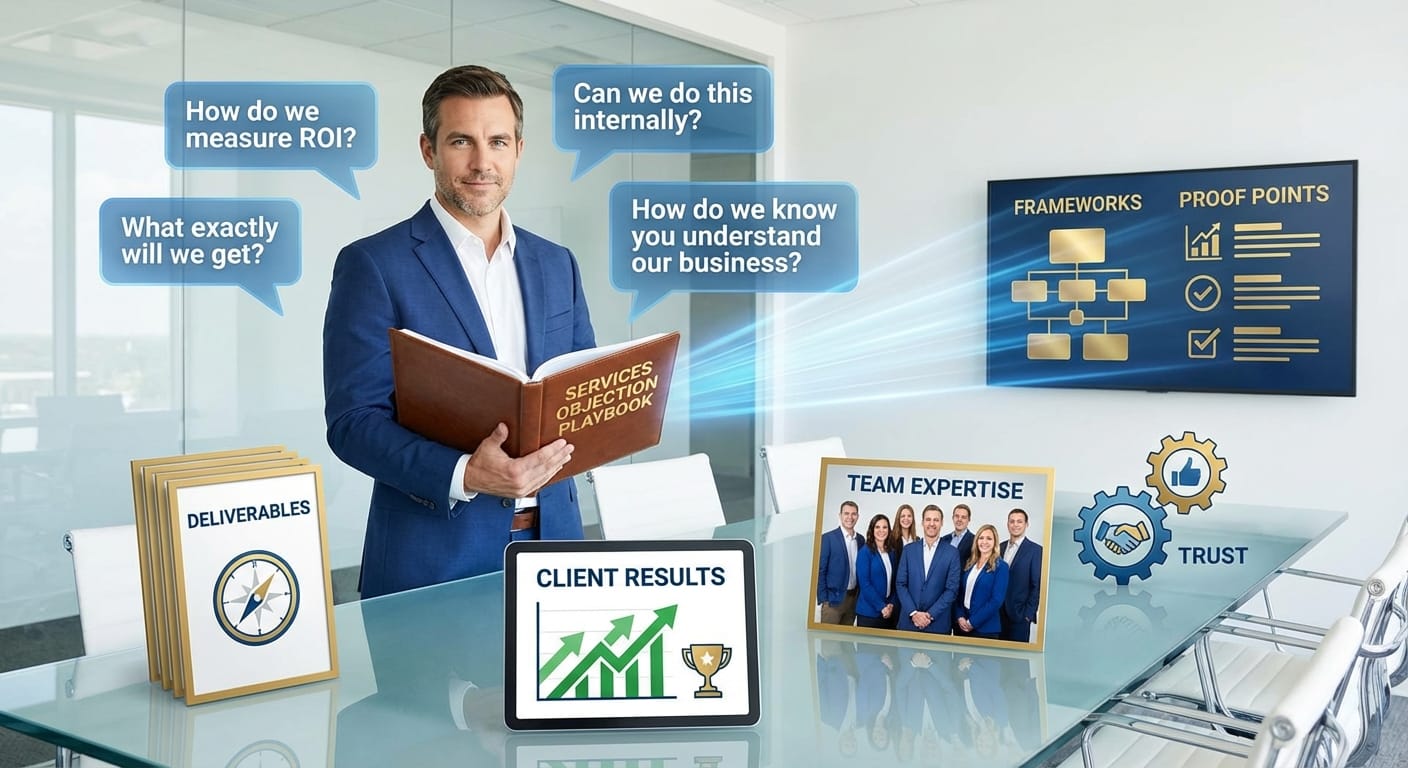
B2B services sales face unique objections around intangible ROI, deliverable uncertainty, and trust in expertise. Here's your complete playbook for handling services-specific objections - plus how to practice until your responses become natural and confident.
B2B services objections are different from product sales. Your prospects aren't evaluating features - they're betting on your team's expertise, trusting you'll deliver results without tangible proof, and trying to measure ROI on intangible outcomes.
Traditional objection frameworks miss the services-specific concerns that actually kill deals: "How do we know you'll deliver?" "What if your team doesn't understand our business?" "How do we measure success?" and "We can hire someone internally cheaper."
This playbook gives you proven response frameworks for every major B2B services objection, from pricing and ROI to expertise credibility and deliverable uncertainty.
Why B2B Services Objections Are Different
Intangible Deliverables: Unlike software with demos or products with specs, services outcomes are intangible until delivery. Prospects can't "see" what they're buying.
People-Dependent Quality: Service quality depends entirely on the people doing the work. Prospects worry about team capability and consistency.
ROI Measurement Challenges: Quantifying value of consulting, strategy, or advisory services is harder than measuring software productivity gains.
Trust and Expertise Concerns: Prospects must trust you understand their business, industry, and challenges better than internal teams or competitors.
Switching Cost Anxiety: Changing service providers means relationship disruption, knowledge transfer challenges, and risk of lower quality.
Services-Specific Objections and Response Templates
Category 1: Pricing and ROI Objections
Objection: "Your fees are higher than other agencies/consultants."
Response: "I appreciate the comparison. The fee difference reflects three things: [1] our specialized expertise in [their industry/challenge], [2] our delivery model that [specific advantage], and [3] our track record of [specific results]. Companies similar to yours chose us over lower-cost alternatives because [key differentiator] delivered [specific outcome]. Would comparing the value of outcomes rather than hourly rates be helpful?"
Why This Works: Shifts from cost comparison to outcome value and expertise quality.
Objection: "How do we measure ROI on consulting/strategy/advisory services?"
Response: "Great question - ROI measurement is critical. Here's how we approach it: we establish baseline metrics before starting [specific KPIs], define success criteria upfront [measurable outcomes], and track improvement throughout the engagement. For example, with [similar client], we measured [specific metric improvement] that translated to [business impact]. Would defining measurable outcomes for your specific situation be valuable?"
Why This Works: Demonstrates you've solved the measurement problem and provides concrete example.
Objection: "We could hire someone internally for less than your retainer."
Response: "Let's look at total cost and capability. Hiring internally means [salary + benefits + ramp time + ongoing management]. That's typically $150K+ annually for one person with limited expertise. Our team provides [breadth of expertise], [speed to results - no ramp time], and [scalability - more or less as needed]. Companies that considered both routes chose us because [specific advantage: speed, expertise breadth, or flexibility]. Would comparing total cost and capability make sense?"
Why This Works: Reveals hidden costs of internal hiring and emphasizes expertise advantages.
Objection: "We need to see guaranteed results before committing."
Response: "I understand wanting certainty. Here's how we provide that: [1] We scope engagements with clear deliverables and success metrics, [2] we structure payment around milestones tied to progress, [3] we provide case studies from similar situations showing [specific results]. We can also structure this as [pilot/phased approach] so you can validate our approach before full commitment. Would starting smaller to prove value work?"
Why This Works: Offers risk mitigation through structure and phased approach rather than upfront guarantees.
Category 2: Expertise and Credibility Objections
Objection: "How do we know you understand our industry/business?"
Response: "Valid concern - industry context matters. Here's our relevant experience: [specific industry clients or situations], [specific challenges we've solved similar to theirs], and [team members with industry background]. More important than past experience is our discovery process: we invest [time/effort] upfront understanding your specific situation before proposing solutions. Would reviewing our approach to understanding your business address this?"
Why This Works: Combines past experience with commitment to learning their specific situation.
Objection: "We've worked with consultants before and they didn't understand our business."
Response: "I appreciate you sharing that - bad consulting experiences create justified skepticism. Here's what we do differently: [1] our discovery process involves [specific approach], [2] we assign team members who [relevant background], [3] we validate our understanding through [specific method] before making recommendations. What specifically went wrong with past consultants, and what would make this different?"
Why This Works: Acknowledges their concern, differentiates approach, and uncovers specific fears to address.
Objection: "Your team hasn't worked with a company exactly like ours before."
Response: "You're right - every company is unique. What we've found is that exact industry match matters less than deep expertise in [relevant challenge/capability]. We've solved [specific problem similar to theirs] across [industries], and the underlying principles apply directly to your situation. For example, [similar challenge in different industry] required [approach that would work for them]. Would seeing how our expertise in [relevant area] applies to your specific situation be valuable?"
Why This Works: Reframes from industry match to capability match with relevant examples.
Category 3: Deliverable and Execution Objections
Objection: "What exactly will we get for our investment?"
Response: "Let me be specific about deliverables: [concrete list: strategy document, implementation roadmap, training program, etc.]. Beyond documents, here's what you actually get: [business outcomes: reduced costs, improved efficiency, revenue growth]. The deliverables are the means; the outcomes are [specific business impact]. Would walking through exactly what you'll receive and how it translates to business results be helpful?"
Why This Works: Provides concrete deliverables while connecting them to business outcomes.
Objection: "How long will this take, and what happens if it takes longer?"
Response: "Timeline is important. Based on [their situation], typical engagement is [timeframe] with these milestones: [specific timeline]. We build in accountability through [progress reviews, milestone payments, etc.]. If timeline extends, it's typically because [scope expansion or access to stakeholders]. We mitigate this by [specific approach]. Would reviewing a detailed project plan with timeline and milestones give you confidence?"
Why This Works: Provides specific timeline with accountability built in.
Objection: "What if we're not satisfied with the work?"
Response: "Valid concern. Here's how we ensure satisfaction: [1] regular progress reviews where you can course-correct, [2] milestone-based payment so you're never too far invested without seeing value, [3] [specific quality assurance process]. We also [offer revision rounds, guarantee specific outcomes, etc.]. With [similar client], we [specific example of how you ensured satisfaction]. Would building in checkpoints and guarantees address this?"
Why This Works: Shows multiple safeguards and demonstrates track record of ensuring satisfaction.
Category 4: Team and Resource Objections
Objection: "Will we work with you or with junior team members?"
Response: "Important question. Here's our staffing model: [senior person] leads the engagement and handles [strategic aspects], supported by [roles] who execute [tactical work]. You'll have direct access to [senior level] for [frequency]. This model ensures [senior expertise] while providing [bandwidth for execution]. Would meeting the full team you'd work with make sense?"
Why This Works: Clarifies team structure and ensures senior involvement is clear.
Objection: "What if the people we like leave your company mid-engagement?"
Response: "Team continuity matters. Here's how we handle that: [1] we assign backup team members who shadow key engagements, [2] we document everything so knowledge doesn't live in one person's head, [3] we have [retention rate or tenure statistics] showing team stability. In the rare case of transition, we ensure [specific transition process]. Would that level of continuity protection work?"
Why This Works: Demonstrates thought about continuity with specific mitigation approaches.
Objection: "We need more resources/bandwidth than you might have."
Response: "Let me address capacity directly. Our current team can handle [scope/volume]. If your needs exceed that, we [scale through partners, hire specifically for engagement, etc.]. We've successfully delivered engagements [larger than theirs] by [specific scaling approach]. Would reviewing our capacity plan for your specific needs make sense?"
Why This Works: Addresses capacity concern with specific scaling options.
Category 5: Competitive and Alternative Objections
Objection: "We're comparing you to [Competitor] who costs less."
Response: "It makes sense to compare options. Here's where we differ from [Competitor]: [specific differentiation on methodology, expertise, or outcomes]. Companies that chose us over them did so because [key advantage]. The cost difference reflects [specific value difference]. Would comparing total value and outcomes rather than just fees be helpful?"
Why This Works: Differentiates on value, not just features, with specific advantages.
Objection: "We're considering doing this internally instead."
Response: "Let's look at both options objectively. Doing this internally requires [specific capabilities, time, resources]. The advantage is [internal knowledge]. The challenge is [typical internal obstacles: bias, capacity, expertise gaps]. We bring [outside perspective, specialized expertise, dedicated focus]. Companies that chose external support did so because [specific reason]. Would comparing both approaches with pros and cons make sense?"
Why This Works: Fairly compares both options while highlighting external advantages.
Objection: "Can we just hire you part-time or as an advisor instead of full engagement?"
Response: "I appreciate wanting to start smaller. Here's what we've found: part-time advisory without [implementation support, full team, etc.] typically doesn't achieve [desired outcomes] because [specific reason]. That said, we can structure this as [phased approach or pilot] that gives you [specific deliverable] to prove value before expanding. Would that achieve your goal of starting smaller while still driving results?"
Why This Works: Explains why reduced scope often fails while offering legitimate phased alternative.
Category 6: Risk and Trust Objections
Objection: "What if this doesn't work for our situation?"
Response: "Every situation is unique, so healthy skepticism makes sense. Here's how we ensure fit: [1] thorough discovery before proposal, [2] [pilot or proof of concept] to validate approach, [3] clear success metrics so we know if it's working. If we determine mid-engagement that our approach isn't right, we [specific commitment: adjust approach, recommend alternatives, etc.]. Would starting with validation phase before full commitment make sense?"
Why This Works: Acknowledges risk while providing multiple safety nets.
Objection: "We need references from companies exactly like us."
Response: "Let me address references thoughtfully. We've worked with companies [similar in size, industry, or challenge], and I can connect you with [specific references]. What's most important in a reference - similar industry, similar challenge, or similar size? I want to make sure you talk to someone whose situation best matches yours. Would speaking with [specific client] about [relevant similar challenge] be valuable?"
Why This Works: Provides references while focusing on most relevant similarity.
Why Practicing Services Objections Is Critical
B2B services objections require confidence in intangible value propositions and trust-building skills that only develop through repetition.
The Services Practice Challenge
Intangible Value Communication: Articulating value of expertise and advisory services requires different skills than demonstrating software features.
Credibility Under Scrutiny: Services buyers probe deeply into expertise, methodology, and team capabilities. Hesitation destroys credibility.
ROI Justification: Defending pricing for intangible deliverables requires practiced confidence and concrete examples.
What Practice Develops
Confident Value Articulation: Natural ability to describe intangible outcomes and expertise value without sounding defensive.
Credibility Signals: Building trust through tone, examples, and methodology explanations that only come with practice.
Objection Anticipation: Recognizing when prospects will question expertise or deliverables and addressing proactively.
How Sellible Masters Services Objection Practice
Services-Specific Scenarios: Practice with AI prospects who raise intangible ROI questions, expertise concerns, and deliverable uncertainty typical of services buying.
Credibility Testing: Work with AI that probes methodology, questions team capabilities, and challenges expertise claims like skeptical services buyers.
Industry-Specific Practice: AI prospects raise objections specific to consulting, marketing agencies, professional services, and advisory firms.
Confidence Building: Practice the same services objections repeatedly until defending intangible value becomes natural and confident.
Services Objection Handling Checklist
Before Sales Conversations:
- Prepare case studies from similar situations
- Know your deliverables and outcomes clearly
- Have ROI examples and measurement approach ready
- Understand competitor positioning and differences
- Review team credentials and relevant experience
During Objection Handling:
- Listen for underlying trust or credibility concerns
- Acknowledge intangible nature, don't defend it
- Provide concrete examples and client results
- Connect deliverables to business outcomes
- Offer risk mitigation (pilots, milestones, guarantees)
- Demonstrate methodology and expertise naturally
After Conversations:
- Document which objections arose
- Note which responses worked effectively
- Identify credibility gaps to address
- Practice weaker responses for next time
Conclusion
B2B services objections center on trust, expertise credibility, and intangible value. Successfully handling these objections requires confident articulation of methodology, proven results, and risk mitigation - skills that develop only through practice.
The frameworks in this playbook work when delivered with absolute confidence in your expertise and value. That confidence comes from practicing services conversations until defending intangible outcomes becomes natural.
Traditional role play can't replicate the deep expertise probing and credibility testing that services buyers deliver. You need realistic practice with AI prospects who question your methodology, challenge your expertise, and demand ROI proof like real services buyers.
Sellible provides that practice. Work with AI prospects who raise services-specific objections, probe your credibility, and force you to defend intangible value until services objection handling becomes your strength.
Ready to master services objections? Book a demo with the Sellible team and practice with AI prospects who challenge like real services buyers.
Frequently Asked Questions
Q: How do I justify services pricing when prospects compare to hourly rates? A: Reframe from hourly rates to outcomes and total cost. Show how your expertise delivers results faster and better than cheaper alternatives, making total investment lower despite higher rates.
Q: What if I don't have case studies from their exact industry? A: Focus on similar challenges across industries. Explain how underlying expertise applies regardless of industry specifics, then demonstrate deep understanding through discovery.
Q: How do I build credibility when prospects question my expertise? A: Demonstrate expertise through insightful questions, relevant examples, and methodology explanation - not just credentials. Show you understand their challenges better than they expect.
Q: Should I offer guarantees on results for services? A: Be careful with guarantees on outcomes you can't fully control. Instead, guarantee process, deliverables, and effort. Structure milestone payments and satisfaction checkpoints as risk mitigation.
Q: How do I handle "we'll do this internally" objections? A: Fairly acknowledge internal advantages (context, ongoing presence) while highlighting what they lose (outside perspective, specialized expertise, dedicated focus, speed). Let them choose with full information.
Related Articles
How Sales Managers Can Use AI Role Play to Reduce Rep Ramp Time - Sales managers can reduce new rep ramp time by 50% using AI role play for unlimited practice, data-driven coaching, and personalized skill development at scale. Learn the framework that accelerates onboarding.
Objection Handling Playbook for Tech Sales - Complete tech sales objection handling playbook with proven responses for technical specifications, security concerns, integration challenges, and build-vs-buy objections specific to technology sales.
The Silent Objections in B2B Sales - Silent objections kill more B2B deals than voiced concerns. Learn to recognize hidden objections, use diagnostic questions to surface them, and address unspoken concerns before they destroy your pipeline.