Objection Handling Playbook for B2B Sales
Complete B2B objection handling playbook with proven response frameworks for price, timing, authority, competition, and value objections. Includes LAER framework and practice strategies.
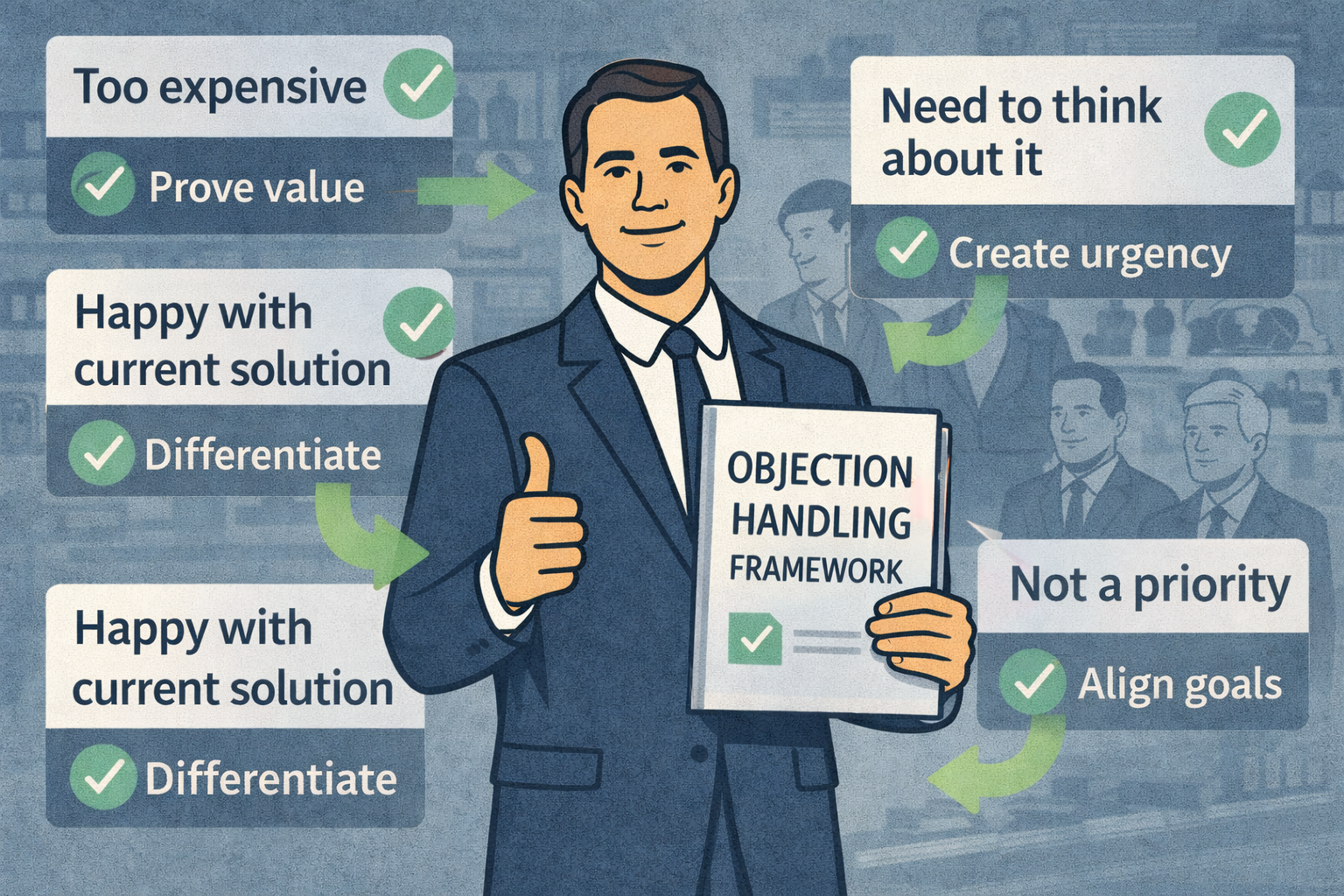
B2B sales objections kill more deals than any other factor. Here's your complete playbook for handling the most common objections from budget concerns to timing issues - plus how to practice until your responses become natural and confident.
B2B sales reps know what objections are coming. Every rep has heard "It's too expensive," "We need to think about it," or "We're happy with our current solution" dozens of times. Yet when these objections arise in actual conversations, many reps still stumble, sound defensive, or deliver unconvincing responses.
The problem isn't knowledge - it's execution under pressure. Knowing how to handle objections intellectually is completely different from delivering compelling responses confidently when a prospect challenges you in real-time.
This playbook gives you proven response frameworks for every major B2B objection category, plus the practice strategy that separates reps who know what to say from reps who can actually say it convincingly.
Why B2B Objections Require a Playbook
B2B Objections Are Predictable: Most B2B deals encounter the same 7-10 objections repeatedly. Having prepared, practiced responses for these common objections is the difference between winning and losing deals.
But Responses Must Sound Natural: Prospects can instantly detect scripted, robotic responses. Your objection handling must sound conversational and authentic while still following proven frameworks.
Traditional Training Doesn't Work:
- Generic objection scripts sound inauthentic
- Role-play with colleagues lacks realistic pressure
- No practice delivering responses under actual sales conversation pressure
- Reps memorize frameworks but can't execute them naturally
The B2B Objection Response Framework
The LAER Model
L - Listen Let the prospect complete their full objection without interrupting. Listen for the real concern behind their stated objection.
A - Acknowledge Validate their concern as legitimate. Show you understand their perspective without agreeing the objection is insurmountable.
E - Explore Ask clarifying questions to understand the root concern. Determine if the objection is a real dealbreaker or negotiable.
R - Respond Address the core concern with data, examples, or reframing. Offer specific solutions or next steps.
Common B2B Objections and Response Templates
Category 1: Price and Budget Objections
Objection: "Your solution is too expensive."
LAER Response:
Listen & Acknowledge: "I appreciate you being direct about price concerns. Budget is always an important consideration."
Explore: "When you say 'too expensive,' are you comparing to a specific budget you had in mind, or to alternatives you're evaluating?"
Respond: "Let me reframe this around value rather than price. Companies similar to yours typically see [specific ROI] within [timeframe]. Would it help to walk through how this investment pays for itself based on your specific situation?"
Objection: "We don't have budget right now."
LAER Response:
Listen & Acknowledge: "I understand budget constraints are real, especially in the current environment."
Explore: "Is this a matter of budget not being allocated yet, or budget being committed to other priorities?"
Respond: "Many clients faced similar situations. What they found was that the cost of not solving [their problem] actually exceeded our investment. When would budget typically become available, and should we explore how to build a business case for that timeline?"
Objection: "Your competitor is cheaper."
LAER Response:
Listen & Acknowledge: "Price comparison is definitely part of your evaluation, and I'm glad you're looking at options."
Explore: "What specifically are you comparing - is it total cost, or initial price? And what other factors besides price are important in your decision?"
Respond: "Price is one factor, but let me show you where the value difference comes from: [specific differentiation]. Our clients who chose us over lower-priced alternatives did so because [key advantage] was worth the investment. Would comparing total value rather than just price be helpful?"
Category 2: Timing and Priority Objections
Objection: "We need to think about it."
LAER Response:
Listen & Acknowledge: "Of course, this is an important decision that deserves careful consideration."
Explore: "What specific aspects do you need to think through? And who else needs to be part of that thinking process?"
Respond: "Let me make that easier. The main considerations are usually [key factors]. Which of these would be most helpful to address right now so you have what you need for your decision?"
Objection: "This isn't a priority right now."
LAER Response:
Listen & Acknowledge: "I understand you have competing priorities for your time and resources."
Explore: "What's taking precedence right now? And what would need to change for this to become a higher priority?"
Respond: "I appreciate the honest prioritization discussion. Let me share what other companies discovered - delaying [solution] actually made their other priorities harder to achieve because [specific reason]. Is that a risk you're comfortable with, or should we explore a way to address this without disrupting current priorities?"
Objection: "Let's revisit this next quarter."
LAER Response:
Listen & Acknowledge: "I understand the need to time decisions appropriately."
Explore: "What specifically about next quarter makes it better timing? Is it budget cycle, resource availability, or something else?"
Respond: "Every quarter you wait costs you [quantified impact]. If we started planning now for next quarter implementation, you'd actually achieve [benefit] sooner. Would exploring how to align with your timeline while capturing value sooner make sense?"
Category 3: Authority and Decision Process Objections
Objection: "I need to discuss this with my team/boss first."
LAER Response:
Listen & Acknowledge: "Absolutely - important decisions should involve key stakeholders."
Explore: "Who else needs to be part of this decision? And what are their primary concerns likely to be?"
Respond: "Let me make those conversations easier. I can provide materials addressing [stakeholder concerns]. Would it be helpful if I joined those discussions to address questions directly, or would you prefer to have initial conversations first?"
Objection: "I don't have authority to make this decision."
LAER Response:
Listen & Acknowledge: "I appreciate you being upfront about decision-making authority."
Explore: "Who does have final authority? And what role do you play in the recommendation or evaluation process?"
Respond: "Understanding the decision process helps me support it effectively. What would you need from me to make a strong recommendation to [decision maker]? And would it make sense to include them in our next conversation?"
Category 4: Competition and Status Quo Objections
Objection: "We're already working with [Competitor]."
LAER Response:
Listen & Acknowledge: "It makes sense you have an existing relationship for something this important."
Explore: "What's working well with your current provider? And what, if anything, could be better?"
Respond: "Many of our best clients had existing relationships before switching to us. The difference that made them change was [specific advantage]. Would it be worth seeing how we compare on the factors most important to you?"
Objection: "We're happy with our current solution."
LAER Response:
Listen & Acknowledge: "Having a solution that meets your needs is valuable."
Explore: "What specifically works well about your current setup? And if you could improve one thing, what would it be?"
Respond: "The question isn't whether your current solution is failing - it's whether [new capability] could create [specific advantage] you can't achieve otherwise. Would you be open to seeing what that looks like?"
Objection: "We're not looking to change right now."
LAER Response:
Listen & Acknowledge: "I understand there's no active search happening."
Explore: "What would trigger you to actively evaluate alternatives? And what would an ideal solution need to deliver to be worth changing?"
Respond: "Most of our clients weren't actively looking when we first connected. What got their attention was [specific insight] that made them rethink their approach. Can I share that perspective in case it's relevant?"
Category 5: Product and Solution Objections
Objection: "We need feature X that you don't have."
LAER Response:
Listen & Acknowledge: "Feature requirements are important to get right."
Explore: "Tell me more about how you'd use that feature. What problem does it solve, and how critical is it to your overall needs?"
Respond: "Here's how our clients handle that requirement: [alternative approach or roadmap]. While we don't have that exact feature, our solution delivers [relevant outcome] through [different method]. Would seeing how that works address your underlying need?"
Objection: "Your solution seems too complex."
LAER Response:
Listen & Acknowledge: "Simplicity and ease of use are definitely important."
Explore: "What specifically seems complex? Is it implementation, daily use, or something else?"
Respond: "I appreciate the complexity concern. Here's what's interesting - clients initially thought the same thing but found [specific aspect] actually made their work simpler. The complexity you're seeing is in the capabilities, not in the user experience. Would seeing how this works in practice address the concern?"
Category 6: Risk and Trust Objections
Objection: "We've never heard of your company."
LAER Response:
Listen & Acknowledge: "Brand recognition matters, especially for important business decisions."
Explore: "What concerns does that create for you? Is it about capability, stability, or something else?"
Respond: "You're right that we're not the biggest name in the space. What our clients value is [specific advantage of our size/focus]. Companies like [similar client] had the same initial concern and chose us because [specific reason]. Would speaking with them about their experience be valuable?"
Objection: "How do we know this will work for us?"
LAER Response:
Listen & Acknowledge: "Every situation is unique, and past results don't guarantee future success."
Explore: "What aspects of your situation are you most concerned about? What would give you confidence this would work?"
Respond: "That's why we don't make guarantees without understanding your specific situation. Based on what you've shared about [their context], here's how we've achieved results with similar companies: [specific examples]. Would a pilot or proof of concept focused on your requirements make sense?"
Category 7: Value and ROI Objections
Objection: "We're not sure this will deliver the value you're claiming."
LAER Response:
Listen & Acknowledge: "Healthy skepticism about ROI claims is smart given how many solutions don't deliver."
Explore: "What would you need to see to have confidence in the value? How do you typically validate ROI?"
Respond: "Let's ground this in your specific numbers rather than our claims. Based on what you've shared about [their metrics], here's how value accrues: [specific calculation]. We can also connect you with [similar customer] who was equally skeptical. Would that combination address your concerns?"
Objection: "The ROI timeline is too long."
LAER Response:
Listen & Acknowledge: "Time to value is definitely an important consideration."
Explore: "What ROI timeline were you expecting or need to achieve? And what's driving that timeline requirement?"
Respond: "Here's how we can accelerate value realization: [specific approach to faster ROI]. Some clients actually see initial value within [shorter timeframe] by focusing on [quick wins]. Would exploring a phased approach that delivers value sooner make sense?"
Why Practice Transforms Objection Handling
You now have proven response frameworks for every major B2B objection. But knowing these responses is only half the equation.
The Practice Gap
Knowing vs. Doing:
- Reading responses ≠ delivering them convincingly
- Understanding frameworks ≠ executing under pressure
- Memorizing scripts ≠ sounding natural and confident
What Happens Without Practice:
- You freeze when unexpected variations arise
- Responses sound scripted and unconvincing
- You get defensive or over-explain under pressure
- Prospects sense lack of confidence instantly
What Practice Develops:
- Automatic, natural response delivery
- Confidence that prospects can hear in your voice
- Ability to handle pushback and follow-up challenges
- Smooth transitions from objection to value discussion
Traditional Practice Limitations
Role-Play with Colleagues:
- Teammates don't give realistic pushback
- Lacks the pressure of actual sales conversations
- Focuses on what you say, not how convincingly you say it
Self-Practice:
- Can't simulate realistic dialogue
- No exposure to unexpected objection variations
- No pressure to maintain composure
- No feedback on delivery effectiveness
How Sellible Masters B2B Objection Practice
Realistic Objection Scenarios
Natural Objection Flow Sellible's AI raises objections naturally within sales conversations, not as isolated events. Practice handling objections the way they actually arise in real deals.
Multiple Objection Types Work through scenarios where prospects raise budget concerns, then timing issues, then competitive questions - building your ability to handle objection combinations.
Varied Objection Language Practice handling the same core objection phrased dozens of different ways, so you're prepared for any variation prospects present.
Pressure Practice Under Realistic Conditions
Pushback and Follow-Up AI prospects don't accept your first response - they challenge assumptions, ask for more detail, and test your confidence just like real buyers.
Unexpected Objections Face objections you didn't anticipate, building your adaptability and confidence when caught off-guard.
Tone and Delivery Coaching Get feedback not just on what you say, but how you say it - the confidence, pacing, and composure that determines whether objection responses land effectively.
Building Objection Handling Confidence
Repetition Creates Mastery Practice the same objections multiple times until responses become automatic and natural rather than forced or scripted.
Progressive Difficulty Start with straightforward objections and build to complex, multi-layered scenarios as your confidence grows.
Safe Learning Environment Make mistakes and try different approaches without risking real deals or relationships.
B2B Objection Handling Checklist
Before Sales Conversations:
- Anticipate 3-5 most likely objections for this prospect
- Review LAER framework for each anticipated objection
- Practice responses until they sound natural
- Prepare supporting materials (case studies, ROI data)
During Objection Handling:
- Listen completely without interrupting
- Acknowledge concern as legitimate
- Explore with questions to understand root issue
- Respond with data, examples, or reframing
- Check for understanding before moving forward
- Maintain calm, confident demeanor
After Conversations:
- Document objections encountered
- Evaluate response effectiveness
- Identify improvement opportunities
- Practice better responses for next time
- Update objection playbook with learnings
Conclusion
B2B objection handling is a learnable skill. The frameworks in this playbook work - they're proven across thousands of successful deals. But frameworks alone don't win deals.
The difference between reps who struggle with objections and reps who handle them masterfully is simple: practice. Not just knowing what to say, but practicing until you can say it naturally, confidently, and convincingly under the pressure of real sales conversations.
Traditional practice methods can't replicate the pressure, variety, and pushback of actual B2B objections. You need realistic practice with AI that challenges like real prospects, raises unexpected objections, and forces you to adapt.
Sellible provides that practice environment. Work with AI prospects who object like real buyers, push back on your responses, and help you build the automatic confidence that wins deals.
Your competitors are winging objection handling and losing winnable deals. When you prepare with this playbook and practice realistically, you'll handle objections with the confidence that turns resistance into closed deals.
Ready to master B2B objection handling? Try Sellible's AI training platform and practice with AI prospects who challenge like real buyers.
Frequently Asked Questions
Q: Should I memorize these exact responses? A: No - internalize the framework and key points, then deliver them conversationally in your own words. Memorized scripts sound robotic.
Q: What if I get an objection I haven't prepared for? A: Use the LAER framework: Listen, Acknowledge, Explore to understand it better, then Respond based on similar objections you have handled.
Q: How many objections should I prepare for before a sales call? A: Prepare responses for the 3-5 most likely objections based on prospect research and conversation stage. Have frameworks ready for unexpected ones.
Q: How do I practice objection handling without sounding scripted? A: Practice responses enough times that you internalize the structure, then deliver them conversationally rather than word-for-word. Focus on the message, not memorizing exact wording.
Q: How often should I practice objection handling? A: 15-20 minutes daily maintains sharp objection handling skills. Practicing responses before important calls builds confidence for specific scenarios.