Objection Handling Playbook for B2B SaaS
Complete B2B SaaS objection handling playbook with proven responses for subscription pricing, integration concerns, user adoption, and build-vs-buy objections specific to software sales.
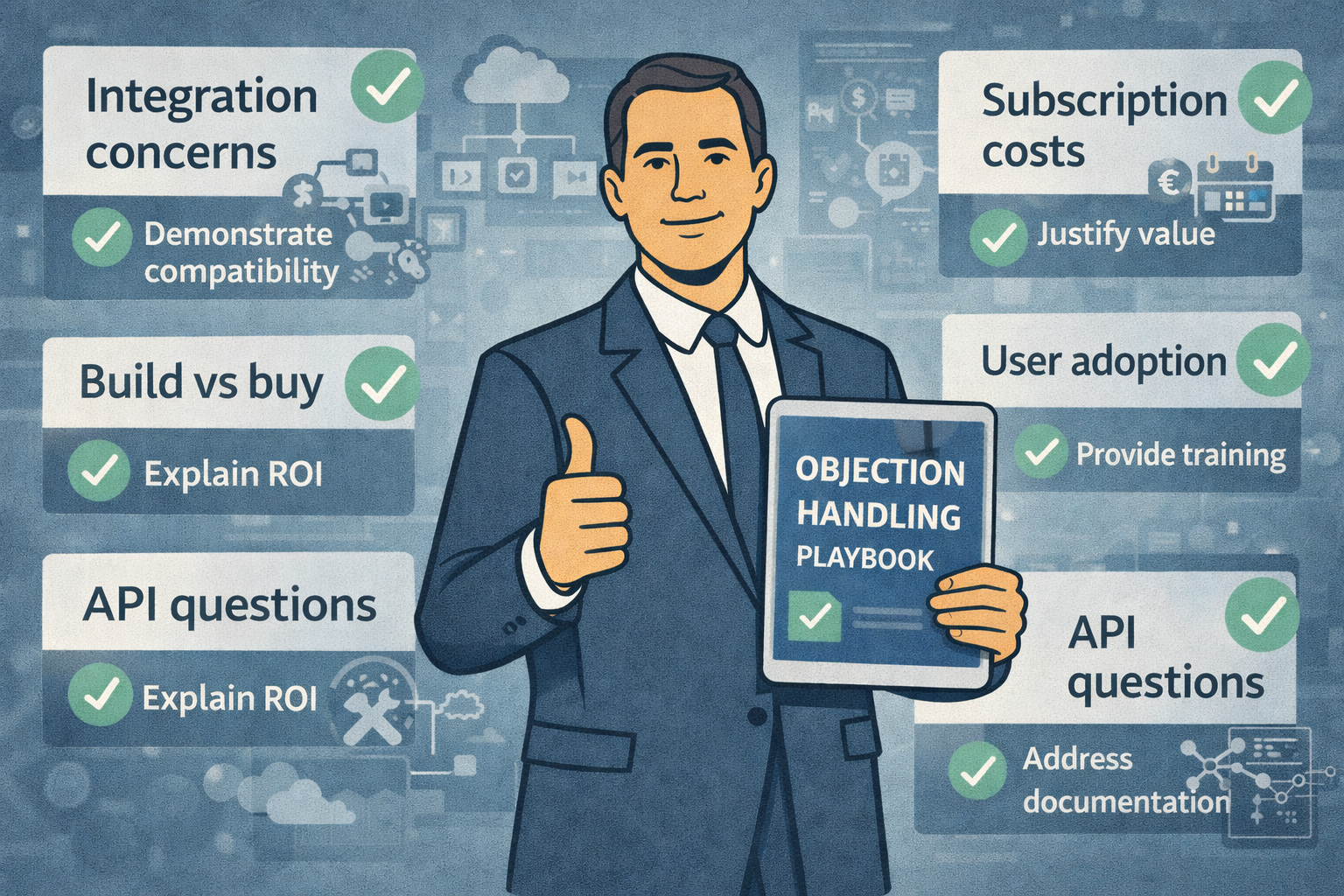
B2B SaaS sales face unique objections around subscriptions, integrations, and switching costs. Here's your complete playbook for handling SaaS-specific objections - plus how to practice until your responses become natural and confident.
B2B SaaS objections are different. Your prospects aren't just evaluating a product - they're committing to ongoing subscriptions, complex integrations, user adoption challenges, and the risk of switching from existing solutions.
Traditional objection handling frameworks miss the SaaS-specific concerns that actually kill deals: integration complexity, subscription fatigue, data migration fears, and the dreaded "we'll build it ourselves" objection that only tech-savvy buyers raise.
This playbook gives you proven response frameworks for every major SaaS objection, from pricing models to technical integration to user adoption concerns.
Why SaaS Objections Are Different
Subscription Model Concerns: Buyers worry about ongoing costs, annual increases, and being locked into contracts they can't escape.
Integration Complexity: Every SaaS purchase requires integration with existing tools, creating technical objections traditional sales never face.
User Adoption Risk: Software is only valuable if users actually adopt it - a concern unique to SaaS that doesn't exist with one-time purchases.
Switching Costs: Prospects are rarely starting fresh - they're switching from existing solutions, creating migration and disruption concerns.
Build vs. Buy: Tech-savvy prospects often consider building solutions internally, an objection specific to software purchases.
SaaS-Specific Objections and Response Templates
Category 1: Pricing and Subscription Objections
Objection: "Your per-user pricing gets expensive as we scale."
Response: "I understand the per-user model concern for growing companies. Let me show you how this actually works economically: companies your size typically see [specific efficiency gain] that actually reduces cost per employee even as headcount grows. We also have volume tiers that kick in at [number] users. Would seeing a multi-year projection based on your growth plans be helpful?"
Objection: "We're hesitant to commit to annual contracts."
Response: "Contract commitment is a valid concern, especially if you're unsure about adoption. Here's what I'd suggest: our most successful clients actually start with annual commitments because [specific advantage]. That said, we can structure this as [alternative approach] for the first year while you validate value. Would that address the commitment concern?"
Objection: "We're already paying for too many SaaS tools."
Response: "SaaS subscription fatigue is real - I completely understand. The question becomes whether this replaces existing tools or adds net new value. Based on what you've shared, this could potentially replace [specific tools], actually reducing your total SaaS spend. Should we map out which current subscriptions this could eliminate?"
Objection: "What happens if we need to cancel?"
Response: "Data portability and exit strategy are important. Here's our approach: [specific cancellation terms and data export process]. We also provide [transition support]. The reality is our best clients stay because of value, not contract terms. Would seeing our customer retention rates and understanding why clients stay give you confidence?"
Category 2: Integration and Technical Objections
Objection: "We're concerned about integration with our existing stack."
Response: "Integration complexity is one of the most important technical considerations. We currently integrate natively with [their key tools] through [integration method]. For your specific stack - [tools they use] - here's how integration works: [technical details]. Would connecting our technical teams to review your specific integration requirements make sense?"
Objection: "Our IT team is worried about security and data privacy."
Response: "IT security concerns are absolutely critical. Here's our security posture: [specific certifications - SOC 2, ISO, etc.]. We're also compliant with [relevant regulations - GDPR, etc.]. Companies like [similar customer] had identical concerns and here's how we addressed them: [specific approach]. Would arranging a security review with your IT team be the right next step?"
Objection: "We need API access for custom integrations."
Response: "API flexibility is important for companies with specific integration needs. Our API supports [capabilities], and we have [documentation/developer resources]. Companies like [similar customer] use our API for [specific use case]. Would having our technical team walk through API capabilities and your specific integration needs be valuable?"
Objection: "What about data migration from our current system?"
Response: "Data migration is a legitimate concern - poorly executed migrations cause major problems. Here's our migration approach: [specific process]. We've migrated [number] companies from [their current solution], and our typical migration timeline is [timeframe] with [support level]. Would seeing a detailed migration plan specific to your data structure address this concern?"
Category 3: User Adoption and Change Management Objections
Objection: "Our team is resistant to changing tools."
Response: "Change resistance is one of the biggest SaaS adoption challenges. This is why our onboarding specifically focuses on [change management approach]. Companies like [similar customer] had teams equally resistant, and here's what made the difference: [specific factors]. We also provide [training/support]. Would reviewing our change management methodology be helpful?"
Objection: "How long does implementation and user adoption take?"
Response: "Time to value is critical for SaaS investments. Our typical implementation for companies your size is [timeframe], with users productive within [timeframe]. We accelerate this through [specific methods]. Would seeing a detailed implementation timeline with milestones give you clarity on what to expect?"
Objection: "What if our users don't actually use it?"
Response: "User adoption risk is real - we see it as our responsibility, not yours. That's why we track adoption metrics and provide [specific support]. Our average adoption rate is [percentage] within [timeframe]. We also build in [specific features encouraging adoption]. Would having adoption guarantees or success metrics built into our agreement address this concern?"
Category 4: Competition and Alternatives Objections
Objection: "We're comparing you to [Competitor]."
Response: "It makes sense you're evaluating multiple options. Let me be direct about where we differ from [Competitor]: [specific differentiation on factors that matter to them]. Companies that choose us over [Competitor] typically do so because [key advantage]. Would doing a side-by-side comparison on your specific criteria be helpful?"
Objection: "We're considering building this ourselves."
Response: "Build vs. buy is a common consideration for companies with engineering resources. Here's what other tech companies discovered: building takes [time/cost] that could go to your core product, plus ongoing maintenance costs of [estimate]. [Similar company] initially planned to build but chose us because [specific reason]. Would comparing total cost of building vs. our solution over 3 years be valuable?"
Objection: "Our current solution is 'good enough'."
Response: "Having a solution that works has real value. The question isn't whether your current solution is failing - it's whether [new capability] creates [specific advantage] you can't achieve otherwise. Companies using [their current solution] who switched to us did so because [specific improvement]. Would seeing what that improvement looks like in your specific situation be worth exploring?"
Category 5: Value and ROI Objections
Objection: "We need to see clearer ROI justification."
Response: "ROI validation is critical for SaaS investments. Based on what you've shared about [their metrics], here's how we calculate value: [specific methodology]. For your situation, conservative estimates suggest [specific return] within [timeframe]. We can also connect you with [similar customer] who had similar skepticism. Would a detailed ROI model using your actual numbers be helpful?"
Objection: "The ROI timeline is too long."
Response: "Time to value matters for SaaS. Here's how we can accelerate ROI: [specific approach]. Some clients see initial value within [shorter timeframe] by focusing on [quick wins]. For example, [similar company] saw [specific quick win]. Would exploring a phased approach that delivers value faster make sense?"
Objection: "We're not sure this will work for our specific use case."
Response: "Every company's situation is unique. That's why we don't do one-size-fits-all implementations. Here's how we've customized for companies with [similar characteristics]: [specific examples]. We can also do a proof of concept focused on your specific use case. Would a 30-day pilot validating fit for your situation address the concern?"
Category 6: Scalability and Future-Proofing Objections
Objection: "Will this scale as we grow?"
Response: "Scalability is critical - you don't want to outgrow your tools. Our platform currently supports customers from [size range], including [large customer example]. We're built to scale in these specific ways: [technical scalability features]. Would understanding our roadmap and how we've scaled with similar companies give you confidence?"
Objection: "What about your product roadmap and future development?"
Response: "Product direction and innovation matter for long-term partnerships. Here's where we're heading: [relevant roadmap items]. We also have a customer advisory board that influences our roadmap - companies like yours help shape what we build. Would reviewing our roadmap and getting involved in shaping it be valuable?"
Objection: "What if you get acquired or shut down?"
Response: "Company stability is a legitimate concern for SaaS purchases. Here's our situation: [funding/backing/financial stability]. We also provide [source code escrow or data portability guarantees]. Our retention rate of [percentage] suggests customers are confident in our stability. Would understanding our business model and trajectory address this concern?"
Category 7: Implementation and Support Objections
Objection: "Do you provide adequate training and support?"
Response: "Training and support quality directly impacts adoption and value. Here's what we provide: [specific training programs, support SLAs, resources]. Our average support response time is [metric], and we assign [specific support model]. Would seeing our complete training and support program give you confidence?"
Objection: "What happens when we have technical issues?"
Response: "Uptime and reliability are critical for business software. Our SLA guarantees [uptime percentage], and our actual uptime over the past year was [actual metric]. When issues do occur, here's our support process: [specific escalation and resolution approach]. Would reviewing our uptime history and support SLAs be helpful?"
Objection: "We need dedicated account management."
Response: "The right level of support matters. For companies at your stage, we provide [specific account management model]. Your account manager would be [role description] with [specific responsibilities]. Companies your size typically benefit from [specific engagement model]. Would understanding exactly what account management looks like address this need?"
Why Practice Transforms SaaS Objection Handling
Knowing these SaaS-specific responses is only half the equation. Delivering them convincingly under pressure is what actually wins deals.
The SaaS Practice Challenge
Technical Objections Require Depth: SaaS objections often involve technical details about APIs, integrations, and security that require confident, knowledgeable responses.
Multiple Stakeholder Objections: SaaS purchases involve IT, finance, and end users - each raising different objections that you must handle seamlessly.
Subscription Model Complexity: Explaining pricing models, contracts, and long-term value requires practice to sound natural and confident rather than defensive.
What Effective Practice Develops
Technical Confidence: Building comfort discussing APIs, integrations, security, and technical architecture without sounding uncertain.
Multi-Objection Handling: Developing ability to address technical, financial, and adoption objections in single conversations.
Value Communication: Mastering how to frame ongoing subscription costs as investment rather than expense.
How Sellible Masters SaaS Objection Practice
SaaS-Specific Scenarios: Practice with AI prospects who raise integration concerns, question subscription value, and compare you to competitors - just like real SaaS buyers.
Technical Pushback: Work with AI that challenges your API claims, questions security architecture, and pushes back on integration complexity - building technical confidence.
Multi-Stakeholder Objections: Handle scenarios where different AI stakeholders raise different objections - IT raises technical concerns while finance questions pricing and end users worry about adoption.
Realistic SaaS Conversations: Practice complete SaaS sales conversations where objections arise naturally, not as isolated events, building your ability to handle real deal complexity.
SaaS Objection Handling Checklist
Before Sales Conversations:
- Research prospect's current tech stack and tools
- Identify likely integration and adoption concerns
- Prepare SaaS-specific responses (subscription, integration, migration)
- Review technical details you might be questioned on
During Objection Handling:
- Listen for underlying technical or adoption concerns
- Acknowledge SaaS-specific risks (integration, change, cost)
- Explore whether objection is technical, financial, or political
- Respond with SaaS examples and relevant case studies
After Conversations:
- Document SaaS-specific objections encountered
- Identify which responses worked vs. fell flat
- Practice technical responses that felt weak
- Update objection playbook with SaaS learnings
Conclusion
B2B SaaS objection handling requires more than generic sales frameworks. You must address subscription concerns, integration complexity, user adoption risk, and technical questions that traditional sales never encounter.
This playbook gives you proven SaaS-specific response frameworks. But frameworks alone don't win deals. You must practice until you can discuss APIs, explain subscription value, and address migration concerns with the natural confidence that wins SaaS deals.
Sellible provides SaaS-specific practice. Work with AI prospects who raise integration objections, question subscription models, and push back on technical claims - building the confidence that closes SaaS deals.
Ready to master B2B SaaS objection handling? Book a demo with the Sellible team and practice with AI prospects who challenge like real SaaS buyers.
Frequently Asked Questions
Q: How technical do I need to be to handle SaaS objections effectively? A: You need enough technical understanding to discuss integrations, APIs, and security confidently. When deeper technical questions arise, involve your technical team but maintain confidence in your understanding.
Q: How do I justify ongoing subscription costs vs. one-time purchases? A: Frame subscriptions as lower risk (can cancel vs. stuck with purchase), always current (updates included), and predictable budgeting. Focus on total value over time, not monthly cost.
Q: What if prospects want to build the solution internally? A: Quantify total cost of building (engineering time, ongoing maintenance, opportunity cost of not building core product) vs. subscription cost. Most build vs. buy objections disappear when total costs are compared.
Q: How do I handle integration objections when I'm not technical? A: Have technical resources available to dive deep, but understand enough to speak confidently about common integrations and escalation path for complex questions.
Q: Should I offer free trials to overcome objections? A: Free trials work best when the objection is about fit or capability, not price or priority. Use trials strategically when prospects need to validate specific functionality or adoption.