MEDDPICC Sales Playbook for B2B SaaS
Systematically qualify B2B SaaS deals using MEDDPICC framework. Prevent pipeline pollution with disciplined qualification across Metrics, Economic Buyer, Decision Criteria, Process, Pain, Champion, Competition.
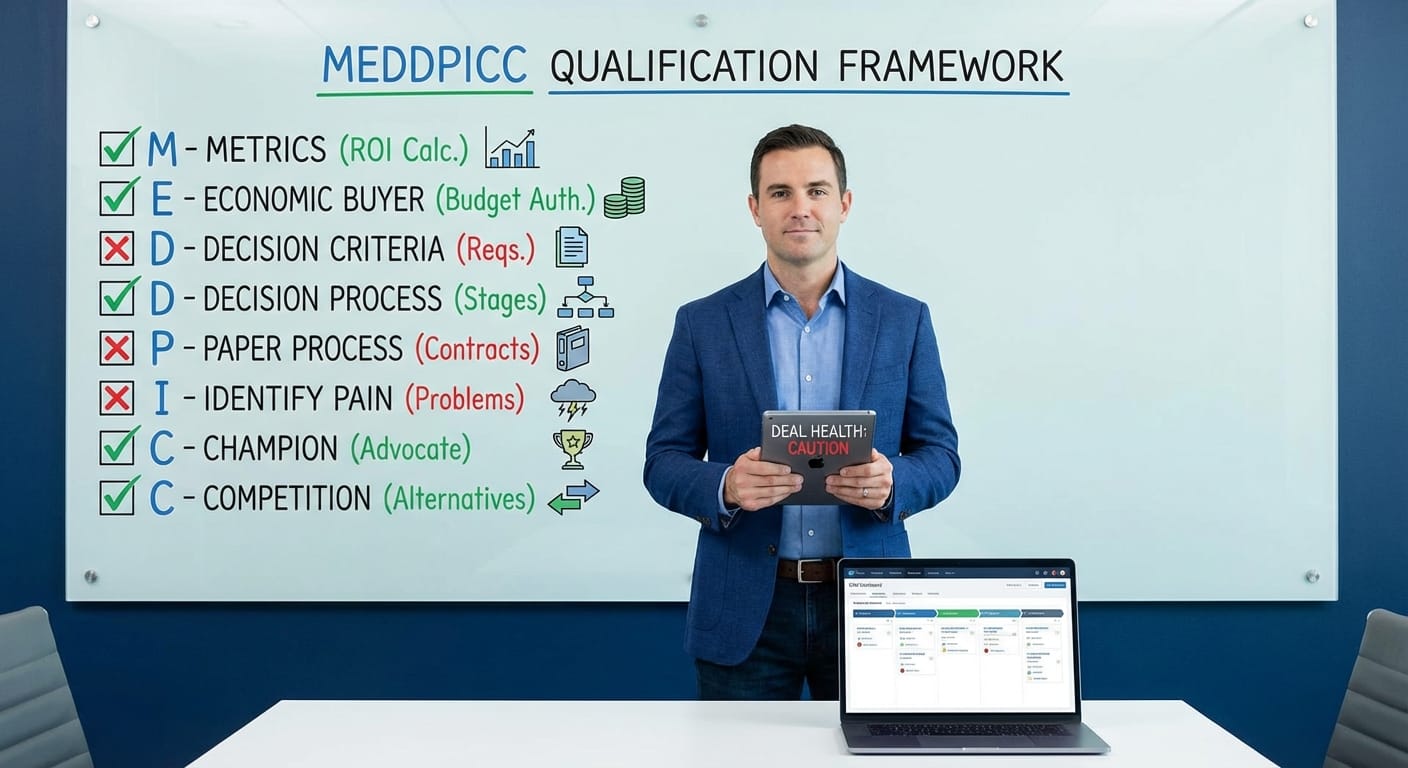
MEDDPICC qualification prevents unwinnable SaaS deals from clogging your pipeline. Here's how to systematically qualify B2B SaaS opportunities using Metrics, Economic Buyer, Decision Criteria, Decision Process, Paper Process, Identify Pain, Champion, and Competition.
Most B2B SaaS deals fail not because reps can't sell, but because they pursue unqualified opportunities. You spend months on deals that were never winnable - wrong champion, no budget, undefined decision process, or competitor already chosen.
MEDDPICC (Metrics, Economic Buyer, Decision Criteria, Decision Process, Paper Process, Identify Pain, Champion, Competition) solves this by forcing systematic qualification. Miss any element and the deal is at risk.
This playbook shows you exactly how to apply MEDDPICC to B2B SaaS sales, with specific questions, qualification standards, and what "fully qualified" actually means.
Why MEDDPICC Works for B2B SaaS
Complex SaaS Sales: Multiple stakeholders, long cycles, procurement processes, and technical evaluation require disciplined qualification.
Prevents Pipeline Pollution: Forces you to qualify out unwinnable deals early instead of chasing hope.
Predictable Forecasting: Fully MEDDPICC-qualified deals close at 80%+ rates vs. 20% for partially qualified.
Resource Allocation: Helps managers invest coaching time on winnable deals, not hopeless ones.
The MEDDPICC Framework for SaaS
M - Metrics (Quantified Business Outcomes)
Purpose: Establish quantified value proposition that justifies investment.
SaaS Metrics Questions:
Current State Metrics:
- "What's your current [efficiency metric, conversion rate, ramp time]?"
- "How much does your team spend on [manual process]?"
- "What's your current cost of [problem area]?"
Target State Metrics:
- "What improvement would make this a huge win?"
- "What metrics are you measured on that this would impact?"
- "What would [X% improvement] be worth to the business?"
SaaS-Specific Metrics:
- User adoption rates needed for ROI
- Subscription payback period
- Time to value expectations
- Cost per user economics
Example: "You mentioned sales ramp time is 6 months. What would reducing that to 3 months be worth? With 20 new hires annually at $200K quota, that's $2M in additional capacity. Does that math work for your situation?"
Qualification Standard: ✅ Quantified current state, target improvement, and business value ❌ Vague "improve efficiency" without numbers
E - Economic Buyer (Budget Authority)
Purpose: Identify who controls budget and can approve the deal.
Economic Buyer Questions:
Direct:
- "Who approves software purchases over [$X]?"
- "What's your budget approval process for SaaS tools?"
- "Who approved your last similar software purchase?"
Indirect:
- "If we align on value and fit, what happens next?"
- "Who needs to sign off before this moves forward?"
SaaS Economic Buyer Complexity: Often distributed between departments. CTO might control tech budget, but VP Sales controls sales tool budget.
Example: Prospect: "I control the budget for sales tools." Rep: "What amount can you approve without further sign-off? And if this exceeds that, who else is involved?"
Qualification Standard: ✅ Economic buyer identified by name, title, and confirmed budget authority ❌ "My boss will approve" without knowing who/how
D - Decision Criteria (Evaluation Standards)
Purpose: Understand formal and informal criteria determining vendor selection.
Decision Criteria Questions:
Functional Requirements:
- "What capabilities are must-haves vs. nice-to-haves?"
- "How will you evaluate different solutions?"
- "What would make one vendor clearly better than another?"
SaaS-Specific Criteria:
- Integration requirements with existing stack
- Security and compliance standards
- User experience/adoption considerations
- Implementation timeline requirements
- Subscription vs. perpetual licensing preference
Weighted Criteria: "If you ranked these factors - functionality, price, implementation speed, vendor stability - what order would they be in?"
Example: Rep: "You mentioned integration with Salesforce is critical. On a scale of must-have to nice-to-have, where does that rank?" Prospect: "Must-have. We won't consider solutions that don't integrate natively."
Qualification Standard: ✅ Clear criteria with relative importance known ❌ Generic "best value" without specifics
D - Decision Process (How Decisions Get Made)
Purpose: Map complete decision-making process from evaluation to signature.
Decision Process Questions:
Process Mapping:
- "Walk me through how you've made similar software decisions?"
- "What are the stages from today to contract signing?"
- "Who's involved at each stage?"
SaaS Decision Stages:
- Initial evaluation (users/champion)
- Technical validation (IT/engineering)
- Security review (IT security/compliance)
- Business case approval (economic buyer)
- Procurement/legal review
- Executive sign-off (if required)
- Contract negotiation
- Final signature
Timeline:
- "What's realistic timeline for each stage?"
- "What typically slows down or speeds up the process?"
Example: Rep: "You mentioned IT security needs to review. What does that review entail and how long does it typically take?" Prospect: "They'll want SOC 2 report, security questionnaire, and potentially pen test. Usually 2-3 weeks."
Qualification Standard: ✅ Complete process mapped with timeline and stakeholders per stage ❌ "We'll evaluate and decide" with no clear process
P - Paper Process (Contract and Legal Requirements)
Purpose: Understand contracting, legal, and procurement requirements.
Paper Process Questions:
Contract Requirements:
- "What's your contract review process?"
- "Who reviews vendor contracts - legal, procurement, both?"
- "Are there standard terms you require?"
SaaS Paper Process Specifics:
- MSA (Master Service Agreement) requirements
- Data Processing Agreement needs
- Security/compliance documentation
- Insurance requirements
- Payment terms restrictions
Timeline:
- "How long does legal review typically take?"
- "What could accelerate or delay that process?"
Example: Rep: "Do you have standard SaaS contract terms you require vendors to accept?" Prospect: "Yes, our legal team has a standard MSA. Most vendors can't accept it as-is and we negotiate." Rep: "What terms typically get negotiated, and how long does that take?"
Qualification Standard: ✅ Paper process, timeline, and requirements understood ❌ "Legal will handle it" with no detail
I - Identify Pain (Compelling Business Problem)
Purpose: Uncover pain severe enough to drive change.
Pain Identification Questions:
Problem Impact:
- "What happens if you don't solve this?"
- "What's the cost of continuing current approach?"
- "How does this affect your ability to hit goals?"
SaaS Pain Urgency:
- Is pain getting worse or staying stable?
- What's driving timing (new regulation, competitive pressure, growth constraint)?
- What triggered evaluation now vs. 6 months ago?
Pain Ownership:
- Does economic buyer feel the pain personally?
- Are there business consequences if pain isn't solved?
Example: Rep: "You mentioned sales ramp time is problematic. What happens if it stays 6 months for another year?" Prospect: "We'll miss our growth targets by $5M and I'll have to explain to board why we can't scale sales effectively."
Qualification Standard: ✅ Quantified, urgent pain felt by economic buyer ❌ Nice-to-have improvement without consequence
C - Champion (Internal Advocate)
Purpose: Identify and develop internal advocate who sells when you're not there.
Champion Identification:
Characteristics:
- Has credibility with economic buyer and stakeholders
- Personally impacted by problem you solve
- Willing to actively advocate internally
- Has access to decision-making conversations
Champion Development:
Enablement:
- Provide ROI calculations for internal presentations
- Offer to join stakeholder meetings
- Share materials addressing likely concerns
Testing Champion Strength:
- Will they arrange meetings with economic buyer?
- Do they share internal intel about process/concerns?
- Are they coaching you on organizational dynamics?
Example: Rep: "How confident are you that [economic buyer] will approve this?" Champion: "Very confident if we address [specific concern]. Let me set up a meeting with them so you can address that directly."
Qualification Standard: ✅ Active champion with credibility, access, and willingness to sell internally ❌ Supporter who won't take action
C - Competition (Alternatives Being Evaluated)
Purpose: Understand competitive landscape and positioning.
Competition Questions:
Direct Alternatives:
- "What other solutions are you evaluating?"
- "Where are you in those evaluations?"
- "What do you like about each option?"
Status Quo:
- "How comfortable are you continuing current approach?"
- "What would make you decide not to change anything?"
Internal Build:
- "Have you considered building this internally?"
- "What would it take to build vs. buy?"
SaaS Competitive Positioning:
- How do you differentiate on criteria that matter to them?
- Where are competitors weak on their requirements?
- Why would they choose you vs. alternatives?
Example: Rep: "You're evaluating us and [Competitor]. What concerns do you have about each option?" Prospect: "They're cheaper but implementation takes 6 months. You're faster to implement but more expensive." Rep: "Given your urgency to see results by [date], which matters more - initial cost or time to value?"
Qualification Standard: ✅ All alternatives known with clear differentiation strategy ❌ "Just looking around" with no competitive intel
MEDDPICC Qualification Checklist
Fully Qualified SaaS Deal:
Metrics:
- Current state quantified
- Target improvement defined
- Business value calculated
- ROI compelling enough to justify investment
Economic Buyer:
- Identified by name and title
- Budget authority confirmed
- Accessible directly or through champion
Decision Criteria:
- Requirements documented
- Must-haves vs. nice-to-haves clear
- Relative importance weighted
- You can win on their criteria
Decision Process:
- Complete process mapped
- Stakeholders identified per stage
- Timeline understood
- Potential obstacles known
Paper Process:
- Contract requirements understood
- Legal/procurement process clear
- Timeline estimated
- Potential red flags identified
Identify Pain:
- Quantified business pain exists
- Urgency established
- Economic buyer feels pain
- Consequences of inaction clear
Champion:
- Champion identified and engaged
- Has credibility and access
- Actively selling internally
- Provides coaching and intel
Competition:
- All alternatives identified
- Competitive positioning clear
- Differentiation on criteria that matter
- Winning strategy defined
MEDDPICC Red Flags
Danger Signs:
❌ Can't identify economic buyer by name ❌ No quantified metrics or ROI ❌ "They'll approve whatever I recommend" (champion overconfidence) ❌ No clear decision process or timeline ❌ Champion won't arrange economic buyer meeting ❌ Pain is nice-to-have, not urgent ❌ Unwilling to discuss competition ❌ Vague about decision criteria ❌ "Legal will be fine" without knowing requirements
When You See Red Flags: Qualify harder or qualify out. Don't hope red flags resolve themselves.
Why Practicing MEDDPICC Is Critical
MEDDPICC requires disciplined questioning that feels unnatural:
Direct Questions: Asking "Who approves budget?" or "What competitors are you evaluating?" requires confidence many reps lack.
Persistent Qualification: Pushing when prospects give vague answers instead of accepting surface-level information.
Comfortable with No: Qualifying out deals when MEDDPICC elements are missing.
How Sellible Masters MEDDPICC Practice
Qualification Scenarios: Practice extracting MEDDPICC elements from AI prospects who don't volunteer information easily.
Evasive Responses: Work with AI that gives vague answers, forcing you to ask follow-up questions until fully qualified.
Red Flag Recognition: Learn to spot missing MEDDPICC elements and either qualify harder or walk away.
Complete Deal Qualification: Practice full MEDDPICC qualification across multiple conversations until it becomes automatic.
MEDDPICC Best Practices
Don't: ❌ Ask all MEDDPICC questions in one call (interrogation) ❌ Accept vague answers without probing ❌ Pursue deals missing critical elements ❌ Let hope override discipline
Do: ✅ Gather MEDDPICC across multiple conversations naturally ✅ Push for specifics when answers are vague ✅ Qualify out deals missing elements ✅ Update qualification as deals progress ✅ Use champion to fill gaps
Conclusion
MEDDPICC prevents wasting months on unwinnable SaaS deals. Systematic qualification across Metrics, Economic Buyer, Decision Criteria, Decision Process, Paper Process, Pain, Champion, and Competition separates real opportunities from pipeline pollution.
Executing MEDDPICC requires disciplined qualification that develops through practice. You need realistic scenarios where prospects don't volunteer information, forcing you to ask direct questions and push for specifics.
Sellible provides that practice. Work with AI prospects who require thorough MEDDPICC qualification, building the discipline that keeps your pipeline healthy.
Ready to master MEDDPICC for SaaS? Book a demo with the Sellible team and practice systematic qualification.
FAQ
Q: How long does MEDDPICC qualification take? A: 2-4 discovery conversations for thorough qualification. Rush it and you'll miss critical elements.
Q: What if prospects won't reveal information? A: Use champion, provide value in exchange for information, or qualify out if they remain evasive.
Q: Can I skip elements if I'm confident? A: No. Deals missing MEDDPICC elements fail at predictable rates regardless of confidence.
Q: How do I qualify economic buyer without offending champion? A: "To make sure we're aligned on value, does it make sense to include [economic buyer] in our next conversation?"
Q: When should I qualify out vs. keep trying? A: If critical elements (economic buyer, pain, champion) are missing after 3-4 conversations, qualify out.