MEDDPICC Sales Methodology Guide for Health Tech Companies
Master MEDDPICC qualification for health tech sales. Learn clinical stakeholder mapping, regulatory qualification, and healthcare-specific decision processes with practice scenarios for complex healthcare sales.
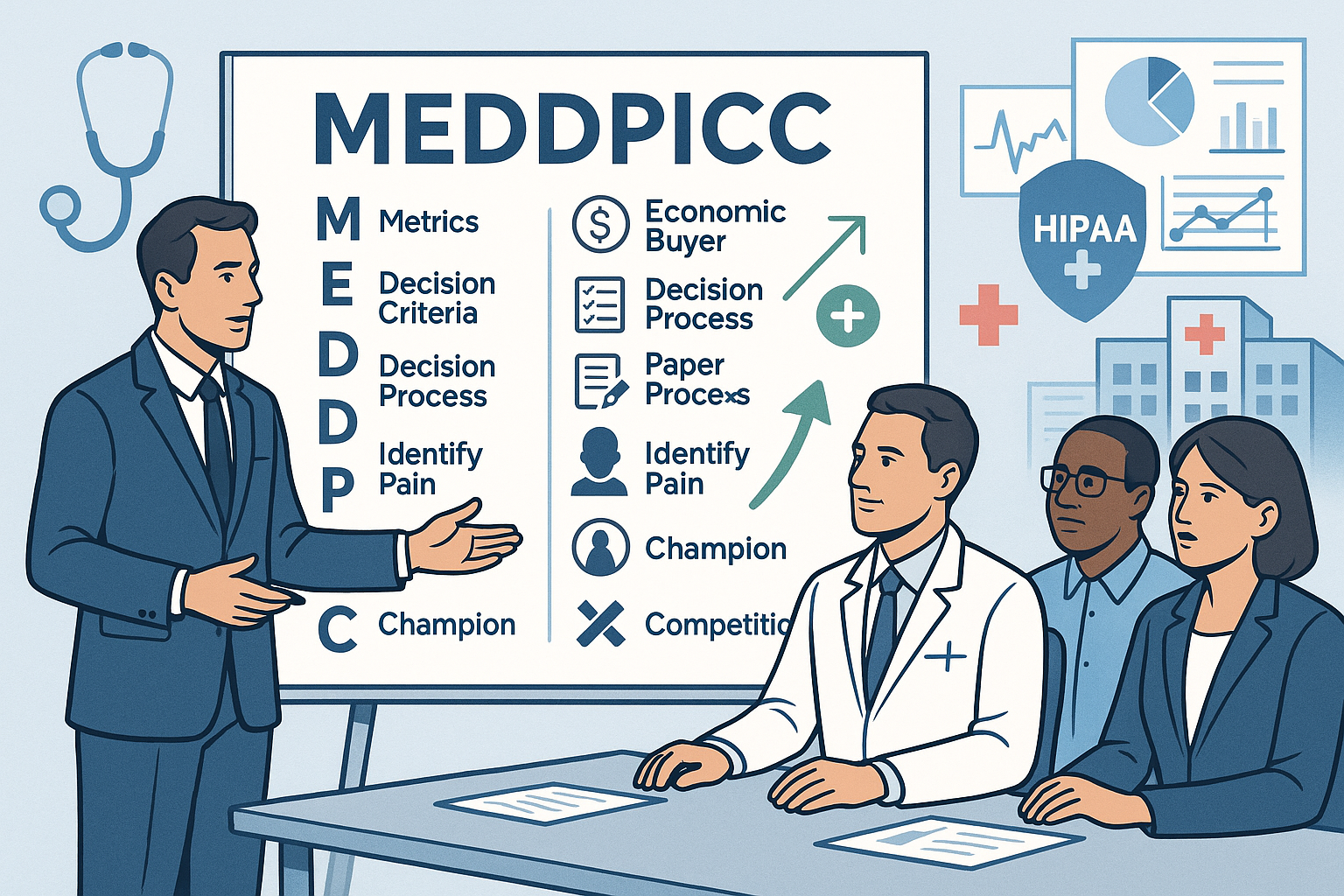
Health tech sales involves complex stakeholder ecosystems, strict regulatory requirements, and long evaluation cycles. Here's how to use MEDDPICC qualification framework specifically for healthcare technology prospects - plus how to practice these sophisticated qualification conversations.
Selling health tech is uniquely complex. You're navigating clinical workflows, HIPAA compliance, budget constraints, physician resistance, IT security requirements, and multi-stakeholder decision processes that can take 12-18 months. Traditional qualification frameworks often miss the healthcare-specific complexity that determines deal success.
MEDDPICC (Metrics, Economic Buyer, Decision Criteria, Decision Process, Paper Process, Identify Pain, Champion, Competition) works powerfully for health tech because it forces disciplined qualification across all the dimensions that matter in healthcare - from clinical outcomes to regulatory compliance to budget approval processes.
But executing MEDDPICC in healthcare requires understanding clinical environments, regulatory constraints, and healthcare purchasing dynamics. You need to practice qualifying deals with prospects who speak about patient outcomes, compliance requirements, and clinical workflows.
This guide shows you exactly how to apply MEDDPICC to health tech sales, including healthcare-specific qualification questions, stakeholder mapping, and how to practice until MEDDPICC becomes second nature in healthcare environments.
Why Health Tech Needs MEDDPICC
Health Tech Sales Complexity:
- Multiple stakeholders (clinical, IT, finance, compliance, administration)
- Patient safety and clinical outcome requirements
- Strict regulatory compliance (HIPAA, FDA, state regulations)
- Long sales cycles (9-18+ months typical)
- Complex integration with existing clinical systems
- Risk-averse decision-making culture
Traditional Qualification Failures:
- Missing key clinical stakeholders
- Underestimating regulatory and compliance requirements
- Not understanding healthcare budget and approval processes
- Failing to identify clinical champions
- Ignoring competitive clinical preferences
- Missing paper process complexity (BAAs, security audits, clinical validation)
MEDDPICC Framework for Health Tech
M - Metrics (Clinical and Business Outcomes)
Purpose: Quantify the clinical, operational, and financial impact your solution must deliver.
Health Tech Metrics to Identify:
Clinical Outcome Metrics:
- "What patient outcomes are you trying to improve?"
- "How do you measure clinical quality and effectiveness?"
- "What are your current readmission rates / infection rates / mortality rates?"
- "What clinical benchmarks are you measured against?"
Operational Efficiency Metrics:
- "How much time do clinicians spend on [current process]?"
- "What's your current patient throughput / wait times?"
- "How many staff hours are dedicated to [manual process]?"
- "What's your bed utilization rate / OR efficiency?"
Financial Metrics:
- "What's the cost per patient encounter / procedure?"
- "What's your reimbursement denial rate?"
- "How much are you spending on [current solution/process]?"
- "What's your target ROI for health tech investments?"
Regulatory/Compliance Metrics:
- "What's your HIPAA audit score / compliance rating?"
- "How many reportable incidents do you have annually?"
- "What's your meaningful use / quality measure performance?"
Example Healthcare Metrics:
- Reduce readmission rates by 15%
- Decrease average length of stay by 0.8 days
- Improve nurse productivity by 20%
- Reduce medication errors by 40%
- Achieve 95%+ meaningful use compliance
E - Economic Buyer (Healthcare Budget Authority)
Purpose: Identify who has final budget authority for health tech purchases.
Health Tech Economic Buyers:
Typical Economic Buyers by Organization:
- Hospitals: CFO, COO, or VP of Operations
- Health Systems: System CFO or System CIO
- Physician Groups: Practice Administrator or Managing Partner
- Payer Organizations: VP of IT or VP of Operations
Qualifying Questions:
- "Who ultimately approves capital expenditures over $[amount]?"
- "What's your annual budget for health tech investments?"
- "Who owns the budget for clinical technology purchases?"
- "How are IT and clinical budgets allocated?"
- "Who approved your last major health tech purchase?"
Healthcare Budget Complexity:
- Multiple budget sources (IT, clinical, operations)
- Capital vs. operational budget distinctions
- Grant funding and value-based care incentives
- Shared savings program implications
Red Flags:
- Can't identify specific economic buyer
- "Committee decides" without named budget owner
- Economic buyer not engaged in evaluation
- Budget source unclear or unfunded
D - Decision Criteria (Clinical and Technical Requirements)
Purpose: Understand the formal and informal criteria that will determine vendor selection.
Health Tech Decision Criteria:
Clinical Criteria:
- "What clinical workflows must be supported?"
- "What clinical outcomes are most important?"
- "How do physicians/nurses evaluate clinical usability?"
- "What clinical evidence or validation do you require?"
Technical Criteria:
- "What EHR/clinical systems must we integrate with?"
- "What security and compliance requirements are mandatory?"
- "What technical standards must we meet (HL7, FHIR, etc.)?"
- "What uptime and reliability requirements do you have?"
Regulatory Criteria:
- "What HIPAA compliance documentation do you need?"
- "What FDA clearance or clinical validation is required?"
- "What state-specific regulations must we comply with?"
- "What audit and reporting capabilities do you need?"
Business Criteria:
- "What financial model works best (CapEx vs. SaaS)?"
- "What ROI timeline are you expecting?"
- "What vendor stability and track record do you require?"
- "What support and training requirements are essential?"
Weighted Criteria Exercise: Ask prospects to rank criteria importance:
- Clinical usability: High/Medium/Low
- Integration capability: High/Medium/Low
- Regulatory compliance: High/Medium/Low
- Cost/ROI: High/Medium/Low
- Vendor experience: High/Medium/Low
D - Decision Process (Healthcare Approval Workflow)
Purpose: Map the complete decision-making process from evaluation to contract signature.
Health Tech Decision Process Questions:
Process Mapping:
- "Walk me through how you've made similar technology decisions?"
- "Who needs to be involved at each stage?"
- "What committees need to review and approve?"
- "How long did your last health tech purchase take?"
Healthcare-Specific Stages:
- Clinical evaluation (physicians/nurses test and validate)
- IT assessment (security, integration, technical review)
- Compliance review (HIPAA, regulatory requirements)
- Financial analysis (CFO ROI approval)
- Committee approval (technology committee, medical board)
- Executive approval (CEO, board for large purchases)
- Contract negotiation (legal, procurement)
- BAA and security documentation
Timeline Questions:
- "What's your target decision timeline?"
- "When does your budget year end?"
- "Are there any clinical go-live date requirements?"
- "What could accelerate or delay this timeline?"
Red Flags:
- Vague or undefined process
- No clear timeline or milestones
- Key stakeholders not identified
- Process owner not designated
P - Paper Process (Healthcare Contract Complexity)
Purpose: Understand the contracting, legal, and compliance documentation requirements.
Health Tech Paper Process:
Healthcare-Specific Documents:
- Business Associate Agreement (BAA) - HIPAA compliance
- Security Risk Assessment - IT security validation
- Clinical Validation Documentation - Evidence of effectiveness
- FDA Clearance (if applicable) - Medical device requirements
- Integration Specifications - Technical integration details
- Service Level Agreements - Uptime and support commitments
- Disaster Recovery Plans - Business continuity requirements
Qualifying Questions:
- "What legal and compliance documents are required?"
- "Who reviews and approves vendor contracts?"
- "How long does your legal review typically take?"
- "What security and compliance audits will we need to pass?"
- "What clinical validation or evidence do you require?"
Healthcare Procurement Complexity:
- Group Purchasing Organization (GPO) requirements
- Value Analysis Committee review
- Clinical validation and pilot requirements
- IT security and compliance sign-off
- Physician committee approval
Timeline Impact:
- Legal review: 4-8 weeks typical
- Security audit: 2-4 weeks
- Clinical validation: 4-12 weeks
- Committee approvals: 2-4 weeks each
Red Flags:
- No understanding of paper process requirements
- Underestimating timeline for approvals
- Missing critical compliance documents
- Legal/procurement not engaged
I - Identify Pain (Clinical and Operational Problems)
Purpose: Uncover compelling clinical, operational, and financial problems that drive urgency.
Health Tech Pain Identification:
Clinical Pain:
- "What patient safety issues are you most concerned about?"
- "Where are clinicians spending too much time on non-clinical work?"
- "What clinical workflows are most problematic?"
- "How are current tools affecting patient outcomes?"
Operational Pain:
- "What operational inefficiencies cost you the most?"
- "Where are you seeing staff burnout or dissatisfaction?"
- "What processes require too much manual work?"
- "How does current technology slow down care delivery?"
Financial Pain:
- "What's costing you more than it should?"
- "Where are you losing reimbursement or revenue?"
- "What inefficiencies impact your bottom line most?"
- "How do current limitations affect your competitive position?"
Regulatory/Compliance Pain:
- "What compliance gaps keep you up at night?"
- "Where are you most vulnerable in audits?"
- "What regulatory requirements are hardest to meet?"
- "How do you currently manage HIPAA compliance?"
Pain Quantification:
- Cost of current problem: $ per year
- Impact on patient outcomes: specific metrics
- Staff time wasted: hours per week
- Revenue lost: $ per quarter
- Regulatory risk: potential penalties
Red Flags:
- No clear, compelling pain
- Pain not urgent or top priority
- Economic buyer doesn't feel the pain
- No quantified impact
C - Champion (Clinical or Operational Advocate)
Purpose: Identify and develop internal advocates who will sell for you when you're not in the room.
Health Tech Champion Characteristics:
Ideal Champion Profile:
- Has political capital and respect in organization
- Personally feels the pain your solution solves
- Has access to economic buyer and decision-makers
- Willing to advocate internally for your solution
- Understands both clinical and business value
Healthcare Champion Types:
- Clinical Champion: Physician or nurse leader who sees clinical value
- IT Champion: CIO or IT director who supports technical fit
- Operational Champion: COO or operations leader focused on efficiency
- Executive Champion: CEO or board member with strategic vision
Champion Development Questions:
- "Who internally would benefit most from solving this problem?"
- "Who has successfully championed technology adoption before?"
- "Who has the ear of [economic buyer]?"
- "Who would look good if this succeeds?"
Champion Enablement:
- Provide clinical evidence and outcomes data
- Share ROI calculations and business case
- Offer reference calls with similar organizations
- Create executive summary for internal selling
- Coach on how to present to committees
Testing Champion Strength:
- Will they arrange meetings with key stakeholders?
- Do they share internal information and insights?
- Will they present your solution in internal meetings?
- Do they coach you on organizational dynamics?
Red Flags:
- No clear champion identified
- Champion lacks organizational influence
- Champion not personally invested in outcome
- Champion won't take action to advance deal
C - Competition (Alternative Solutions and Status Quo)
Purpose: Understand competitive alternatives and why prospects might choose them.
Health Tech Competition:
Competitive Landscape:
- Direct competitors: Other health tech vendors
- Alternative solutions: Different technology approaches
- Status quo: Continue with current process/system
- Build internally: IT team creates custom solution
Competition Qualifying Questions:
- "What other solutions are you evaluating?"
- "How did you hear about [competitor]?"
- "What do you like about their approach?"
- "What concerns do you have about [competitor]?"
- "How does your current process compare?"
- "Have you considered building something internally?"
Healthcare Competitive Factors:
- Clinical preference: Physicians prefer familiar tools
- Existing relationships: Incumbent vendor relationships
- Integration complexity: Current system integration challenges
- Change management: Resistance to new workflows
- Risk aversion: Preference for established solutions
Competitive Strategy:
- Map your strengths to their decision criteria
- Identify competitor weaknesses
- Address status quo inertia with urgency
- Differentiate on clinical outcomes and evidence
Red Flags:
- Unwilling to discuss competitors
- Already committed to another vendor
- Status quo has strong internal support
- No compelling reason to change now
Health Tech MEDDPICC Qualification Checklist
Fully Qualified Deal Requirements:
✅ Metrics:
- [ ] Quantified clinical outcome targets
- [ ] Measurable operational efficiency goals
- [ ] Clear financial/ROI requirements
- [ ] Defined compliance metrics
✅ Economic Buyer:
- [ ] Budget owner identified by name
- [ ] Budget amount and source confirmed
- [ ] Economic buyer engaged in process
- [ ] Authority level validated
✅ Decision Criteria:
- [ ] Clinical requirements documented
- [ ] Technical criteria defined
- [ ] Regulatory requirements clear
- [ ] Weighted importance established
✅ Decision Process:
- [ ] Process stages mapped
- [ ] Timeline and milestones defined
- [ ] All stakeholders identified
- [ ] Committee approvals understood
✅ Paper Process:
- [ ] BAA requirements known
- [ ] Security audit process defined
- [ ] Legal review timeline estimated
- [ ] Compliance documentation listed
✅ Identify Pain:
- [ ] Compelling pain articulated
- [ ] Pain quantified financially
- [ ] Urgency established
- [ ] Economic buyer feels pain
✅ Champion:
- [ ] Champion identified and engaged
- [ ] Champion has organizational influence
- [ ] Champion personally invested
- [ ] Champion actively selling internally
✅ Competition:
- [ ] All alternatives identified
- [ ] Competitive position understood
- [ ] Differentiation strategy defined
- [ ] Winning strategy in place
Why MEDDPICC Practice Is Critical for Health Tech
Health tech MEDDPICC requires navigating clinical terminology, understanding healthcare organizational dynamics, and managing complex multi-stakeholder qualification - skills that demand specialized practice.
What Makes Health Tech MEDDPICC Challenging
Clinical Language Fluency: Understanding clinical workflows, patient outcomes, and healthcare terminology well enough to ask intelligent qualification questions.
Stakeholder Complexity: Mapping and qualifying across clinical, IT, finance, compliance, and administrative stakeholders with different priorities.
Regulatory Knowledge: Understanding HIPAA, FDA, and healthcare compliance requirements that impact qualification.
Long Sales Cycles: Maintaining MEDDPICC discipline across 12-18 month cycles with multiple evaluation stages.
The Health Tech Practice Problem
Colleagues Lack Healthcare Context: Traditional role-play doesn't include clinical knowledge or healthcare organizational dynamics needed for realistic qualification.
Missing Stakeholder Complexity: Generic practice can't replicate the multi-stakeholder approval processes typical in healthcare.
No Regulatory Depth: Most practice scenarios lack the compliance and regulatory complexity that drives health tech decisions.
How Sellible Masters Health Tech MEDDPICC
AI Prospects Who Understand Healthcare
Clinical and Regulatory Fluency Sellible's AI understands healthcare terminology, clinical workflows, and regulatory requirements, responding like actual healthcare decision-makers and clinical stakeholders.
Multi-Stakeholder Scenarios Practice qualification conversations with AI representing different healthcare stakeholders - physicians, IT directors, CFOs, compliance officers - each with different priorities.
Healthcare-Specific Qualification Work through MEDDPICC qualification with AI prospects who discuss patient outcomes, HIPAA compliance, clinical integration, and healthcare budget processes.
Progressive Health Tech MEDDPICC Difficulty
Community Healthcare Organizations Practice with smaller hospitals and clinics with simpler stakeholder structures but limited budgets.
Mid-Size Health Systems Work through more complex multi-stakeholder processes with regional health systems.
Enterprise Healthcare Organizations Handle advanced scenarios with large academic medical centers or national health systems with extensive approval processes.
Implementation Plan for Health Tech MEDDPICC
Week 1: MEDDPICC Foundation
- Days 1-2: Learn MEDDPICC framework and healthcare-specific application
- Days 3-5: Practice basic qualification with healthcare-focused AI prospects
- Weekend: Review healthcare terminology and organizational structures
Week 2: Multi-Stakeholder Qualification
- Days 1-3: Practice qualifying across clinical, IT, and financial stakeholders
- Days 4-5: Work on identifying and developing champions in healthcare organizations
Week 3: Complex Deal Qualification
- Days 1-2: Practice complete MEDDPICC qualification on realistic health tech deals
- Days 3-5: Apply skills in real prospect calls while continuing practice
Ongoing MEDDPICC Mastery
- Daily Practice: 15-20 minutes focusing on qualification gaps and stakeholder management
- Deal Reviews: Use Sellible to practice upcoming qualification calls
- Continuous Learning: Stay current with healthcare trends affecting buyer priorities
Conclusion
Health tech sales success requires disciplined qualification across clinical, technical, regulatory, and financial dimensions. MEDDPICC provides the framework to qualify effectively in this complex environment.
But executing MEDDPICC in healthcare requires understanding clinical workflows, regulatory requirements, and healthcare organizational dynamics. You must ask intelligent questions of physicians, IT directors, CFOs, and compliance officers while managing long, complex sales cycles.
This expertise requires practice with realistic scenarios that include healthcare stakeholder complexity, clinical terminology, and regulatory requirements. Traditional role-play cannot provide this level of healthcare-specific qualification practice.
Sellible provides the health tech-specific practice environment you need. Work with AI prospects who understand clinical workflows, speak healthcare language, and respond like actual healthcare decision-makers across multiple stakeholder roles.
Your competitors are running unqualified opportunities through long healthcare sales cycles. When you master health tech MEDDPICC through realistic practice, you'll qualify effectively and focus on winnable deals.
Ready to master MEDDPICC for health tech sales? Book a demo with the Sellible team and practice qualification conversations with AI prospects who understand healthcare complexity and speak clinical language.
Frequently Asked Questions
Q: How do I handle multiple stakeholders in health tech MEDDPICC? A: Qualify each stakeholder separately using MEDDPICC elements relevant to their role. Map their influence and relationship to economic buyer and decision process.
Q: What if I can't access the economic buyer directly? A: Work through your champion to understand economic buyer priorities. Request champion arrange introduction for specific business discussion.
Q: How long should health tech MEDDPICC qualification take? A: Initial qualification: 2-3 discovery calls. Complete MEDDPICC: 4-8 weeks across multiple stakeholders and evaluation stages.
Q: What if clinical stakeholders don't care about business metrics? A: Frame metrics in clinical terms - patient outcomes, care quality, clinician satisfaction. Connect business ROI to clinical mission.
Q: How do I practice MEDDPICC with limited healthcare knowledge? A: Start with basic healthcare terminology and organizational structures. Use Sellible to practice with AI that provides healthcare context and coaching.