How to Handle the "We Need to Think About It" Objection in B2B Sales
We need to think about it" kills more B2B deals than any objection. Learn to uncover real concerns, address what's actually stopping deals, and move forward instead of waiting forever.
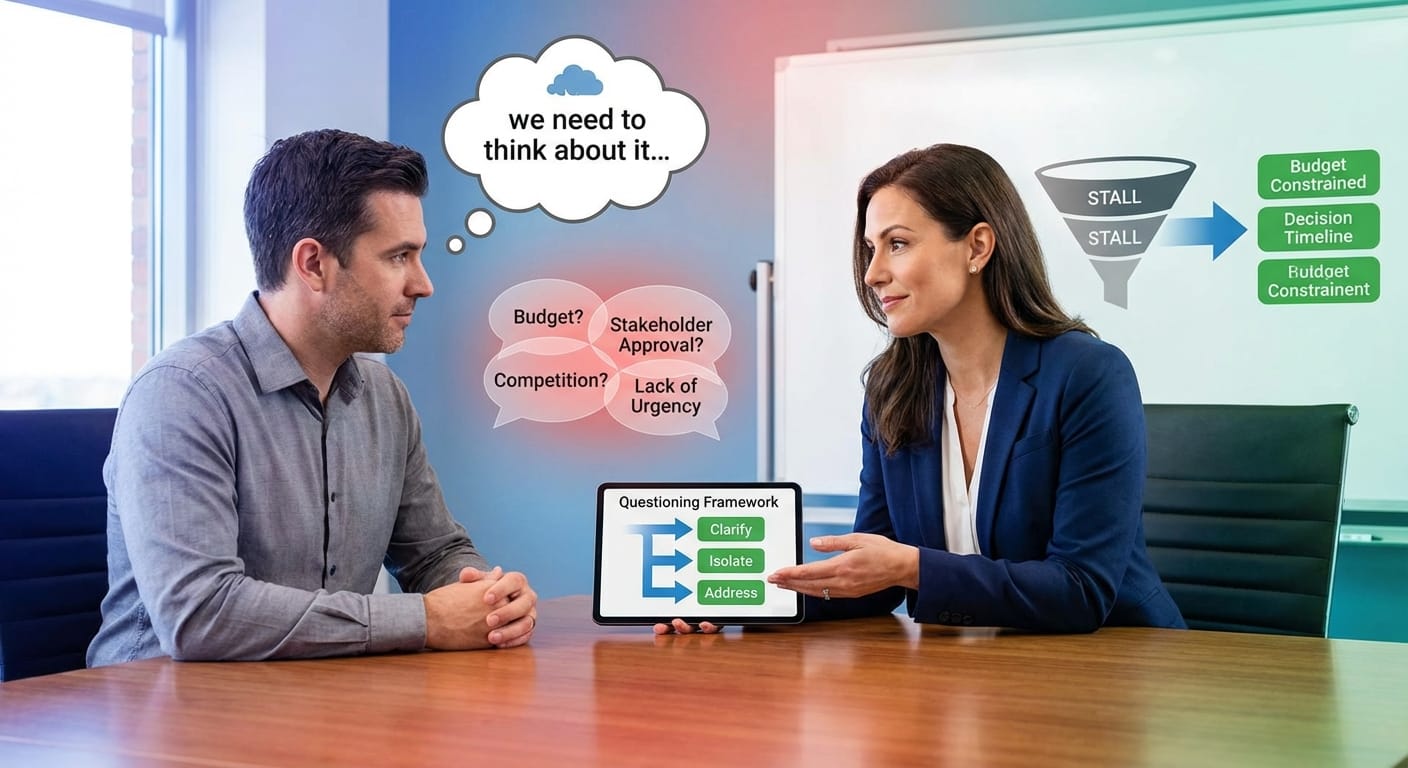
"We need to think about it" is the most common stall in B2B sales - and most reps handle it wrong. Here's how to uncover the real concern, address what's actually stopping the deal, and move forward instead of waiting forever.
"We need to think about it."
Every B2B sales rep has heard this. It sounds reasonable - prospects should think through important decisions. But in reality, "we need to think about it" almost never means they're actually going to think. It means they're politely ending the conversation without committing or revealing their real concerns.
Most reps accept it passively: "Sure, take your time. I'll follow up next week." Then they wait. And wait. And the deal dies quietly in their pipeline while they hope the prospect will magically decide.
"We need to think about it" is rarely about needing time to think. It's about hidden objections, missing stakeholders, lack of urgency, or polite rejection. This guide shows you how to uncover what's really happening and move deals forward.
Why "We Need to Think About It" Kills Deals
It's Not About Thinking: Prospects who genuinely need time specify what they're thinking about: "I need to discuss budget with my CFO" or "I want to review this with my team." Vague "need to think" signals something else.
Real Concerns Stay Hidden: When prospects don't voice real objections, you can't address them. Deals die from concerns you never knew existed.
Deals Lose Momentum: Sales cycles lose urgency when you accept vague delays. What was "top priority" becomes "we'll get back to you eventually."
You Lose Control: Accepting "think about it" puts prospects in control of timeline. You're now waiting for them instead of actively driving the deal.
Competition Fills the Void: While you're patiently waiting, competitors who push harder or address real concerns move ahead.
What "We Need to Think About It" Really Means
Translation 1: "I'm not convinced of the value." The prospect doesn't see enough value to justify investment or change. They need more compelling reasons to move forward.
Translation 2: "I need to get buy-in from others." There are stakeholders you haven't met who need to approve. The prospect isn't sure how to get internal support.
Translation 3: "I have concerns I'm not comfortable voicing." Real objections exist - price, capability doubts, risk concerns - but they don't want direct confrontation.
Translation 4: "This isn't actually a priority." Despite what they said earlier, solving this problem isn't urgent enough to act on now.
Translation 5: "I'm talking to competitors." They're evaluating alternatives and using "think about it" to buy time for other conversations.
Translation 6: "I'm not the decision maker." The real economic buyer or decision authority is someone else they haven't revealed.
Translation 7: "I'm just being polite - I'm not interested." Sometimes it's a soft rejection. They don't want to say no directly.
The Framework: Uncover and Address the Real Issue
Step 1: Don't Accept It - Dig Deeper
When They Say "We Need to Think About It":
Pause and Acknowledge: "I completely understand - this is an important decision that deserves careful thought."
Then Immediately Explore: "Help me understand - when you say 'think about it,' what specifically are you going to be thinking through? Is it budget, timing, fit for your situation, or something else?"
Why This Works: Forces them to articulate actual concerns instead of hiding behind vague stall.
Alternative Phrasing:
- "What questions or concerns do you need to think through?"
- "What would you need to see or know to feel comfortable moving forward?"
- "If you were me, what would you be most concerned about in your situation?"
Step 2: Isolate the Objection
Use the Isolation Technique:
"Let me ask directly - if we could address [budget/timing/specific concern], is this something you'd want to move forward with? Or are there other concerns beyond what you've mentioned?"
What This Reveals:
If They Say "Yes, just that one thing": You've isolated the real objection. Address it directly.
If They Hesitate or Raise Other Issues: The stated concern wasn't the real one. Keep exploring.
Example Exchange: Rep: "You mentioned needing to think about budget. If we could work out pricing that fits your budget, is this the solution you'd want?" Prospect: "Well, I also need to make sure our IT team is comfortable with the integration." Rep: "So it's not just budget - it's also IT approval. Who from IT needs to be involved, and what are their typical concerns?"
Result: Uncovered that IT approval, not budget, is the real issue.
Step 3: Create Collaborative Thinking
Instead of Letting Them Think Alone:
"Rather than you thinking through this alone, what if we think through it together right now? What specific questions or concerns should we address?"
Why This Works: Keeps conversation active and surfaces real objections you can address.
Follow-Up: "Let's talk through the key considerations: [budget, ROI, implementation, stakeholder buy-in]. Which of these needs most attention?"
Example: Rep: "Instead of you thinking through this alone, let's work through the key decisions together. The main considerations are usually: does this solve your problem, does ROI make sense, can you get budget approved, and can you get stakeholder buy-in. Which of those needs most focus?" Prospect: "Honestly, it's getting our VP to prioritize this over other initiatives." Rep: "So it's about internal prioritization and VP buy-in. Tell me more about what the VP cares about and what other initiatives are competing."
Result: Uncovered that VP prioritization, not "thinking," is the real barrier.
Step 4: Address Specific "Think About It" Scenarios
Scenario 1: Budget/Price Concerns
They're Really Thinking: "Can we afford this? Is it worth the investment?"
How to Address:"I understand budget is a consideration. Let's make sure the ROI is clear. Based on [their situation], this delivers [ X value] at [Y investment], paying for itself in [timeframe]. Does that math work, or is there a budget constraint we need to address differently?"
If Budget is Real Constraint: "What budget did you have allocated? Let's see if we can structure this differently - phased approach, different payment terms, adjusted scope - to fit within budget while still delivering value."
Scenario 2: Need Stakeholder Buy-In
They're Really Thinking: "How do I get my boss/team/CFO to approve this?"
How to Address: "It sounds like you need to get others on board. Who else needs to be involved in this decision, and what concerns will they raise? Rather than you selling this alone internally, would it help if I joined those conversations to address questions directly?"
Offer Support: "What would make it easier to get internal buy-in? I can provide [ROI analysis for CFO, technical specs for IT, implementation plan for operations] to help you make the case internally."
Scenario 3: Talking to Competitors
They're Really Thinking: "Let me see what else is out there before deciding."
How to Address: "I appreciate you doing thorough evaluation. Are you actively looking at alternatives, or is this more of a 'make sure we're not missing anything' check? Because that affects how we should think about timing."
If Comparing: "What specific alternatives are you evaluating, and what questions remain? I'd rather address concerns now than have them come up during your comparison."
Scenario 4: Not Actually Interested
They're Really Thinking: "I'm not interested but don't want to say no directly."
How to Address: "Let me ask directly - on a scale of 1-10, how interested are you in moving forward with this? If it's less than 7, I'd rather know honestly so I don't waste your time following up."
If Low Interest: "I appreciate the honesty. What would need to be different - solution, pricing, timing, approach - for this to become a priority? Or should we step back for now?"
Why This Works: Gives them permission to say no honestly, which is better than false hope.
Scenario 5: Lack of Urgency
They're Really Thinking: "This isn't urgent enough to prioritize right now."
How to Address: "I understand this might not be urgent. Help me understand - what would make this become urgent? And what's the cost of waiting another quarter/year to address this?"
Create Urgency: "Every month you wait costs you [quantified impact]. If we moved forward now, you'd see [specific benefit by specific date]. Does that timing matter, or is the delay acceptable?"
Step 5: Set Specific Next Steps
Never End with Vague Follow-Up:
Bad: ❌ "Take your time and let me know when you're ready." ❌ "I'll check back with you next week to see what you're thinking."
Good: ✅ "I'll send over [specific materials addressing concerns] today. Can you review by [day] and let's schedule 20 minutes [specific day/time] to discuss your questions?" ✅ "You mentioned needing to discuss with [stakeholder]. When is that conversation happening, and should I join or provide materials to support it?"
Get Commitment: "Rather than open-ended thinking time, let's set a specific checkpoint. How does [specific date/time] work to discuss where you landed and what questions came up?"
Why This Works: Creates accountability and maintains momentum instead of losing control.
Response Templates for "We Need to Think About It"
Template 1: The Direct Exploration
"I appreciate you want to think through this carefully. Help me understand - what specifically will you be thinking about? Is it budget, timing, whether this solves your problem, or something else? Because I'd rather address concerns now than leave them unresolved."
Template 2: The Collaborative Approach
"Rather than thinking through this separately, what if we work through the key considerations together right now? The main questions are usually: does this solve the problem, does ROI make sense, can we get budget, and can we get stakeholder buy-in. Which needs most attention?"
Template 3: The Isolation Question
"Let me ask directly - if we could address [specific concern], is this something you'd want to move forward with? Or are there other concerns we haven't discussed?"
Template 4: The Timeline Challenge
"I understand wanting time to think. What's a realistic timeline for that thinking, and what will you need from me to help make a decision? Let's schedule [specific date/time] to discuss where you landed."
Template 5: The Honest Assessment
"Let me be direct - on a scale of 1-10, how likely is this to move forward? If it's less than 7, I'd rather know honestly so we can either address what's missing or agree to step back."
Common Mistakes When Handling "Think About It"
Mistake 1: Accepting It Passively ❌ "Sure, take your time. I'll follow up next week." ✅ "Help me understand what specifically you need to think through."
Mistake 2: Pressuring Without Understanding ❌ "There's no time to think - you need to decide now!" ✅ "I understand you need time. What specific concerns should we address?"
Mistake 3: Not Isolating the Objection ❌ Taking stated concern at face value ✅ "If we addressed that, would you move forward, or are there other concerns?"
Mistake 4: No Specific Next Steps ❌ "Let me know when you're ready." ✅ "Let's schedule [specific time] to discuss your questions."
Mistake 5: Giving Up Too Easily ❌ Accepting first "need to think" as final answer ✅ Exploring what's really happening before stepping back
Why Practicing "Think About It" Responses Is Critical
Most reps accept "think about it" because they don't know how to push back without being pushy. Practice develops:
Comfortable Exploration: Asking "what specifically" naturally without sounding aggressive
Objection Isolation: Uncovering real concerns hidden behind vague stalls
Collaborative Tone: Being direct while staying helpful, not confrontational
How Sellible Masters "Think About It" Practice
Realistic Stall Scenarios: AI prospects use "think about it" naturally, forcing you to uncover real concerns
Various Hidden Objections: Practice when "think about it" means budget, stakeholders, competition, or lack of interest
Pressure Balance: Learn to be direct without being pushy - the tone that keeps deals moving
"Think About It" Response Checklist
When You Hear It:
- Don't accept passively - explore immediately
- Ask what specifically they're thinking about
- Isolate the objection: "If we addressed that, would you move forward?"
- Uncover stakeholders, competition, or lack of urgency
- Offer to think through concerns together now
- Set specific next steps with timeline and accountability
Never:
- End with "let me know when you're ready"
- Accept vague delays without understanding why
- Pressure without understanding real concerns
- Give up after first "need to think"
Conclusion
"We need to think about it" is rarely about thinking. It's about hidden objections, missing stakeholders, lack of urgency, or polite rejection. Accepting it passively kills deals.
The frameworks in this guide work when delivered with genuine curiosity and collaborative tone - not aggressive pressure, but direct exploration of what's really happening.
That balance develops through practice. You need to experience "think about it" objections dozens of times to become comfortable pushing back without being pushy.
Sellible provides that practice. Work with AI prospects who use "think about it" naturally, hiding various real concerns, forcing you to develop the skills that keep deals moving.
Ready to master "think about it" responses? Book a demo with the Sellible team and practice with AI prospects who stall realistically.
FAQ
Q: How hard should I push when they say "think about it"? A: Be direct but collaborative. "Help me understand what you're thinking through" is appropriate. Demanding immediate decision is not.
Q: What if they get defensive when I ask what they're thinking about? A: Use softer language: "I want to make sure I've addressed everything. What questions remain?" If still defensive, they're probably not interested.
Q: How long should I give them to "think"? A: Get specific: "What's realistic timeline for thinking through this?" Then schedule specific follow-up, don't leave it open-ended.
Q: What if "think about it" really means they need stakeholder approval? A: Uncover that: "Who else needs to be involved?" Then offer to join those conversations or provide materials to support internal discussions.
Q: When should I accept "think about it" and step back? A: When you've explored thoroughly, they won't reveal real concerns, and interest seems low. Better to qualify out than chase forever.