Discovery Call Playbook for Packaging & Containers Manufacturing (Using Challenger Sale)
Complete Challenger-style discovery playbook for packaging and containers manufacturing. Industry-specific insights, challenging questions, and qualification frameworks for uncovering operational pain.
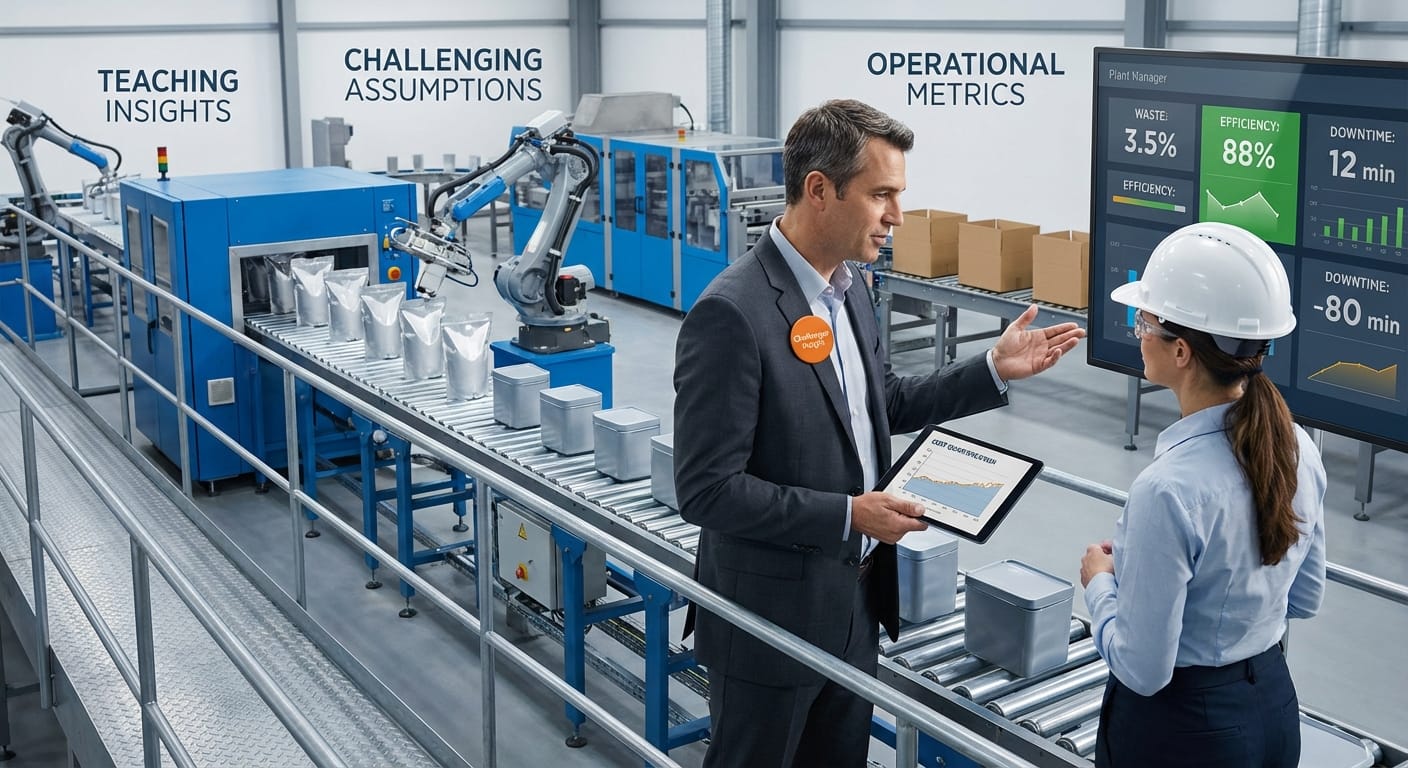
Packaging and containers manufacturing has unique challenges around raw material costs, production efficiency, and sustainability demands. Here's your complete Challenger-style discovery playbook for uncovering pain, teaching insights, and qualifying opportunities in this industry.
Selling to packaging and containers manufacturers requires understanding their specific challenges: volatile raw material pricing, thin margins, sustainability pressure from brands, production efficiency demands, and supply chain complexity.
Generic discovery questions don't work. You need industry-specific questions that demonstrate you understand their world - and Challenger Sale methodology that teaches them something new about their business while uncovering compelling pain.
This playbook gives you the complete framework for running Challenger-style discovery calls with packaging manufacturers, from teaching insights to challenging assumptions to qualification.
Why Challenger Works for Packaging Manufacturing
Commoditized Market: Packaging feels like commodity business. Teaching unique insights differentiates you.
Operational Focus: Manufacturers are operations-focused. Teaching better approaches to efficiency, waste, or costs resonates.
Sustainability Pressure: Brands demand sustainable packaging. Teaching how others navigate this creates urgency.
Margin Pressure: Thin margins mean status quo feels safer than change. Challenging their approach creates momentum.
Conservative Decision-Making: Manufacturing culture resists change. Teaching ROI and challenging assumptions overcomes inertia.
The Challenger Discovery Framework
Phase 1: Lead with Teaching (First 10 Minutes)
Purpose: Share insight that reframes how they think about their challenges.
Teaching Insight Examples:
Insight 1: Hidden Cost of Material Waste "Most packaging manufacturers track material costs closely - resin prices, corrugate costs, aluminum costs. But here's what we're seeing: the bigger cost is actually waste and scrap in production. Companies calculate waste at 3-5%, but when you include trim waste, off-spec product, changeover scrap, and rework, real waste is often 8-12%. That 5-7% gap costs a typical mid-size plant $2-4M annually. Are you tracking total waste or just obvious scrap?"
Why This Works: Challenges their waste measurement and reveals hidden costs.
Insight 2: Sustainability as Competitive Advantage "Most manufacturers view sustainability requirements from brands as cost burden - switching to recycled content, lightweighting, reducing plastic. But early movers are discovering it's actually competitive advantage. Brands will pay premium for sustainable packaging that helps them hit ESG goals, and they're consolidating to fewer suppliers who can deliver it. The question isn't if you'll need sustainable solutions, it's whether you'll be positioned as premium supplier or late-to-market commodity player. Where are you in that transition?"
Why This Works: Reframes sustainability from cost to opportunity.
Insight 3: Production Efficiency vs. Equipment Utilization "Here's a pattern we see in packaging plants: manufacturers focus heavily on equipment utilization - keeping machines running. But high utilization doesn't always mean high efficiency. Running machines at 85% utilization with 15% waste is worse than 75% utilization with 5% waste. The metric that matters is saleable output per hour, not machine runtime. Are you optimizing for utilization or actual productivity?"
Why This Works: Challenges their key operational metric.
Insight 4: Supply Chain Vulnerability "Most packaging manufacturers diversified suppliers after pandemic shortages. But diversification creates hidden costs: managing multiple supplier relationships, inconsistent material quality affecting production, inventory carrying costs for safety stock. Companies calculate 15-20% cost premium from over-diversification. The companies winning are those who optimized to 2-3 strategic suppliers rather than 6-8 tactical ones. How many suppliers are you managing across key materials?"
Why This Works: Reveals cost of their risk mitigation strategy.
Phase 2: Tailor to Their Situation (5 Minutes)
Purpose: Customize teaching to their specific packaging segment and challenges.
Segment-Specific Tailoring:
Flexible Packaging: "In flexible packaging specifically, the challenge we see is film waste during changeovers. Multi-layer co-extrusion lines can waste 500-1000 pounds per changeover. With 8-12 changeovers daily, that's $15-25K monthly in scrap. Companies reducing changeover waste by 40% through [approach] see immediate margin improvement."
Rigid Plastics: "For injection molding and blow molding operations, the hidden cost is typically cycle time variation. A molding line running 10-second cycles with 2-second variation produces 15% less than one with consistent 10-second cycles. That variability costs 3,000-5,000 units daily on a single line."
Corrugated/Paperboard: "In corrugate converting, the margin killer is usually setup and waste on shorter runs. As brands demand smaller quantities and more SKUs, your average run size drops while setup time stays constant. Plants built for 50,000-piece runs struggle with 5,000-piece runs unless they fundamentally change setup processes."
Metal Containers: "For can manufacturing, coating and curing efficiency drives profitability. We're seeing plants reduce energy costs 20-30% through oven optimization while improving coating consistency. That's $200-400K annually for a typical can plant."
Example Tailored Opening: Rep: "Before diving into your situation, let me share what we're seeing across flexible packaging manufacturers. The biggest margin impact right now isn't material costs - it's changeover waste on multi-layer films. Plants averaging 800 pounds of scrap per changeover with 10 changeovers daily are burning $180K monthly. The companies cutting that waste 40% are seeing immediate margin improvement without capital investment. Does that changeover waste resonate with your operation?"
Phase 3: Discovery Questions That Challenge (15 Minutes)
Purpose: Uncover pain while challenging their assumptions about causes and solutions.
Material Cost Discovery:
Standard Question: "What are your biggest cost pressures right now?"
Challenger Question: "Most manufacturers say material costs are their biggest pressure. But when we look at total cost, it's often inefficiency, waste, and downtime that exceed material cost volatility. If you could eliminate all material price fluctuation tomorrow, would that solve your margin challenges, or are there bigger operational costs eating margin?"
Why This Works: Challenges assumption that material costs are the real problem.
Production Efficiency Discovery:
Standard Question: "What's your overall equipment effectiveness?"
Challenger Question: "You're probably tracking OEE around 70-80% which feels acceptable. But here's what we're finding: that 20-30% downtime gap costs more than most manufacturers realize because it's happening at peak demand when customers need capacity. A line down for 3 hours during slow period costs production tonnage. Same line down during peak season costs customer orders and forces overtime. Are you calculating downtime cost by timing, or do you treat all downtime equally?"
Why This Works: Challenges how they measure downtime impact.
Quality and Waste Discovery:
Standard Question: "What's your scrap rate?"
Challenger Question: "Most plants report 3-5% scrap rate measuring only obvious waste. But when you include trim waste that gets reground, off-spec product, startup waste on changeovers, and rework, real material waste is often double reported numbers. One flexible packaging plant thought they had 4% waste - detailed analysis showed 9% total material loss. If your reported scrap is 4%, what's your actual total material waste including all sources?"
Why This Works: Challenges their waste measurement accuracy.
Sustainability Discovery:
Standard Question: "Are your customers asking for sustainable packaging?"
Challenger Question: "Every manufacturer says customers want sustainability. But here's the interesting pattern: brands will pay 8-15% premium for packaging that helps them hit ESG commitments - but only if you can prove sustainability claims with data and certifications. Most manufacturers can't quantify or verify their sustainability story. Are you positioned as premium sustainable supplier with proof, or hoping brands will believe general claims?"
Why This Works: Challenges whether they can capitalize on sustainability demand.
Supply Chain Discovery:
Standard Question: "How's your supply chain performing?"
Challenger Question: "Most manufacturers added suppliers during shortages for resilience. But more suppliers means more complexity, quality inconsistency, and carrying costs. We're seeing plants with 6-8 suppliers spending 20% more in total costs than plants with 2-3 strategic suppliers who get volume commitments and better pricing. Are you optimized for resilience or total cost, and is that the right balance?"
Why This Works: Challenges their supplier strategy.
Customer Demand Discovery:
Standard Question: "How are your volumes trending?"
Challenger Question: "Volume is one metric, but what's happening to your mix? Most packaging manufacturers are seeing volumes stay flat but SKU count double as brands want smaller runs and more customization. That shift from high-volume/low-SKU to lower-volume/high-SKU destroys efficiency in plants designed for long runs. Is your mix changing, and is your operation built for that shift?"
Why This Works: Challenges whether their operation matches demand evolution.
Phase 4: Quantify Pain and Impact (10 Minutes)
Purpose: Get specific numbers that justify change.
Quantification Questions:
Waste and Scrap:
- "How many pounds of scrap do you generate monthly across all lines?"
- "At current material costs, what does that scrap represent in dollars?"
- "What percentage of total material purchased becomes scrap?"
- "If you could reduce scrap 30%, what would that save annually?"
Downtime and Efficiency:
- "How many hours of unplanned downtime do you experience monthly?"
- "What does one hour of downtime cost in lost production and labor?"
- "What percentage of planned production do you actually achieve?"
- "If you could add 5% capacity without new equipment, what would that be worth?"
Energy and Utilities:
- "What are your monthly energy costs across production?"
- "What percentage of energy cost is heating/cooling vs. running equipment?"
- "Have you benchmarked energy efficiency against similar plants?"
Labor and Productivity:
- "How many operators run your packaging lines?"
- "What's your labor cost as percentage of revenue?"
- "Where do you see operators spending time that doesn't add value?"
Quality and Customer Issues:
- "How many customer quality complaints or rejections monthly?"
- "What does a rejected shipment cost including material, labor, and customer relationship?"
- "How much product is reworked or downgraded vs. sold at full value?"
Example Quantification Exchange: Rep: "You mentioned changeover waste is a problem. How many changeovers do you run daily?" Prospect: "Probably 8-10 on our main film line." Rep: "What's typical scrap per changeover?" Prospect: "Maybe 600-800 pounds." Rep: "At $1.50 per pound for your film, that's $1,000 per changeover, or $8-10K daily in scrap just on that one line. Call it $200K monthly. If you could cut that waste 40%, you'd save $80K monthly or nearly $1M annually just from changeover improvement. Does that math sound right?"
Result: Quantified $1M annual opportunity from one specific improvement area.
Phase 5: Challenge Status Quo (5 Minutes)
Purpose: Create productive tension between current state and better future.
Challenging Techniques:
Challenge Their Timeline: Prospect: "We're planning to address this next year." Rep: "Let me challenge that timeline. You're losing $80K monthly in changeover waste. Waiting 12 months costs you nearly $1M. What needs to happen between now and next year that's worth $1M to delay addressing this?"
Challenge Their Investment Thinking: Prospect: "We can't invest in new equipment right now." Rep: "I'm going to push back on that - because the companies solving this aren't buying new equipment. They're optimizing existing lines through process changes, operator training, and better changeover procedures. That approach costs $50-100K but saves $800K-$1M annually. Is the concern capital investment, or have you assumed equipment is the only solution?"
Challenge Their Priorities: Prospect: "We have other priorities right now." Rep: "Fair enough - I'm curious what priorities generate better ROI than $1M annually? Because I want to make sure we're comparing this to actual alternatives, not just feeling like you have competing priorities."
Challenge Their Risk Assessment: Prospect: "We've tried to improve this before and it didn't work." Rep: "That's exactly why companies are struggling - they've tried traditional approaches that don't work. Let me challenge the assumption that past failures predict future results. What specifically failed before, and was the approach fundamentally different than what I'm describing?"
Packaging Manufacturing Discovery Checklist
Before Calls:
- Research their packaging segment (flexible, rigid, corrugated, metal)
- Prepare 1-2 industry-specific teaching insights
- Know typical cost structures and challenges for their segment
- Have quantification questions ready for waste, downtime, efficiency
During Discovery:
- Lead with teaching insight relevant to their segment
- Challenge their assumptions about costs, efficiency, priorities
- Quantify impact in dollars (waste costs, downtime costs, lost capacity)
- Create tension between current state and better future
- Maintain collaborative but challenging tone
Qualification Criteria:
- Quantified operational pain (waste, downtime, efficiency losses)
- Pain felt by economic buyer (plant manager, operations VP, owner)
- Urgency exists (margin pressure, customer demands, competitive threat)
- Authority identified (who approves operational improvements)
- Openness to challenging status quo
Common Packaging Manufacturing Objections
"Our margins are too thin for any investment" Challenge: "That's exactly the problem - thin margins mean you can't afford NOT to address waste and inefficiency. Plants with 3% margins that reduce waste 40% improve margins 50% without touching pricing or volume. Are thin margins the reason to avoid improvement or the reason it's urgent?"
"We're too busy to implement changes" Challenge: "Being too busy is usually symptom of inefficiency, not excuse to avoid fixing it. The plants that say 'too busy' stay busy. The ones that address root causes get less busy. Would you rather stay perpetually busy or fix what's making you busy?"
"Our customers won't pay for improvements" Challenge: "Let me challenge that - if improvements reduce your costs, you don't need customer price increases to see benefit. And if improvements enable sustainability or faster changeovers, customers will pay premium. Are you certain customers won't pay, or have you not positioned improvements as value they care about?"
Why Practicing Challenger Discovery Is Critical
Challenger-style discovery requires skills that feel unnatural:
Teaching Confidently: Leading with insights about their industry without sounding arrogant
Challenging Assumptions: Pushing back on their thinking while staying collaborative
Creating Tension: Making them uncomfortable with status quo without being aggressive
How Sellible Masters Packaging Challenger Practice
Industry Scenarios: Practice with AI packaging manufacturers who respond like real operations leaders
Challenge Resistance: Work with AI that defends status quo, forcing you to maintain Challenger stance
Teaching Practice: Deliver industry insights conversationally until it feels natural
Tone Calibration: Build the balance between challenging and collaborative through feedback
Conclusion
Packaging and containers manufacturing discovery requires industry knowledge combined with Challenger methodology. Teaching insights about waste, efficiency, and sustainability while challenging their assumptions positions you as expert advisor.
These frameworks work when delivered with collaborative confidence that develops through practice. You need realistic scenarios with manufacturing prospects who challenge back.
Sellible provides that practice. Work with AI packaging manufacturers who respond like real operations leaders, building Challenger skills that win manufacturing deals.
Ready to master packaging manufacturing discovery? Book a demo with the Sellible team and practice with AI prospects from the packaging industry.
FAQ
Q: Do I need deep packaging manufacturing knowledge? A: Know basics of their segment (flexible vs rigid vs corrugated), typical challenges (waste, efficiency, sustainability), and cost structures. Deeper knowledge builds credibility.
Q: How technical should discovery questions be? A: Balance operational understanding with business impact. Ask about waste rates and efficiency, but always connect to cost and margin impact.
Q: What if they're defensive about their operations? A: Challenge assumptions, not their competence. Frame as "here's what we're seeing across industry" not "you're doing this wrong."
Q: How do I create urgency in conservative manufacturing culture? A: Quantify cost of delay (monthly waste, lost capacity). Show competitive risk (others moving faster on sustainability, efficiency).
Q: When should I introduce my solution? A: After teaching, challenging, and quantifying pain. Once they see gap between current and possible, they'll ask how to close it.