Discovery Call Playbook for Financial Services
Complete financial services discovery playbook with regulatory-aware questions, compliance-focused frameworks, and stakeholder mapping for banking, insurance, and investment firms.
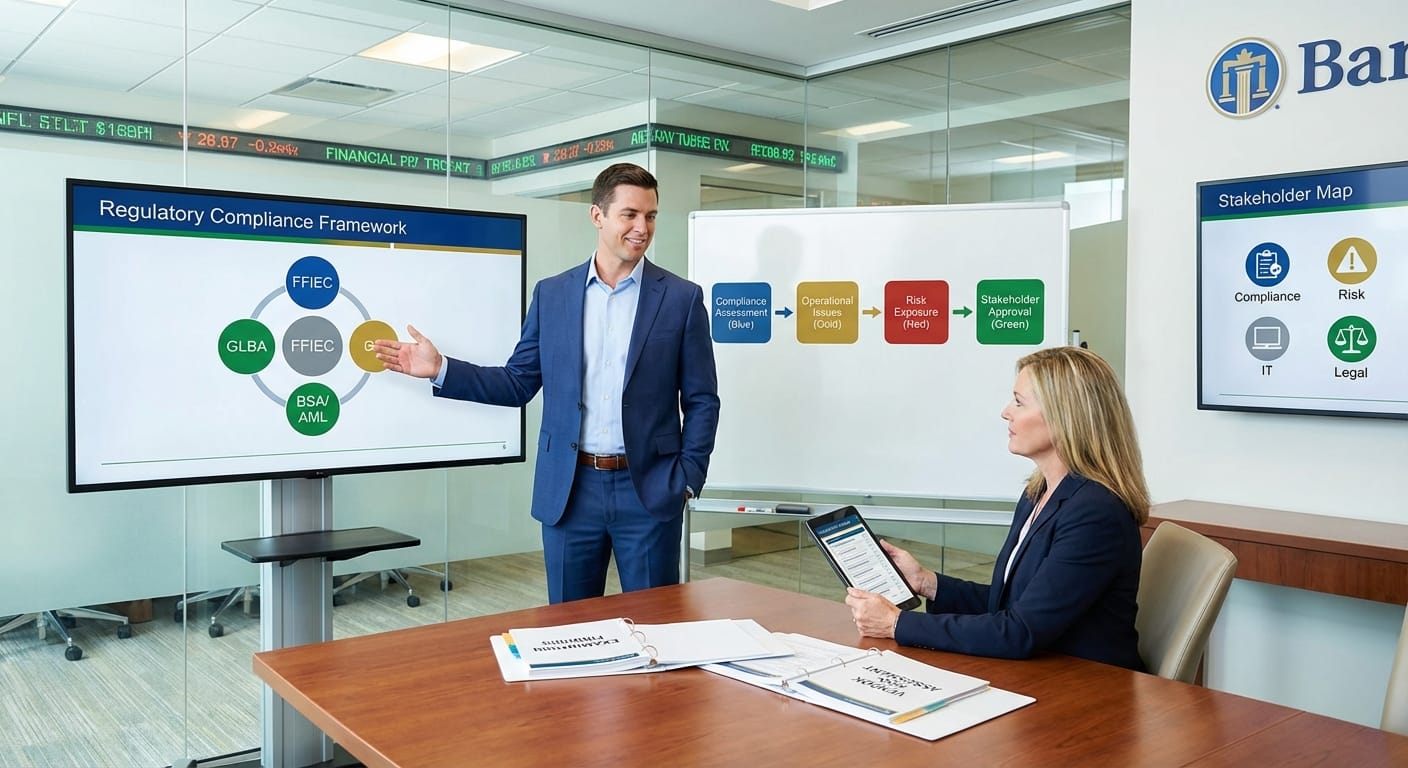
Financial services discovery requires navigating regulatory concerns, fiduciary responsibilities, and risk-averse decision-making. Here's your complete playbook for running discovery calls that uncover compliance pain, assess risk tolerance, and qualify effectively in banking, insurance, and investment firms.
Financial services discovery is different. Your prospects aren't just evaluating solutions - they're assessing regulatory compliance impact, fiduciary risk, examination readiness, and whether your solution creates new compliance burdens or solves them.
Generic discovery frameworks miss the financial services-specific concerns that determine deal success: regulatory examination findings, compliance officer approval requirements, vendor risk assessment processes, and the conservative decision-making culture that dominates banking and insurance.
This playbook gives you the complete framework for financial services discovery that uncovers compelling compliance pain, navigates regulatory complexity, and qualifies deals effectively in this highly regulated environment.
Why Financial Services Discovery Is Different
Regulatory Compliance Focus: Every decision involves regulatory implications. Prospects evaluate solutions through lens of OCC, FDIC, SEC, state regulators, and examination readiness.
Risk-Averse Culture: Financial institutions are inherently conservative. Change must demonstrate clear risk mitigation, not just operational improvement.
Fiduciary Responsibility: Decision-makers have legal obligations to act in institution's and clients' best interests, creating heightened scrutiny of vendor relationships.
Examination-Driven Urgency: Regulatory examination findings create urgent need to address deficiencies before next exam cycle.
Vendor Risk Management: Extensive vendor due diligence processes mean longer sales cycles and more stakeholders than other industries.
The 6-Phase Financial Services Discovery Framework
Phase 1: Set the Stage (5 minutes)
Purpose: Establish credibility and compliance awareness from the start.
Opening Template: "Thanks for your time. I'd like to understand your current approach to [relevant area], any regulatory or compliance considerations, and what you're trying to achieve. Then we can determine if there's a fit and what makes sense. I work specifically with [banks/credit unions/insurance firms], so I understand the regulatory environment you operate in. Sound good?"
Why This Works: Immediately signals you understand their regulatory world, not generic sales approach.
Set Compliance Context: "Before we dive in - are there any specific regulatory requirements or examination findings driving this conversation, or is this more proactive evaluation?"
Confirm Stakeholders: "Beyond yourself, who typically needs to be involved from compliance, risk, IT security, and legal perspectives?"
Phase 2: Understand Regulatory and Compliance Context (10 minutes)
Purpose: Map regulatory environment and compliance obligations before exploring operational issues.
Regulatory Framework Questions:
Primary Regulators:
- "Who are your primary regulators - OCC, FDIC, state banking, SEC, state insurance?"
- "When was your last examination and what areas did they focus on?"
- "Are there any open examination findings related to [relevant area]?"
- "What compliance frameworks do you follow - FFIEC, GLBA, BSA/AML, others?"
Compliance Priorities:
- "What are your top compliance priorities this year?"
- "What keeps your compliance officer up at night?"
- "Are there any upcoming regulatory changes affecting [area]?"
- "What vendor risk management requirements do you have?"
Current Compliance Approach:
- "How do you currently handle [compliance requirement]?"
- "What systems or processes support compliance in this area?"
- "How do you demonstrate compliance during examinations?"
- "Where do examiners typically probe or question your approach?"
Why This Matters: Understanding regulatory context reveals compliance-driven pain that creates urgency generic operational issues don't.
Example Exchange: Rep: "When was your last FDIC examination?" Prospect: "Six months ago." Rep: "Did they raise any concerns about [relevant area]?" Prospect: "Actually yes - they flagged our vendor risk management process as needing improvement. That's driving this evaluation." Rep: "What specifically needs to improve, and what's your timeline before the next exam?"
Result: Uncovered examination finding creating urgent compliance need.
Phase 3: Uncover Operational and Risk Problems (15 minutes)
Purpose: Identify operational inefficiencies, risk exposures, and business impact within regulatory context.
Operational Problem Questions:
Process Inefficiencies:
- "Walk me through your current process for [function]?"
- "Where are the bottlenecks or manual workarounds?"
- "How much staff time goes into [process] weekly?"
- "What breaks down or creates errors?"
Risk Exposure Questions:
- "Where do you see risk exposure in your current approach?"
- "What would happen if regulators audited [process] today?"
- "What keeps you from being fully confident in [compliance area]?"
- "Where could compliance failures occur?"
Business Impact Questions:
- "How does [operational inefficiency] affect member/customer service?"
- "What does [manual process] cost in staff time and resources?"
- "How does this impact your ability to [strategic objective]?"
- "What competitive disadvantages does this create?"
Examination Readiness:
- "How prepared are you for examination questions about [area]?"
- "What documentation or evidence do you have to demonstrate compliance?"
- "Where would examiners find gaps or deficiencies?"
- "How quickly could you respond to examiner information requests?"
Quantification Questions:
- "How many hours weekly does your team spend on [manual compliance work]?"
- "What's the cost of your current approach - staff time, external resources, opportunity cost?"
- "What would a compliance failure or enforcement action cost?"
- "How much are you spending on [current solution/approach]?"
The Financial Services "So What?" Technique: When prospects describe operational problems, always connect to regulatory impact: "How does that affect examination readiness?" or "What compliance risk does that create?"
Example Exchange: Prospect: "Our vendor risk management process is completely manual - spreadsheets and emails." Rep: "How does that manual approach affect examination readiness?" Prospect: "Last exam, we couldn't quickly provide documentation they requested. It took us three days to compile everything." Rep: "What was examiners' reaction to that delay?" Prospect: "They noted it as a process deficiency. We need to fix it before next exam." Rep: "When's your next examination cycle?" Prospect: "In 8 months. If we don't have this solved, it'll be a bigger finding."
Result: Moved from "manual process" to "examination finding with 8-month deadline."
Phase 4: Map Decision Process and Stakeholders (10 minutes)
Purpose: Understand financial services-specific approval requirements and risk assessment process.
Stakeholder Mapping:
Compliance Stakeholders:
- "Who from compliance needs to approve this?"
- "What's your Chief Compliance Officer's role in vendor decisions?"
- "Does your compliance committee review vendor relationships?"
Risk Management:
- "Who handles vendor risk assessment?"
- "What's your vendor risk management process for new providers?"
- "How long does vendor due diligence typically take?"
IT and Security:
- "Who from IT security needs to review this?"
- "What security assessments or audits will you require?"
- "Do you need SOC 2, penetration testing, or other security validations?"
Legal and Contracts:
- "Who reviews vendor contracts and agreements?"
- "What contract terms are non-negotiable from legal perspective?"
- "How long does legal review typically take?"
Executive Approval:
- "What level of executive approval is required?"
- "Does board or board committee need to approve vendor relationships?"
Decision Process Understanding:
Typical Timeline:
- "Walk me through your complete vendor evaluation and approval process?"
- "What are the stages from initial evaluation to contract signing?"
- "What typically slows down or extends the process?"
- "What's realistic timeline for decision and implementation?"
Evaluation Criteria:
- "How do you evaluate vendor solutions - what criteria matter most?"
- "How do you assess regulatory compliance of vendor solutions?"
- "What differentiates acceptable from unacceptable vendors?"
- "What past vendor relationships have gone well or poorly, and why?"
Budget and Approval:
- "Is budget allocated for this, or does it need to be secured?"
- "What's your budget approval process and timeline?"
- "Are there fiscal year or budget cycle considerations?"
Why This Matters: Financial services vendor approval processes are extensive. Understanding full process prevents surprises and stalled deals.
Phase 5: Assess Strategic Priorities and Urgency (5 minutes)
Purpose: Connect tactical needs to strategic institution priorities.
Strategic Context Questions:
Institution Priorities:
- "What are your institution's top strategic priorities this year?"
- "How does [this initiative] support those priorities?"
- "Where does this rank versus other technology/compliance investments?"
Competitive Positioning:
- "How do you compete in your market?"
- "What competitive advantages or disadvantages do you have?"
- "How does [current limitation] affect competitive position?"
Growth and Expansion:
- "What are your growth plans - new products, markets, acquisitions?"
- "How does current [limitation] affect growth capability?"
- "What needs to change to support growth objectives?"
Urgency Drivers:
- "What's making this evaluation urgent now versus six months ago?"
- "Is there a specific deadline or event driving timeline?"
- "What happens if this doesn't get addressed this year?"
- "Are examination findings or regulatory changes creating urgency?"
Example Exchange: Rep: "What made you reach out now versus addressing this earlier?" Prospect: "We're planning to expand into new states next year. Our current compliance approach won't scale to multi-state operations. We need this solved before expansion." Rep: "What's your expansion timeline?" Prospect: "Q2 launch. We need new compliance infrastructure in place by Q1."
Result: Clear urgency tied to strategic growth initiative with specific deadline.
Phase 6: Provide Industry Insights and Next Steps (5 minutes)
Purpose: Demonstrate financial services expertise and establish clear path forward.
Summary with Industry Context:
"Based on what you've shared:
- Your current [process] creates compliance risk around [specific area]
- Last examination flagged [finding], creating urgency for next cycle in [timeframe]
- This affects [quantified impact] in staff time and compliance risk
- Decision involves [compliance, risk, IT, legal] with [vendor assessment process]
- Timeline is driven by [examination, strategic initiative, regulatory change]
Here's what we typically see with [banks/credit unions/insurance firms] in similar situations: [relevant regulatory insight or industry pattern].
Does that capture your situation accurately?"
Why This Works: Shows you understood regulatory complexity while demonstrating industry expertise.
Determine Next Steps:
If Strong Regulatory Fit: "Based on examination finding and timeline, this seems like strong fit. Next step would be [compliance review meeting, vendor risk assessment, technical validation]. I can provide [SOC 2 reports, security documentation, regulatory compliance materials] to support your vendor due diligence. How does [specific next step] work?"
If Need Compliance Validation: "I want to make sure we can actually address your compliance requirements before going further. Would it make sense to have [compliance-focused discussion, regulatory documentation review] to validate we meet your needs?"
Critical for Financial Services: Schedule next meeting AND confirm who else needs to be involved: "Should we include your compliance officer in that conversation, or handle this in stages?"
Financial Services Discovery Question Frameworks
Framework 1: Regulatory Risk Chain
Identify Regulatory Requirement: "What compliance requirements apply to [area]?"
Assess Current Approach: "How do you currently meet those requirements?"
Uncover Gaps: "Where are the vulnerabilities or gaps in current approach?"
Quantify Risk: "What would compliance failure or examination finding cost?"
Example: Requirement: "BSA/AML transaction monitoring requirements" Approach: "Manual review of flagged transactions" Gap: "Can't document we reviewed 100% of alerts within required timeframe" Risk: "Examination finding could lead to consent order and reputation damage"
Framework 2: Examination Findings Exploration
Last Examination: "What areas did examiners focus on in last exam?"
Findings and Deficiencies: "Were there any findings, MRAs, or areas for improvement?"
Remediation Status: "What have you done to address findings?"
Next Examination: "What will examiners look at next time, and are you ready?"
Example: Focus: "IT security and vendor management" Findings: "Inadequate vendor risk assessment documentation" Remediation: "Started improving process but not complete" Readiness: "Next exam in 6 months - need solution in place"
Framework 3: Fiduciary Responsibility Assessment
Member/Customer Impact: "How does [current limitation] affect members/customers?"
Duty of Care: "What's your fiduciary responsibility related to this?"
Risk to Institution: "What risk does current approach pose to the institution?"
Board/Executive Concern: "What would board say about current risk exposure?"
Example: Impact: "Members experience delays in loan approvals" Duty: "We have responsibility to serve members efficiently and fairly" Risk: "Inefficient process could disadvantage certain member segments" Concern: "Board has asked about operational efficiency and member satisfaction"
Framework 4: Vendor Risk Due Diligence
Vendor Risk Process: "Walk me through your vendor risk assessment process?"
Required Documentation: "What security, compliance, and financial documentation do you require?"
Assessment Timeline: "How long does vendor due diligence typically take?"
Approval Requirements: "Who needs to approve vendor relationships and what concerns do they raise?"
Example: Process: "Compliance reviews regulatory fit, IT reviews security, legal reviews contracts" Documentation: "SOC 2 Type II, financial statements, security assessments, reference checks" Timeline: "4-6 weeks for vendor risk assessment alone" Approval: "Vendor risk committee, then executive approval for contracts over $50K"
Common Financial Services Discovery Mistakes
Mistake 1: Ignoring Regulatory Context ❌ Jumping to operational benefits without understanding compliance drivers ✅ Start with regulatory environment before exploring operational issues
Mistake 2: Underestimating Approval Complexity ❌ Assuming quick decisions like other industries ✅ Map complete stakeholder process including compliance, risk, IT, legal, executive
Mistake 3: Missing Examination Urgency ❌ Treating evaluation as routine vendor comparison ✅ Uncover examination findings creating urgent compliance deadlines
Mistake 4: Generic Value Proposition ❌ Talking about "efficiency" and "productivity" ✅ Frame value in compliance risk mitigation and examination readiness
Mistake 5: No Compliance Credibility ❌ Speaking generically about financial services ✅ Reference specific regulations (FFIEC, GLBA, BSA/AML) and examination processes
Why Practicing Financial Services Discovery Is Critical
Financial services discovery requires regulatory knowledge, compliance awareness, and understanding of conservative decision-making that only develops through practice.
The Financial Services Practice Challenge
Regulatory Fluency: Discussing OCC, FDIC, SEC, state regulators, and compliance frameworks confidently without sounding generic.
Risk-Aware Questioning: Framing questions around compliance risk and examination readiness, not just operational efficiency.
Conservative Stakeholder Navigation: Understanding the extensive approval processes and risk-averse culture that governs decisions.
What Practice Develops
Compliance Credibility: Natural use of regulatory terminology and examination awareness that builds immediate credibility.
Risk-Based Discovery: Automatic connection of operational issues to compliance risk and examination exposure.
Stakeholder Complexity Management: Comfort navigating multi-stakeholder processes involving compliance, risk, IT, and legal.
How Sellible Masters Financial Services Discovery Practice
Regulatory-Aware AI Prospects: Practice with AI that raises compliance concerns, mentions examination findings, and speaks about regulatory requirements like real financial services buyers.
Conservative Decision-Maker Scenarios: Work with AI prospects who exhibit risk-averse decision-making and require extensive due diligence typical of banking and insurance.
Multi-Stakeholder Complexity: Practice discovery involving compliance officers, risk managers, and IT security - each with different regulatory concerns.
Industry-Specific Terminology: AI uses appropriate regulatory language (FFIEC, GLBA, BSA/AML, vendor risk management) preparing you for real conversations.
Financial Services Discovery Checklist
Before Discovery Calls:
- Research institution type and primary regulators
- Understand relevant compliance requirements (BSA/AML, GLBA, etc.)
- Prepare regulatory-aware questions
- Know recent examination trends in their segment
- Have compliance documentation ready (SOC 2, security, etc.)
During Discovery Calls:
- Establish regulatory credibility early
- Understand examination history and findings
- Map compliance, risk, IT, and legal stakeholders
- Quantify compliance risk and operational impact
- Connect issues to strategic priorities
- Set expectations for vendor due diligence process
After Discovery Calls:
- Document examination findings and urgency
- Note all stakeholders and approval requirements
- Identify regulatory gaps in understanding
- Assess realistic timeline given approval complexity
- Prepare compliance materials for vendor assessment
Discovery Call Checklist Using Sellible
Before Calls:
- Make sure your calendar is connected to Sellible
- Sellible will automatically research the prospect and give you a clear meeting focus and agenda
- Review the information on Sellible
- Run a short discovery simulation with the prospect's AI clone on Sellible
During Calls:
- Establish regulatory credibility early
- Understand examination history and findings
- Map compliance, risk, IT, and legal stakeholders
- Quantify compliance risk and operational impact
- Connect issues to strategic priorities
- Set expectations for vendor due diligence process
After Calls:
- Paste the transcript in Sellible
- Review the discovery effectiveness and next steps
- Plan next steps based on findings
Conclusion
Financial services discovery determines whether deals navigate successfully through complex approval processes or stall in compliance review. Effective discovery uncovers examination-driven urgency, maps stakeholder complexity, and demonstrates regulatory credibility from the first conversation.
These frameworks work when delivered with genuine understanding of regulatory environment and fiduciary responsibilities. That understanding develops through practice until regulatory awareness becomes natural and compliance-focused questioning becomes instinct.
Traditional role play can't replicate the regulatory complexity and conservative decision-making of real financial services buyers. You need practice with AI prospects who raise examination concerns, require vendor due diligence, and exhibit the risk-averse culture of banking and insurance.
Sellible provides that practice. Work with AI prospects who speak about compliance requirements, mention examination findings, and respond like actual financial services decision-makers navigating regulatory obligations.
Ready to master financial services discovery? Book a demo with the Sellible team and practice with AI prospects who respond like real banking and insurance buyers.
Frequently Asked Questions
Q: How much regulatory knowledge do I need for financial services sales? A: Know basic frameworks (FFIEC, GLBA, BSA/AML, vendor risk management) and examination processes. You don't need compliance expertise, but must demonstrate awareness of regulatory environment.
Q: How long do financial services sales cycles typically take? A: 6-18 months for significant vendor relationships. Vendor risk assessment alone takes 4-8 weeks, plus compliance review, legal, IT security, and executive approval.
Q: Should I start with compliance or operational benefits in discovery? A: Start with regulatory context, then explore operational issues. Financial services buyers evaluate everything through compliance lens first.
Q: What if I don't know specific regulations they mention? A: Ask them to explain: "Help me understand how [regulation] affects your approach to [area]." Shows genuine interest and they'll appreciate explaining their regulatory world.
Q: How do I create urgency in risk-averse cultures? A: Connect to examination findings with deadlines, regulatory changes with effective dates, or strategic initiatives with timelines. Internal urgency exists - uncover it rather than create it.