Discovery Call Playbook for B2B Sales
Complete B2B discovery call playbook with 6-phase framework, powerful question templates, and proven techniques for uncovering quantified pain and qualifying effectively.
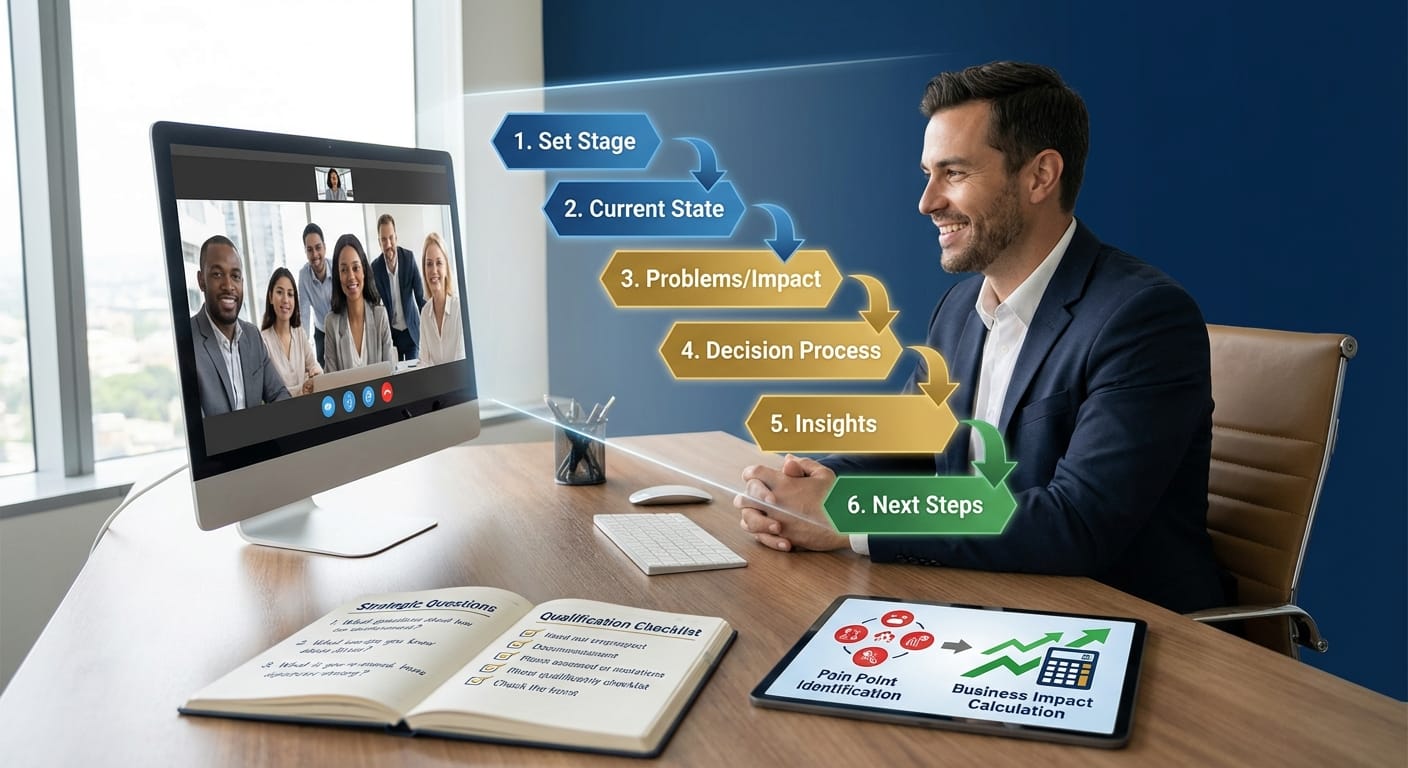
Discovery calls determine whether deals close or stall. Here's your complete playbook for running discovery that uncovers real pain, qualifies effectively, and sets up winning proposals - plus how to practice until discovery becomes your strongest skill.
Most B2B deals are won or lost during discovery. Not during demos, not during negotiation - during the discovery call where you either uncover compelling reasons to buy or fail to find anything worth solving.
Yet most reps treat discovery as a checkbox exercise, running through generic questions without uncovering real pain or business impact. They finish discovery with surface-level understanding and wonder why deals stall.
Effective discovery requires structured frameworks and deep questioning skills. Here's the complete playbook for discovery calls that consistently uncover compelling pain and set up winning deals.
The 6-Phase Discovery Framework
Phase 1: Set the Stage (5 minutes)
Purpose: Create collaborative environment and set expectations.
Opening Template: "Thanks for your time. I'd like to understand your current situation around [area], the challenges you're facing, and what you're trying to achieve. Then we can determine if there's a fit and what makes sense as next steps. Sound good?"
Set Expectations:
- Confirm time available: "I've blocked 45 minutes - does that still work?"
- Establish agenda: "My goal is to understand [areas]. What's most important for you to get from this conversation?"
Why This Works: Sets collaborative tone and positions discovery as exploration, not interrogation.
Phase 2: Understand Current State (10 minutes)
Purpose: Map existing situation before identifying problems.
Key Questions:
Process Understanding:
- "Walk me through how you currently handle [process]?"
- "What tools or systems do you use?"
- "Who's involved and what are their roles?"
Performance Baseline:
- "How do you measure success today?"
- "What results are you seeing with [metrics]?"
- "How does that compare to your targets?"
Context:
- "What led you to reach out now?"
- "Has something changed recently?"
- "What have you tried in the past?"
Why This Matters: Understanding current state establishes baseline and reveals gaps.
Phase 3: Uncover Problems and Impact (15 minutes)
Purpose: Identify problems, quantify business impact, understand urgency.
Problem Identification:
- "What's not working as well as you'd like?"
- "Where are bottlenecks or inefficiencies?"
- "What frustrations do you or your team have?"
Impact Quantification:
- "How does [problem] affect business results?"
- "What does [problem] cost in time/money/opportunity?"
- "Can you put a number on what this costs you?"
Urgency Assessment:
- "How urgent is solving this versus other priorities?"
- "What's driving the timeline?"
- "What happens if this doesn't get solved?"
The "So What?" Technique: Always follow problem descriptions with "What impact does that have on the business?"
Example: Prospect: "Our reps spend 10 hours weekly on manual data entry." Rep: "What impact does that have?" Prospect: "Takes time from selling." Rep: "What does that translate to in revenue?" Prospect: "Probably $500K in missed opportunities quarterly."
Result: Moved from "manual data entry" to "$2M annual revenue impact."
Phase 4: Explore Decision Process (10 minutes)
Purpose: Understand how decisions get made and who's involved.
Stakeholder Mapping:
- "Who else needs to be involved in evaluating this?"
- "Who has final approval for investments like this?"
- "Whose support do we need to move forward?"
Process Understanding:
- "Walk me through how you typically evaluate solutions like this?"
- "What steps happen between today and a decision?"
- "What could slow down or accelerate the process?"
Success Criteria:
- "What would success look like?"
- "How will you evaluate different options?"
- "What criteria matter most?"
Why This Matters: Prevents deals from stalling due to unknown stakeholders or approval requirements.
Phase 5: Provide Value and Insights (5 minutes)
Purpose: Demonstrate understanding and provide value through insights.
Summary Template: "Based on what you've shared:
- Your current approach has [specific limitations]
- This costs you [quantified impact]
- You're looking to [desired outcome] by [timeline]
- Decision involves [stakeholders] with concerns about [issues]
Here's what we typically see in situations like yours: [relevant insight].
Does that capture it, or did I miss anything?"
Why This Works: Shows active listening, demonstrates expertise, positions you as advisor.
Phase 6: Determine Next Steps (5 minutes)
Purpose: Establish clear next actions and maintain momentum.
If Strong Fit: "Based on our conversation, I think there's a strong fit. The next step would be [specific action]. How does [date/time] work?"
If Uncertain Fit: "I'm not sure yet if we're the right fit. Would it make sense to [exploratory action] to determine if we can help?"
If Not a Fit: "Based on what you've shared, I'm not confident we're the right solution. Here's why: [honest assessment]."
Critical Rule: Don't end without concrete next meeting scheduled.
Powerful Discovery Question Frameworks
Framework 1: Problem-Impact-Implication
Level 1 - Identify Problem: "What challenges are you facing with [area]?"
Level 2 - Quantify Impact: "How does that affect [key objective]?" "What does that cost in time/money/resources?"
Level 3 - Explore Implications: "If this continues, what happens to [business goal]?"
Example: Problem: "Reps aren't following methodology." Impact: "Deal cycles 30% longer, win rates down." Implication: "We'll miss our number by $8M. That would cost me my job."
Framework 2: Current vs. Desired State
Current Reality: "What results are you getting now?"
Desired Future: "What would ideal performance look like?"
Gap Analysis: "What's the difference worth to the business?" "What's preventing you from getting there?"
Example: Current: "Close rate is 19%." Desired: "Need 28% to hit targets." Gap: "9-point gap = $4M in lost revenue."
Framework 3: The "What Else" Excavation
Primary Pain: "What's the biggest challenge?"
Uncover More:
- "What else is problematic?"
- "Who else is affected?"
- "What other issues does this create?"
- "What am I not asking that I should be?"
Why This Works: Reveals full scope of pain across stakeholders.
Framework 4: Timeline and Urgency
Cost of Delay: "What does another quarter of [problem] cost you?"
Urgency Drivers: "What's making this urgent now?" "What deadline is driving your timeline?"
Acceleration Value: "If you solved this a month sooner, what would that be worth?"
Example: Delay: "Every month costs $400K in lost productivity." Driver: "If we don't allocate budget now, wait 12 months." Value: "Implementing Q1 vs Q2 = $1.2M difference."
Common Discovery Mistakes to Avoid
Mistake 1: Pitching Too Early Don't jump to solutions before fully understanding problems. ❌ "You mentioned slow response. Our platform can help - let me show you..." ✅ "Tell me more about response time challenges. What's causing delays? What's the business impact?"
Mistake 2: Accepting Surface-Level Answers Don't stop at first answer - dig deeper. ❌ Prospect: "We need better reporting." Rep: "Great, our reports are excellent." ✅ Prospect: "We need better reporting." Rep: "What's not working with current reports? What decisions can't you make?"
Mistake 3: Question Lists Without Listening Don't just run through questions - listen for pain signals and dig deeper.
Mistake 4: No Value Exchange Provide insights and perspectives, not just questions. After several questions: "What you're describing is a pattern we see. Here's what we've learned..."
Mistake 5: Vague Next Steps Don't end with "I'll send you something." Schedule concrete next meeting immediately.
Why Practicing Discovery Is Critical
Discovery requires skills that only develop through repetition:
Active Listening: Hearing pain signals while managing conversation flow.
Question Sequencing: Knowing which questions to ask based on responses, not rigid scripts.
Comfortable Silence: Letting prospects think without jumping in.
Deep Curiosity: Genuine interest in their situation, not rushing to pitch.
The Practice Problem
Traditional Role Play Fails:
- Colleagues give simplified answers vs. complex real responses
- Predictable scenarios vs. unexpected turns
- Limited repetition - can't practice 20+ times
What You Need: Realistic practice with prospects who give nuanced answers, require follow-up questions, and respond like actual buyers with complex situations.
How Sellible Masters Discovery Practice
Realistic Responses: AI prospects give complex, nuanced answers requiring deep exploration - not simple yes/no responses.
Industry-Specific Pain: Practice with AI describing challenges specific to their industry with appropriate terminology.
Unexpected Scenarios: AI introduces surprises just like real prospects - testing your ability to adapt.
Question Quality Feedback: Immediate feedback on whether questions were open vs. closed, surface vs. deep.
Repetition for Mastery: Practice discovery 20+ times with different AI prospects until it becomes automatic.
Discovery Call Checklist
Before Calls:
- Research prospect company and potential pain
- Prepare 5-7 tailored questions
- Set clear objective for what you need to learn
- Block 45-60 minutes minimum
During Calls:
- Set collaborative tone upfront
- Understand current state before problems
- Ask follow-ups, don't accept surface answers
- Quantify pain and business impact
- Map decision process and stakeholders
- Provide insights, not just questions
- Schedule next action before ending
After Calls:
- Document pain points and quantified impact
- Note stakeholders and decision process
- Assess qualification and fit
- Plan next steps based on findings
Discovery Call Checklist Using Sellible
Before Calls:
- Make sure your calendar is connected to Sellible
- Sellible will automatically research the prospect and give you a clear meeting focus and agenda
- Review the information on Sellible
- Run a short discovery simulation with the prospect's AI clone on Sellible
During Calls:
- Set collaborative tone upfront
- Understand current state before problems
- Ask follow-ups, don't accept surface answers
- Quantify pain and business impact
- Map decision process and stakeholders
- Provide insights, not just questions
- Schedule next action before ending
After Calls:
- Paste the transcript in Sellible
- Review the discovery effectiveness and next steps
- Plan next steps based on findings
Conclusion
Discovery determines whether deals progress or stall. Effective discovery uncovers quantified pain, urgent business impact, and clear decision paths. Poor discovery results in weak qualification and deals lost to "no decision."
These frameworks work - but only with skill and curiosity developed through practice. You can't master discovery by reading frameworks. You must practice until question sequencing becomes automatic and digging deeper becomes instinct.
Traditional role play can't provide the complex responses and unexpected turns that actual discovery involves. You need practice with AI prospects who give nuanced answers and respond like real buyers.
Sellible provides that practice. Work with AI prospects who describe industry-specific challenges, require deep questioning, and develop the discovery skills that separate average reps from top performers.
Ready to master discovery? Book a demo with the Sellible team and practice with AI prospects who give realistic, complex responses.
Frequently Asked Questions
Q: How long should B2B discovery calls be? A: Minimum 30 minutes, 60 minutes ideal. Shorter calls force superficial discovery. If prospect only has 30 minutes, schedule follow-up rather than rushing.
Q: Should I follow a script during discovery? A: Have framework and key questions prepared, but stay flexible. Best discovery feels like natural conversation, not rigid interrogation.
Q: What if prospects give vague answers? A: Build rapport first, explain why you're asking ("to determine if we can help"), demonstrate value through insights. If they stay guarded, question if they're serious.
Q: How many discovery calls before proposing? A: Simple B2B: 1 thorough call. Enterprise: Often 2-3 with different stakeholders to fully understand the situation.
Q: Should I pitch during discovery? A: No. Note relevant capabilities but focus on understanding problems completely before presenting solutions.