Cold Calling Playbook for B2B Sales
Complete B2B cold calling playbook with proven framework for opening calls, qualifying prospects, handling objections, and booking meetings. Structure that works.
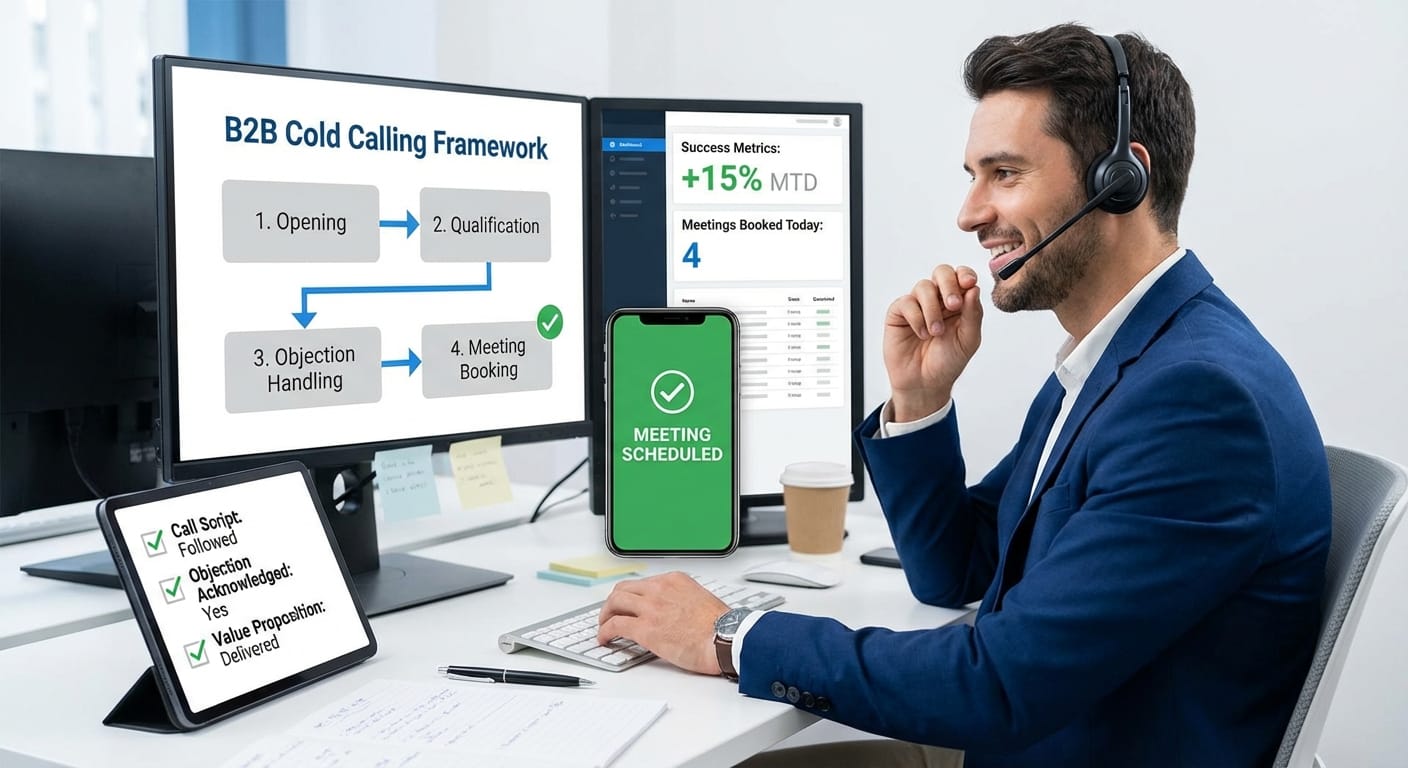
Cold calling works when you have a structured approach. Here's your complete playbook for opening calls, qualifying prospects, handling objections, and booking meetings - plus how to practice until cold calling becomes your strength instead of your weakness.
Most B2B reps hate cold calling because they wing it. No structure, no plan, just dialing and hoping prospects will talk. When prospects inevitably brush them off, they take it personally and avoid calling.
Cold calling works when you follow a proven framework. Not a rigid script - a flexible structure that guides you from opening to qualification to booking meetings, with built-in responses for common objections.
This playbook gives you that framework: how to open calls, what to say when they answer, how to qualify quickly, handle objections, and secure meetings.
Why Most Cold Calling Fails
No Clear Objective: Reps ramble about their company instead of driving to specific outcome.
Weak Opening: Generic "how are you today" or immediate pitch triggers brush-offs.
Can't Handle Objections: First "I'm busy" or "not interested" ends the call.
No Structure: Each call is different with no repeatable process to improve.
Takes Rejection Personally: Treating "no" as personal failure instead of numbers game.
The Cold Calling Framework
Phase 1: Pre-Call Preparation (2 minutes)
Purpose: Know who you're calling and why before dialing.
Research Minimum:
- Company name, industry, size
- Role of person you're calling
- One relevant business trigger (funding, growth, hiring, expansion)
Call Objective: What specifically do you want from this call? Usually: book discovery meeting.
Qualifying Questions Ready: 2-3 questions to determine if they're worth pursuing.
Example Prep:
- Calling: VP Sales at 50-person SaaS company
- Trigger: Just raised Series A, hiring 10 reps
- Objective: Book 30-minute discovery call
- Qualifying questions: Current ramp time? Training approach? Pain with onboarding?
Phase 2: The Opening (First 15 Seconds)
Purpose: Get past gatekeepers and earn right to have conversation.
Structure:
1. Name and Company: "Hi [Name], this is [Your Name] from [Company]."
2. Permission-Based Pattern Interrupt: "Do you have a quick 30 seconds?"
Why This Works: Direct ask for minimal time commitment, shows respect.
3. Reason for Call: "The reason I'm calling - we work with [roles, e.g., sales leaders] like you to help their teams close more deals faster without burning pipeline. Is this relevant to you?"
Examples:
- "I saw you're hiring 10 sales reps and most companies struggle with 6-month ramp times. That's why I called."
- "I noticed your recent funding announcement. Companies scaling sales teams typically face [problem]. Does that apply to you?"
Complete Opening Example: "Hi Sarah, this is Mike from Sellible. Do you have a quick 60 seconds? [Pause] The reason I'm calling - we work with sales leaders like you to help their teams close more deals faster without burning pipeline. Is this relevant to you?"
Why This Works:
- Gets permission for short time
- Names their role and peers
- States clear outcome (close more deals faster)
- Asks if it's relevant (qualifying question)
Phase 3: Handle Initial Objection (Next 15 Seconds)
Most Common Initial Objections:
"I'm busy right now" Response: "I understand - I caught you at a bad time. Do you mind if I ask you a quick question to see if there's a fit and it's even worth your time later?"
"Send me information" Response: "Happy to send something. Quick question before I do that - what would you like to see in that email? I want to make sure you have all the relevant information to get your questions answered. [Pause] From what I've seen, a 15-minute conversation is usually better to see if it's a fit?"
"Not interested" Response: "I totally get it - I haven't given you enough information yet. Let me be direct: companies your size typically face [problem costing X]. Does that apply to your situation, or are you somehow avoiding that issue?"
[See "Top 10 Cold Call Objections" article for complete objection responses]
Phase 4: Qualification (30-60 Seconds)
Purpose: Determine if they're worth pursuing before investing time.
Key Qualifying Questions:
Problem Confirmation:
- "Are you currently facing [problem]?"
- "How are you handling [challenge] today?"
- "What's your current approach to [area]?"
Impact Assessment:
- "What's that costing you in [time/money/opportunity]?"
- "How does that affect your ability to [key objective]?"
Authority Check:
- "Are you the person who handles [area]?"
- "Who else is typically involved in decisions about [category]?"
Timing/Urgency:
- "Is this something you're actively looking to address?"
- "What's driving the timeline on this?"
Example Qualification: Rep: "How much time are you spending on ramping new BDRs?" Prospect: "It takes our reps 3-4 months to get productive." Rep: "What's that costing you when you have 10 new hires coming on?" Prospect: "Probably $1M in lost pipeline." Rep: "Are you the one who owns sales training and onboarding?" Prospect: "Yes, that's me." Rep: "Is this something you're actively trying to improve, or just dealing with for now?" Prospect: "We need to fix it - our CEO is pushing on this."
Result: Qualified - they have problem, feel pain, have authority, and urgency exists.
Phase 5: Bridge to Meeting (15-30 Seconds)
Purpose: Secure specific next step (usually discovery meeting).
Assumptive Close: "Based on what you've shared, it sounds like there's a fit worth exploring. I'd suggest we schedule 30 minutes for a proper conversation where I can learn more about your situation and show you how we've helped companies like [similar company] reduce ramp time from 6 months to 3 months. How does [specific day/time] work?"
Why This Works: Assumes meeting makes sense, gives specific time, names value.
If They Hesitate: "Let me ask directly - based on [problem they confirmed], does it make sense to invest 30 minutes seeing if we can help? If not, I won't push it."
Why This Works: Direct question forces yes/no, shows you'll respect their decision.
Lock in Details:
- Specific day, date, and time
- Who else should attend
- What to prepare or send beforehand
- Send calendar invite immediately while on call
Example: Rep: "Perfect - I've got us down for Thursday the 28th at 2pm EST. Will it just be you or should anyone else from your team join?" Prospect: "Just me initially." Rep: "Great. I'll send a calendar invite right now with a brief agenda. One thing that would be helpful - can you send me your current new hire onboarding timeline before our call? That way I can come prepared."
Call Volume and Success Metrics
Realistic Expectations:
Dial-to-Connect Rate: 30-40% Out of 100 dials, you'll speak to 30-40 people.
Connect-to-Conversation Rate: 30-50% Of those 30-40 connects, 10-20 will have brief conversation.
Conversation-to-Meeting Rate: 20-30% Of those conversations, 2-6 will book meetings.
Overall: 100 dials → 2-6 meetings booked
Daily Volume Goal:
- 50-80 dials
- 15-25 connects
- 5-10 conversations
- 1-3 meetings booked
Key Insight: Success is about quality conversations with those who engage, not total dials.
What Separates Good from Great Cold Callers
Great Cold Callers: ✅ Follow structured framework consistently ✅ Sound confident and conversational, not scripted ✅ Handle objections without getting rattled ✅ Qualify quickly and move on from bad fits ✅ Treat "no" as information, not rejection ✅ Track what works and refine approach
Struggling Cold Callers: ❌ Wing every call differently ❌ Sound nervous or read scripts robotically ❌ Get thrown by first objection ❌ Spend time on unqualified prospects ❌ Take rejection personally ❌ Repeat same approach without learning
Common Cold Calling Mistakes
Mistake 1: Talking Too Much ❌ Pitching features for 2 minutes ✅ Quick relevant hook, then qualify with questions
Mistake 2: No Structure ❌ Different approach every call ✅ Consistent framework that can be refined
Mistake 3: Giving Up After First Objection ❌ "Okay, sorry to bother you" ✅ Handle objection, attempt to continue conversation
Mistake 4: Not Qualifying ❌ Trying to book meetings with everyone ✅ Quick qualification, move on from bad fits
Mistake 5: Vague Next Steps ❌ "Let's connect sometime next week" ✅ "Thursday at 2pm - does that work?"
Why Practicing Cold Calling Is Critical
Cold calling requires skills that only develop through repetition:
Confident Opening: Sounding natural and confident in first 15 seconds
Objection Immunity: Handling "I'm busy" and "not interested" without hesitation
Qualification Speed: Quickly determining if prospect is worth pursuing
Comfortable Asking: Directly requesting meetings without sounding desperate
The Practice Problem
Can't Practice on Real Prospects: Burning through prospect list while learning is expensive.
Limited Volume: Can't make 100+ practice calls to build muscle memory.
No Feedback: Don't know what's working vs. failing without analysis.
How Sellible Masters Cold Calling Practice
Unlimited Volume: Make 50+ practice cold calls in an hour without burning prospect lists.
Realistic Responses: AI prospects respond like real buyers - some receptive, most brush you off initially.
Objection Practice: Experience all common objections repeatedly until handling them becomes automatic.
Tone and Delivery Feedback: Get feedback on confidence, pacing, and natural delivery - not just words.
Pattern Recognition: Learn which openings, qualifying questions, and approaches work through repetition.
Cold Calling Checklist
Before Calling:
- Research prospect (company, role, trigger)
- Know your call objective (usually book meeting)
- Prepare 2-3 qualifying questions
- Review common objection responses
During Calls:
- Confident opening with permission-based interrupt
- Handle initial objection smoothly
- Qualify quickly (problem, pain, authority, urgency)
- Bridge to specific meeting time
- Lock in details and send calendar invite
After Call Block:
- Track connects, conversations, meetings booked
- Note which objections came up most
- Identify what worked vs. fell flat
- Refine approach based on patterns
Conclusion
Cold calling works when you have structure. This framework - opening, objection handling, qualification, and meeting booking - turns random calls into systematic process.
The framework works, but only when delivered with confidence and natural tone that comes from repetition. You can't become great at cold calling by reading playbooks. You must practice until opening naturally, handling objections smoothly, and asking for meetings confidently.
Sellible provides unlimited cold call practice with AI prospects who respond realistically - building the confidence and muscle memory that makes cold calling successful.
Ready to master cold calling? Book a demo with the Sellible team and practice with AI prospects that respond like real buyers.
FAQ
Q: How many calls should I make daily? A: 50-80 dials daily. Consistent volume builds skills and fills pipeline. Quality matters more than pure quantity.
Q: Should I use a script or framework? A: Framework, not rigid script. Know structure and key points, deliver conversationally not robotically.
Q: What's realistic success rate? A: 100 dials → 2-6 meetings booked. Focus on improving this ratio, not just volume.
Q: How do I stay motivated through rejection? A: Expect most calls won't convert. Track small wins (conversations, not just meetings). Practice builds rejection immunity.
Q: When should I give up on a call? A: After handling 1-2 objections. If they're still not engaging, politely end and move to next call.