Closing Conversation Playbook for B2B Sales
Complete B2B closing conversation playbook with frameworks for pricing discussions, securing commitment, handling final objections, and navigating procurement to convert qualified deals to revenue.
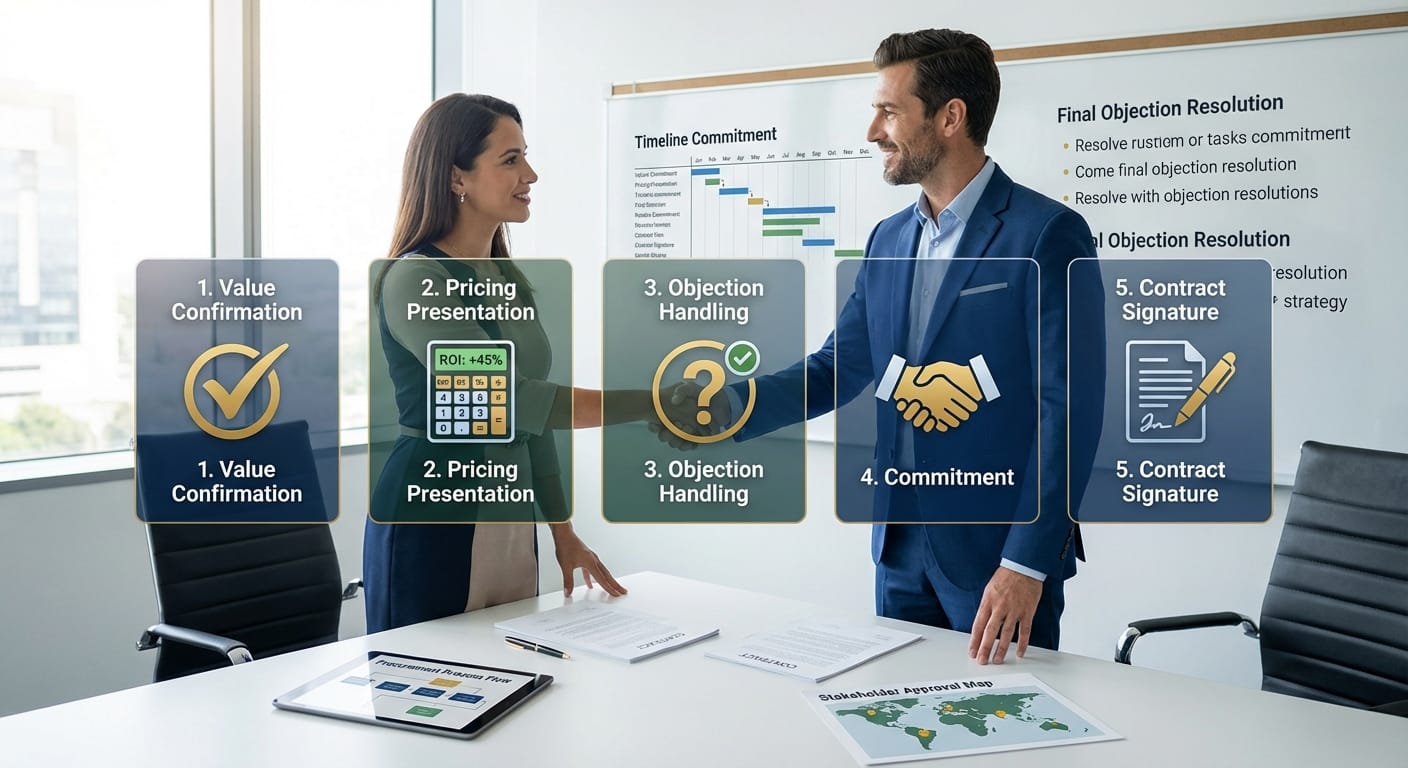
The closing conversation determines whether qualified opportunities convert to revenue or stall indefinitely. Here's your complete playbook for navigating pricing discussions, securing commitment, and driving decisions - plus how to practice until closing becomes your strongest skill.
Most B2B deals don't fail during discovery or demos - they stall during the closing conversation when it's time to discuss pricing, commit to next steps, and make final decisions. Reps who ran excellent discovery suddenly become passive, hoping prospects will "get back to them" instead of actively driving to close.
The closing conversation requires different skills than discovery: confidently discussing pricing, creating urgency without pressure, addressing final objections, securing executive commitment, and navigating procurement. Miss any of these, and qualified deals die in your pipeline.
This playbook gives you the complete framework for closing conversations that convert qualified opportunities to signed contracts.
Why Closing Conversations Are Different
Financial Commitment: Discovery was exploration. Closing involves actual budget commitment and financial risk, raising prospect anxiety and triggering new objections.
Executive Decision-Making: You're often no longer talking to your champion but to CFOs, VPs, or procurement who weren't involved in discovery and bring fresh skepticism.
Competitive Pressure: Prospects mention competitors and alternatives they didn't reveal earlier, testing your response under pressure.
Risk Becomes Real: Abstract benefits discussed in discovery become concrete commitments with implementation risk, change management, and accountability.
Procurement Process: Legal, contracts, and procurement get involved with requirements and negotiations that can derail deals if mishandled.
The 5-Phase Closing Conversation Framework
Phase 1: Confirm Value and Decision Criteria (10 minutes)
Purpose: Re-establish value proposition and ensure decision criteria haven't changed before discussing price.
Value Confirmation: "Before we discuss pricing and next steps, let me confirm we're aligned on value. Based on our previous conversations, you're looking to solve [specific problems] which currently cost you [quantified impact]. Our solution would deliver [specific outcomes] worth approximately [ROI calculation]. Is that still accurate, or has anything changed?"
Why This Works: Anchors conversation in value before price discussion and surfaces any changes in needs or priorities.
Decision Criteria Validation:
- "What criteria are most important in your final decision?"
- "How will you evaluate us against alternatives?"
- "Has anything changed in terms of what matters most?"
- "Are there new stakeholders or requirements we haven't discussed?"
Champion Check-In: "How confident are you that this addresses what [other stakeholders] need? Are there concerns we should address before moving forward?"
Example Exchange: Rep: "Based on our demo and discovery, you identified reducing sales ramp time from 6 months to 3 months as the key outcome, worth about $2M in additional capacity. Is that still the primary driver?" Prospect: "Yes, though our CFO is also focused on manager time savings. Can you quantify that?" Rep: "Absolutely - let me add that to the ROI calculation before we discuss pricing."
Result: Uncovered new stakeholder concern (CFO) before pricing discussion.
Phase 2: Present Pricing and Investment (10 minutes)
Purpose: Confidently present pricing framed as investment with clear ROI.
Pricing Presentation Framework:
Set Context: "Let me walk through the investment and how it maps to the value we discussed."
Present Pricing Clearly: "The investment is [total amount] structured as [payment terms: annual, monthly, upfront]. That includes [everything included - implementation, training, support, etc.]."
Connect to ROI Immediately: "Based on the [specific outcome] we discussed worth [$X], this delivers [ROI calculation] in [timeframe]. Essentially, the solution pays for itself in [period] and everything after that is pure value."
Pause and Let Them Process: Don't fill silence after presenting price. Let them absorb and respond first.
Alternative Framing - Break Down Cost:"Another way to look at it: for your team of [size], that's [X per user/month] to deliver [specific outcome].Compare that to the [X cost] of [current problem]."
What NOT to Do: ❌ Apologize for price: "I know it's a lot, but..." ❌ Immediately offer discounts before they object ❌ Present price without connecting to value ❌ Rush through pricing nervously
Example: "The investment is $180K annually, which includes full implementation, unlimited training, and dedicated support. Based on reducing ramp time from 6 months to 3 months for your 20 annual new hires, that's $2M in additional revenue capacity. The solution pays for itself in the first month, delivering 11:1 ROI in year one. [Pause]"
Why This Works: Frames price as investment with immediate ROI validation, delivered confidently.
Phase 3: Address Final Objections and Concerns (15 minutes)
Purpose: Handle last-minute objections and stakeholder concerns that emerge during closing.
Common Closing-Stage Objections:
"We need to discuss this internally first."
Response: "Absolutely - internal alignment is important. Help me understand who needs to be part of that discussion and what their primary concerns are likely to be. Would it make sense for me to join that conversation to address questions directly, or would you prefer to discuss first and then loop me in?"
Why This Works: Uncovers stakeholders and concerns while offering to help rather than waiting passively.
"Can you do better on price?"
Response: "Let me understand the concern. Is this about the total investment being over budget, or about comparing to alternatives? Because how we address that depends on what's driving the question."
Follow-Up Based on Response:
- If over budget: "What budget did you have allocated? Let me see if we can structure this differently - phased approach, different payment terms, adjusted scope."
- If comparing alternatives: "What specifically are you comparing? I want to make sure we're comparing equivalent value and total cost, not just initial price."
Why This Works: Uncovers real issue (budget vs. comparison) before responding.
"We're still evaluating [Competitor]."
Response: "That's smart to evaluate options. Where are you in that evaluation, and what questions remain about each option? I'd rather address any concerns now than have them come up later."
Specific Questions:
- "What do you like about their approach?"
- "Where do you see gaps or concerns with their solution?"
- "What would make us the clear choice versus them?"
- "Is this a timing question or a preference question?"
Why This Works: Surfaces competitive concerns and positions you to address them directly.
"This is a lot of change for our team."
Response: "Change management is a legitimate concern. Let me address that specifically: [implementation approach, training plan, change management support]. We've successfully implemented with companies like [similar customer] who had similar concerns. The key is [specific approach]. Would reviewing our detailed implementation and adoption plan address this?"
Why This Works: Acknowledges concern while providing concrete mitigation plan.
Phase 4: Secure Commitment and Next Steps (10 minutes)
Purpose: Get clear commitment to move forward with specific next actions and timeline.
The Assumptive Close: "Based on our conversation, it sounds like we're aligned on value and this addresses your needs. The next step is [specific action: legal review, procurement, contract signing]. I'll send over [contract, MSA, order form] today. What's the timeline for [legal/procurement] review on your end?"
Why This Works: Assumes sale and focuses on process rather than asking "do you want to move forward?"
The Direct Close: "Does this make sense to move forward with? What concerns remain that we need to address?"
Why This Works: Direct question forces clear yes/no and surfaces final concerns.
The Timeline Close: "We're aligned on value and pricing. What needs to happen between now and contract signature, and what's realistic timeline for each step?"
Why This Works: Shifts to implementation logistics, assuming decision is yes.
Get Specific Commitments:
Avoid Vague: ❌ "Let's circle back next week." ❌ "I'll send the contract and you can review." ❌ "Let me know what you think."
Get Concrete: ✅ "I'll send the contract today. Can you review by Friday and let me know any questions by Monday?" ✅ "Who specifically needs to review and approve, and when can you get their input?" ✅ "Let's schedule 30 minutes Thursday to address any final questions that come up."
The Champion Commitment: "What do you need from me to help you get this approved internally? How can I support you in making this happen?"
Why This Works: Enlists champion's active support in driving internal approval.
Phase 5: Navigate Procurement and Legal (Ongoing)
Purpose: Successfully navigate final contract, legal, and procurement processes that can stall or kill deals.
Procurement Process Understanding:
Map the Process:
- "Walk me through your procurement process from here?"
- "Who reviews contracts and what are they looking for?"
- "What typically slows down or complicates procurement?"
- "How long does legal review typically take?"
- "Are there any procurement requirements we should know upfront?"
Accelerate Procurement:
Provide What They Need Proactively: "To accelerate legal review, I'll send our standard MSA, security documentation, insurance certificates, and vendor information form. What else does your legal team typically require?"
Address Common Sticking Points: "The areas legal typically flags are [liability caps, indemnification, data security]. Here's our standard position on each and where we have flexibility."
Set Timeline Expectations: "What's realistic timeline for legal review? If they have questions, who's the best point of contact?"
Stay Engaged During Procurement:
Weekly Check-Ins: "I'll check in Friday to see where things stand and address any questions that came up."
Remove Friction: "If anything is slowing down the process - questions, concerns, missing information - let me know immediately so I can help."
Executive Escalation When Needed: "If this gets stuck in legal, I can have our counsel connect with yours to work through issues directly. Would that help?"
Contract Negotiation Principles:
Know Your Non-Negotiables: Understand what you can flex on (payment terms, implementation timeline) vs. what you can't (liability, IP).
Don't Negotiate Against Yourself: Wait for actual redlines or requests before offering concessions. "I'm happy to review your redlines when legal provides them."
Trade, Don't Give: "If we accommodate [their request], we'd need [corresponding adjustment]. Does that trade work for both sides?"
Example Procurement Navigation:
Rep: "What's your procurement process from here?" Prospect: "Legal reviews contracts, procurement verifies vendor insurance and financials, then finance approves payment terms." Rep: "What typically causes delays in that process?" Prospect: "Legal gets backed up. Can take 2-3 weeks." Rep: "Would it help if I had our legal team send a redline comparison to your standard terms proactively? That often accelerates legal review." Prospect: "Yes, that would help significantly."
Result: Identified bottleneck (legal) and offered proactive solution to accelerate.
Closing Conversation Question Frameworks
Framework 1: Decision Process Mapping
Current Stage: "Where are we in your decision process right now?"
Next Steps: "What needs to happen between now and final signature?"
Timeline: "What's realistic timeline for each step?"
Obstacles: "What could slow down or derail the process?"
Acceleration: "What would make this happen faster?"
Framework 2: Stakeholder Commitment Assessment
Champion Confidence: "On a scale of 1-10, how confident are you this will get approved?"
If Less Than 9: "What would get us to a 9 or 10?"
Stakeholder Concerns: "What concerns will [CFO/VP/procurement] raise?"
Your Support: "How can I help you get this across the line?"
Framework 3: Risk Reversal
Implementation Risk: "What concerns do you have about implementation?"
Mitigation Offer: "Here's how we mitigate that: [specific approach]."
Proof: "[Similar customer] had identical concerns and here's how we addressed them."
Guarantee: "We can structure this with [milestones, guarantees, pilot] to reduce your risk."
Framework 4: Urgency Creation
Cost of Delay: "What does another quarter without this solution cost you?"
Timeline Benefits: "If we close by [date], you could see [specific outcome] by [date]. Does that timing matter?"
Competitive Pressure: "How is this affecting your competitive position while you evaluate?"
Opportunity Cost: "What are you missing out on while running the current approach?"
Common Closing Conversation Mistakes
Mistake 1: Passive Waiting ❌ "Let me know when you're ready to move forward." ✅ "Here's what happens next: [specific steps, timeline, commitments]."
Mistake 2: Discounting Too Quickly ❌ Offering discount before prospect asks or as first response to budget concern ✅ Understanding real concern and addressing value/structure before considering price adjustments
Mistake 3: No Timeline Accountability ❌ "Take your time reviewing the contract." ✅ "Can you review by Friday? I'll check in Monday morning to address any questions."
Mistake 4: Ignoring Procurement Complexity ❌ Thinking "yes" means deal is done ✅ Understanding and actively navigating legal/procurement/approval process
Mistake 5: Accepting Stalls ❌ Accepting "we need to think about it" without understanding real concern ✅ "Help me understand - is this a timing issue, budget concern, or something else we need to address?"
Why Practicing Closing Conversations Is Critical
Closing conversations require confidence under pressure, objection handling, and commitment-seeking skills that only develop through repetition.
The Closing Practice Challenge
Financial Pressure: Discussing large investments creates pressure that causes reps to get nervous, offer discounts prematurely, or sound desperate.
Objection Intensity: Final objections are often more aggressive and stakeholder-driven than discovery objections, requiring practiced confidence.
Commitment Asking: Many reps struggle to directly ask for commitment, defaulting to passive "let me know" approaches.
What Practice Develops
Pricing Confidence: Presenting prices without apology or nervousness, delivered as matter-of-fact investment with clear ROI.
Pressure Immunity: Maintaining composure when prospects push back on price, mention competitors, or raise concerns.
Direct Commitment: Comfort directly asking for next steps and holding prospects accountable to commitments.
Objection Handling: Smooth responses to closing-stage objections without getting defensive or desperate.
How Sellible Masters Closing Practice
Pricing Pressure Scenarios: Practice with AI prospects who challenge pricing, mention budget constraints, and compare to competitors - building confidence under financial pressure.
Procurement Complexity: Work through AI scenarios involving legal review, procurement questions, and stakeholder approval - preparing for real closing complexity.
Commitment Conversations: Practice asking directly for commitment with AI prospects who deflect, stall, or raise final concerns typical of closing stage.
Multiple Stakeholder Scenarios: Navigate closing conversations involving champion, CFO, procurement, and legal - each with different concerns requiring different approaches.
Closing Conversation Checklist
Before Closing Calls:
- Confirm value proposition and ROI calculation
- Prepare pricing presentation with clear ROI framing
- Anticipate likely final objections and prepare responses
- Understand their procurement and legal process
- Have contract and supporting documents ready
- Know your pricing flexibility and non-negotiables
During Closing Calls:
- Reconfirm value and decision criteria first
- Present pricing confidently with immediate ROI connection
- Pause after pricing, let them respond first
- Address objections directly without defensiveness
- Ask for commitment - don't hint or hope
- Get specific next steps with timeline and accountability
- Identify procurement/legal process and obstacles
After Closing Calls:
- Send contract/documents immediately as promised
- Schedule follow-up for specific date/time
- Engage with legal/procurement proactively
- Weekly check-ins until signature
- Address obstacles immediately as they arise
Conclusion
Closing conversations determine whether qualified opportunities convert to revenue or die in your pipeline. Effective closing requires confident pricing presentation, direct commitment asking, and active navigation of procurement processes.
The frameworks in this playbook work when delivered with absolute confidence and without desperation. That confidence comes from practicing closing conversations until asking for commitment becomes natural and pricing discussions become comfortable.
Traditional role play can't replicate the pressure, objections, and procurement complexity of real closing conversations. You need realistic practice with AI prospects who challenge pricing, raise stakeholder concerns, and create the pressure typical of final decisions.
Sellible provides that practice. Work with AI prospects who push back on price, mention competitors, and require direct commitment - building the closing skills that convert opportunities to revenue.
Ready to master closing conversations? Book a demo with the Sellible team and practice with AI prospects who respond like real buyers making final decisions.
Frequently Asked Questions
Q: When is the right time to present pricing? A: After establishing value and confirming decision criteria. Don't lead with price, but don't wait until they ask. Present when value is clear and they're ready to evaluate investment.
Q: How do I ask for commitment without sounding pushy? A: Be direct but collaborative: "Does this make sense to move forward? What questions remain?" Direct doesn't mean aggressive - it means clear about next steps.
Q: What if they say "we need to think about it"? A: Uncover the real concern: "I appreciate that. Help me understand - is this a timing issue, budget concern, or something else we should address?" Don't accept vague stalls.
Q: Should I offer discounts to close deals? A: Defend value first. If genuine budget constraints exist, explore payment terms, phased implementation, or scope adjustments before discounting price.
Q: How long should closing take from pricing presentation to signature? A: Varies by deal size and procurement complexity. Simple B2B: 1-2 weeks. Enterprise: 4-8 weeks for legal/procurement. Set expectations based on their process, not your hopes.