Challenger Sale Playbook for Financial Services
Execute Challenger Sale methodology for financial services with regulatory insights, risk-challenging techniques, and urgency creation for banking, insurance, and wealth management.
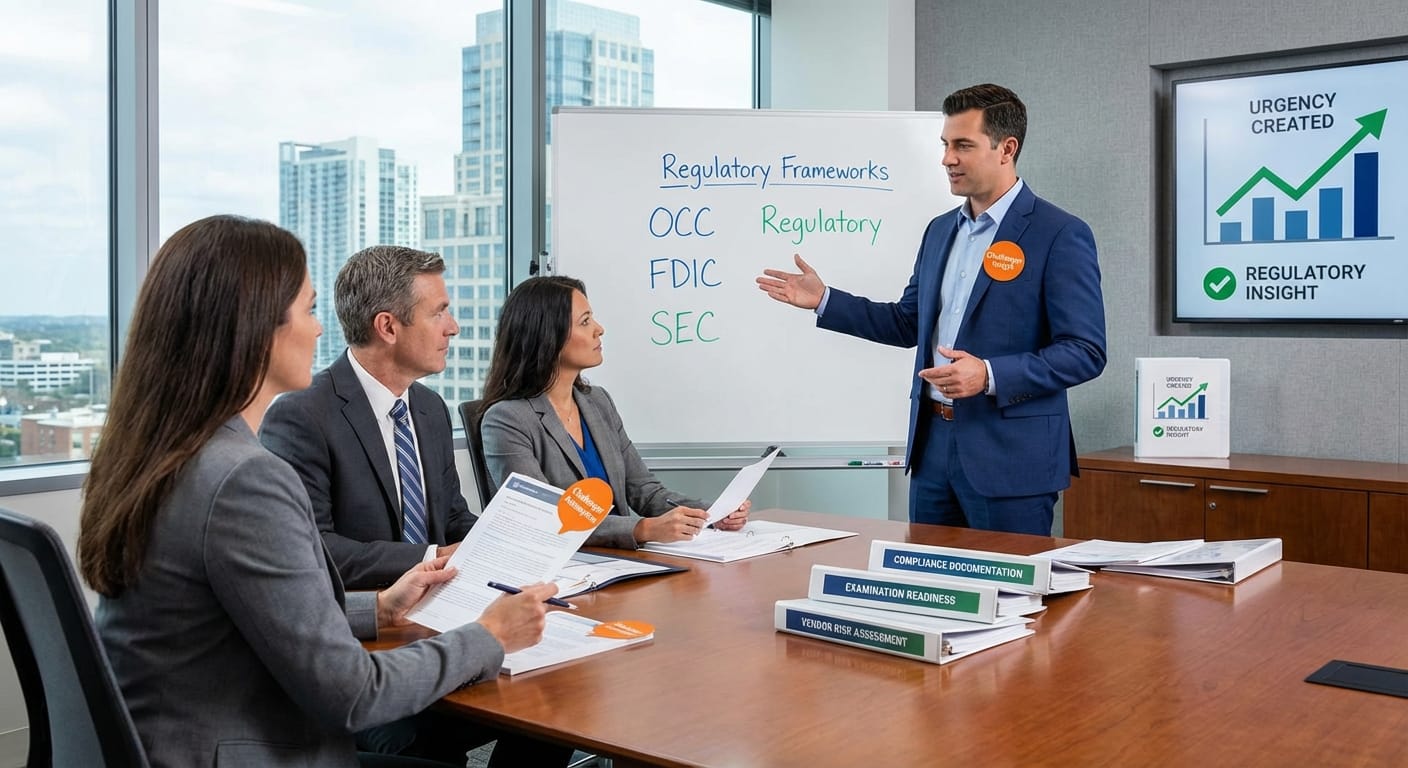
Financial services buyers are risk-averse, compliance-focused, and skeptical of vendor claims. The Challenger Sale helps you break through by teaching regulatory insights, challenging their approach to risk, and disrupting comfortable status quo - here's how to execute it for banking, insurance, and wealth management.
Selling to financial services institutions is challenging. Buyers are conservative, regulatory scrutiny is intense, and decision cycles are long. Traditional relationship-selling doesn't differentiate when every vendor claims to be "compliant" and "secure."
The Challenger Sale works powerfully in financial services because it positions you differently: you're not another vendor checking compliance boxes, you're the expert teaching them something new about regulatory risk, operational efficiency, or competitive positioning while challenging assumptions that keep them stuck.
This playbook shows you exactly how to execute Challenger Sale methodology for financial services, from teaching regulatory insights to challenging their risk tolerance to creating urgency in risk-averse cultures.
Why Challenger Works for Financial Services
Conservative Decision-Making: Risk aversion makes status quo comfortable. Teaching insights that reveal hidden risks creates urgency.
Regulatory Complexity: Compliance requirements are overwhelming. Teaching how to navigate them positions you as expert advisor.
Crowded Vendor Market: Every vendor claims compliance and security. Teaching differentiates you from checklist-sellers.
Long Sales Cycles: Multi-stakeholder approval processes drag on. Challenger creates momentum by revealing problems that demand attention.
Examination-Driven Urgency: Regulatory examinations create pressure. Teaching how to address findings before next exam cycle drives action.
The Financial Services Challenger Framework
Phase 1: Teach Regulatory and Risk Insights
Purpose: Lead with insights about compliance, risk, or competitive positioning they haven't considered.
Financial Services Teaching Examples:
Insight 1: Hidden Compliance Risk "Most banks focus on obvious compliance requirements - BSA/AML, fair lending, data security. But here's what examiners are increasingly focused on: third-party risk management and vendor oversight. The OCC and FDIC issued updated guidance requiring banks to demonstrate ongoing monitoring, not just initial vendor due diligence. Banks that can't show continuous vendor risk assessment are getting MRAs and consent orders. We're seeing institutions with 50+ vendors struggle to demonstrate they're meeting these requirements. How confident are you in your vendor risk documentation if examiners asked today?"
Why This Works: Reveals compliance gap they likely have, creates examination urgency.
Insight 2: Cost of Manual Compliance Processes "Most financial institutions know compliance is expensive, but here's what we're finding: the real cost isn't the compliance team - it's the operational burden on frontline staff. Bank branches spending 12+ hours weekly on compliance documentation means those same employees aren't serving customers or generating revenue. When you calculate fully-loaded cost of compliance time across all branches, it's often 2-3x what institutions estimate. One regional bank thought compliance cost them $2M annually - detailed analysis showed $6M in total burden including operational time. Are you measuring just compliance department costs or total organizational burden?"
Why This Works: Quantifies hidden costs beyond obvious compliance budget.
Insight 3: Competitive Risk from Fintech "Traditional banks view fintech as competitors for deposits or lending. But here's the bigger threat: fintechs are training customers to expect digital-first experiences. When customers get instant account opening and real-time approvals from fintechs, they view traditional bank processes as outdated regardless of relationship history. The risk isn't losing customers today - it's becoming irrelevant to next generation of banking customers who won't tolerate analog processes. Banks that haven't modernized customer experience by 2027 will struggle to attract customers under 40. Where are you in digital transformation?"
Why This Works: Reframes fintech competition from products to customer expectations.
Insight 4: Examination Finding Patterns "We analyze hundreds of examination reports annually across community and regional banks. Here's the pattern: 70% of MRAs and matters requiring attention come from three areas - vendor risk management, BSA/AML program effectiveness, and IT security. Examiners aren't finding new issues - they're finding the same three areas repeatedly because banks focus on point solutions instead of systematic approaches. Banks addressing all three proactively before examinations get clean reports. Those addressing reactively after findings get escalating regulatory pressure. Which category are you in?"
Why This Works: Shows pattern across industry and positions proactive vs. reactive approach.
Phase 2: Tailor to Financial Services Segment
Purpose: Customize teaching to their specific segment - banking, credit unions, insurance, wealth management.
Segment-Specific Tailoring:
Community Banks: "For community banks specifically, the challenge is regulatory burden designed for large institutions applied to smaller operations. You don't have dedicated vendor risk management teams, but examiners expect the same rigor as regional banks with full compliance departments. Community banks winning are those using technology to automate vendor monitoring instead of hiring more compliance staff. That approach delivers examiner-ready documentation at fraction of headcount cost."
Credit Unions: "Credit unions face unique member-owned governance complexity. Board members who aren't financial services experts need to oversee vendor relationships, cybersecurity, and regulatory compliance. The credit unions succeeding are those who translate complex compliance into board-friendly reporting that enables oversight without requiring expertise. That keeps examiners satisfied with governance while not overwhelming volunteer boards."
Insurance: "In insurance, state regulatory fragmentation creates compliance complexity. Operating in 15 states means 15 different regulatory requirements, examination schedules, and reporting obligations. The carriers managing this effectively centralize compliance tracking across all states rather than treating each state separately. That approach prevents gaps where something required in one state gets missed."
Wealth Management/RIAs: "For RIAs and wealth managers, the SEC examination focus has shifted from investment advice to cybersecurity and business continuity. Examiners increasingly probe: how do you protect client data, what happens if your systems go down, how do you ensure vendor security. RIAs still focused only on investment compliance are getting surprised by cyber-focused examinations."
Example Tailored Opening: Rep: "Before we discuss your situation, let me share what we're seeing across community banks your size. The biggest examination risk right now isn't traditional compliance - it's vendor risk management. The OCC and FDIC updated guidance requiring ongoing vendor monitoring, not just initial due diligence. Community banks with 30-50 vendors can't manually track vendor performance, financial health, security, and compliance. The ones getting clean examination reports have automated vendor monitoring. Does vendor risk management come up in your examinations?"
Phase 3: Challenge Their Assumptions
Purpose: Constructively push back on their thinking about risk, compliance, and operations.
Financial Services Challenging Techniques:
Challenge Risk Tolerance: Prospect: "Our current approach to vendor risk management is fine." Challenger Response: "Let me challenge 'fine' - because examiners don't grade on 'fine,' they grade on 'demonstrates effective ongoing oversight.' If examiners requested vendor risk documentation today - ongoing financial monitoring, security assessments, business continuity validation - how quickly could you produce examiner-ready evidence? Fine for internal purposes often doesn't meet examination standards."
Why This Works: Challenges gap between internal satisfaction and regulatory expectations.
Challenge Compliance Investment: Prospect: "We can't afford to invest more in compliance right now." Challenger Response: "I'm going to push back on that because banks that say 'can't afford compliance investment' often can't afford NOT to invest. An MRA or consent order costs significantly more in remediation, legal, and reputational damage than proactive compliance. One bank spent $50K preventing vendor risk issues versus $800K remediating after examination findings. Are you comparing investment cost to prevention value or just treating compliance as expense?"
Why This Works: Reframes compliance from cost to risk mitigation investment.
Challenge Their Timeline: Prospect: "We'll address this after our next examination." Challenger Response: "Let me challenge that timeline. If examiners find deficiencies in your next examination, you're in reactive remediation mode under regulatory pressure with tight deadlines. That's the most expensive, stressful way to address compliance. Banks addressing proactively before examinations do so on their timeline with better outcomes. Why wait for examiners to force action when you can address it strategically now?"
Why This Works: Uses examination pressure to create urgency.
Challenge Their Vendor Strategy: Prospect: "We're comfortable with our current vendors." Challenger Response: "Comfortable is interesting word choice. Let me ask - are you comfortable because vendors are performing well, or because changing vendors feels risky in regulated environment? Because we see banks stay with underperforming vendors due to change aversion, not actual vendor quality. If you objectively evaluated current vendors against alternatives, would they win on performance, or are you choosing familiarity over excellence?"
Why This Works: Challenges whether comfort equals performance or just risk aversion.
Challenge Their Digital Transformation Pace: Prospect: "We're taking a measured approach to digital transformation." Challenger Response: "Measured is good for risk management, but here's the challenge: customer expectations are changing faster than measured approaches can address. When fintech competitors offer instant account opening and traditional banks take 45 minutes and three forms, 'measured transformation' looks like 'slow decline' to customers under 40. Is measured pace matching customer expectation evolution, or are you measuring yourself to irrelevance?"
Why This Works: Creates urgency around competitive positioning.
Phase 4: Create Constructive Tension
Purpose: Generate productive tension between current state and regulatory/competitive risks.
Tension Creation Techniques:
Examination Pressure: "Your next examination is in [timeframe]. Examiners will probe vendor risk management, cybersecurity, and BSA/AML effectiveness. Right now, could you demonstrate ongoing oversight in all three areas with examiner-ready documentation? The gap between current state and examination readiness is what creates findings. That gap is closeable - the question is whether you close it before or after examiners identify it."
Competitive Positioning: "Your competitors are implementing [digital account opening, automated lending, advanced fraud detection]. Every month you wait, the customer experience gap widens. Early movers get customer loyalty and market position. Late movers struggle to catch up while defending declining market share. Where do you want to be in this transition - leader, fast follower, or laggard?"
Regulatory Change: "New [regulation/guidance] takes effect in [timeframe]. Institutions addressing this now have 6-12 months for strategic implementation. Those waiting until deadline will rush implementation under pressure, often with poor outcomes and higher costs. Which approach matches your risk tolerance - strategic preparation or deadline scramble?"
Cost of Inaction:"Continuing current approach costs you [X in operational burden + compliance risk exposure + competitive disadvantage]. Over next 12 months, that gap compounds. Addressing this delivers [Y operational efficiency + examination readiness + competitive positioning]. The math strongly favors action. What would make delaying worth the cost?"
Financial Services Challenger Discovery Questions
Regulatory and Examination:
- "When was your last examination and what findings did you receive?"
- "What areas do you expect examiners to focus on next time?"
- "How confident are you in your examination readiness if they came tomorrow?"
- "Where do you see regulatory gaps or vulnerabilities?"
Compliance Burden:
- "How much time does your team spend on compliance vs. strategic work?"
- "What compliance processes are most manual and time-consuming?"
- "If you could automate one compliance area, what would have biggest impact?"
- "What's total organizational burden of compliance beyond compliance department?"
Vendor and Third-Party Risk:
- "How many third-party vendors do critical operations depend on?"
- "How do you monitor vendor financial health, security, and compliance?"
- "Could you demonstrate ongoing vendor oversight if examiners requested documentation?"
- "What vendor risks concern you most?"
Digital and Competitive:
- "How are customer expectations changing in your market?"
- "Where are fintech competitors gaining ground?"
- "What digital capabilities do customers expect that you don't offer?"
- "How does your digital experience compare to competitors?"
Risk Tolerance:
- "What keeps your risk committee up at night?"
- "Where do you see unacceptable risk exposure?"
- "What compliance failures would have most serious consequences?"
- "How do you balance innovation with risk management?"
Financial Services Objection Challenging
"We need to see ROI before investing" Challenge: "Let me challenge ROI thinking in compliance context. ROI on compliance isn't revenue generation - it's risk mitigation and cost avoidance. One consent order, data breach, or examination finding costs more than proactive investment. Are you calculating ROI including cost of compliance failure, or just looking at investment in isolation?"
"Our regulators haven't required this yet" Challenge: "Waiting for regulators to require something means you're always reactive. Banks that wait for regulatory mandates operate under pressure with tight deadlines. Those who address emerging expectations proactively implement strategically on their timeline. Do you want to be proactive leader or reactive follower?"
"We're too small for this to matter" Challenge: "Examiners apply same standards to community banks as regionals - they don't grade on curve based on asset size. Small institutions get same vendor risk, cybersecurity, and BSA/AML examination scrutiny. Being small doesn't reduce regulatory expectations, it just makes compliance harder with fewer resources. Doesn't that make automation and efficiency more important, not less?"
Why Practicing Financial Services Challenger Is Critical
Challenger in financial services requires skills that feel risky in conservative culture:
Regulatory Credibility: Teaching about compliance without sounding like you're giving legal advice
Constructive Challenging: Pushing back on risk tolerance without appearing reckless
Urgency Creation: Using examination pressure without fear-mongering
How Sellible Masters Financial Services Challenger
Regulatory Scenarios: Practice with AI financial services buyers who respond like conservative, compliance-focused decision-makers
Challenge Resistance: Work with AI that defends status quo using risk aversion, requiring you to maintain Challenger stance
Examination Pressure: Learn to create urgency using regulatory cycles without sounding alarmist
Tone Calibration: Develop balance between challenging and respecting their conservative culture
Conclusion
Challenger Sale works powerfully in financial services by teaching regulatory insights, challenging risk assumptions, and creating urgency in conservative cultures. You position as expert advisor who understands their world, not generic vendor.
These frameworks work when delivered with credibility and collaborative challenge. That balance develops through practice with realistic financial services scenarios.
Sellible provides that practice. Work with AI financial services buyers who respond like real compliance-focused decision-makers, building Challenger skills that win banking, insurance, and wealth management deals.
Ready to master Challenger for financial services? Book a demo with the Sellible team and practice with AI prospects from banking and insurance.
FAQ
Q: How much regulatory knowledge do I need? A: Know basic frameworks (BSA/AML, vendor risk, cybersecurity) and examination processes. You're not compliance expert, but must demonstrate you understand their regulatory world.
Q: Won't challenging financial services buyers backfire in risk-averse culture? A: Constructive challenging based on regulatory insight builds credibility. Aggressive or uninformed challenging backfires. Frame as "here's what we're seeing" not "you're wrong."
Q: How do I create urgency when decision cycles are 12+ months? A: Use examination cycles, regulatory deadlines, and competitive pressure. Financial services has built-in urgency - you just need to surface it.
Q: What if they say "we need legal/compliance to review everything"? A: Expected in financial services. Offer to provide compliance documentation, engage with their legal/compliance directly, and build that time into sales process.
Q: When should I introduce solution after teaching? A: After teaching creates credible gap between current state and examination/competitive readiness. Once they see gap, they'll ask how to close it.