Challenger Sale Playbook for B2B SaaS
Execute Challenger Sale methodology for B2B SaaS with frameworks for teaching unique insights, challenging software buyer assumptions, and taking control of crowded SaaS sales conversations.
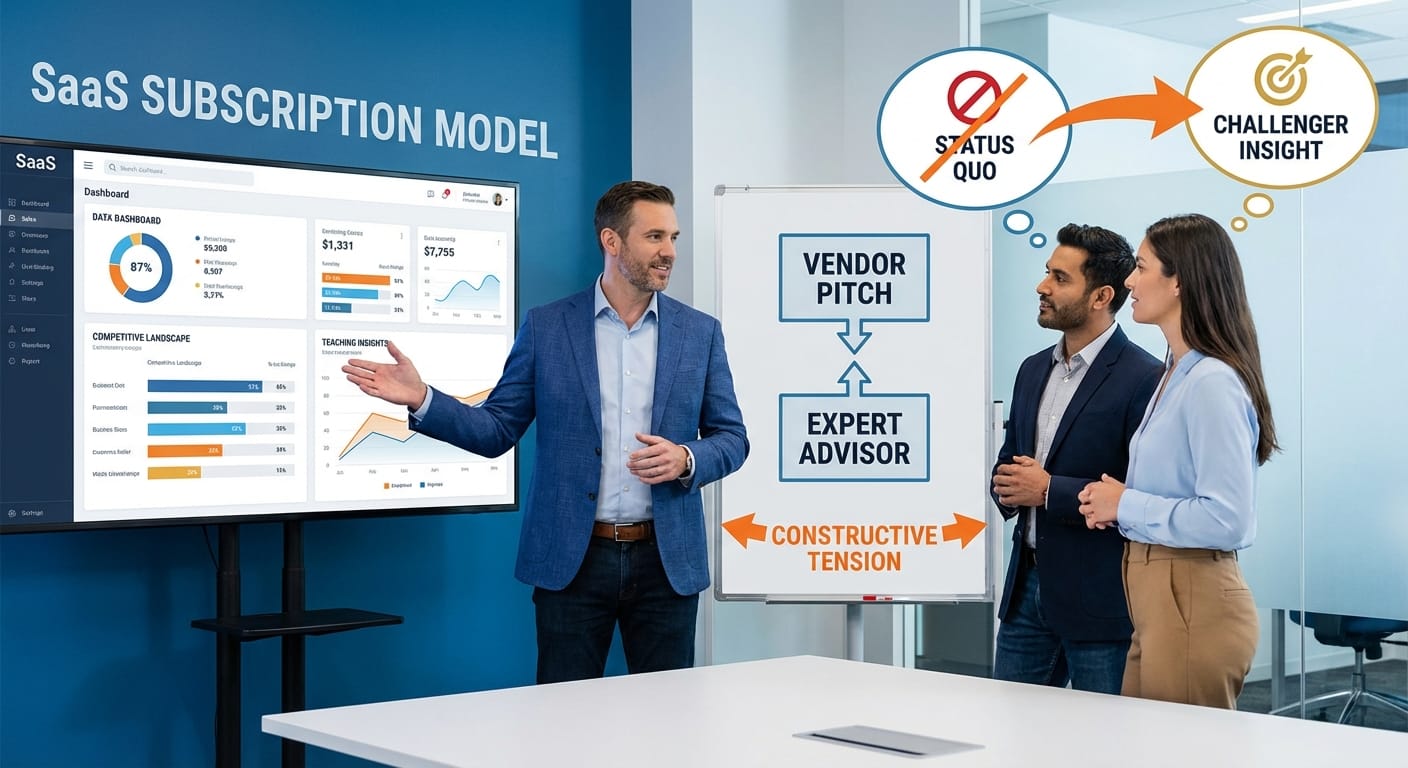
SaaS buyers are drowning in vendor pitches and think they know everything about software. The Challenger Sale helps you stand out by teaching insights, challenging assumptions, and disrupting the status quo - here's how to execute it for B2B SaaS.
B2B SaaS sales is crowded. Every buyer gets 20+ vendor pitches monthly, sits through countless demos, and believes they're sophisticated software evaluators. Traditional relationship-selling doesn't differentiate anymore - buyers expect you to be consultative and helpful.
The Challenger Sale approach works powerfully in SaaS because it positions you differently: you're not another vendor pitching features, you're the expert teaching them something new about their business and challenging how they think about solving problems.
This playbook shows you exactly how to execute Challenger Sale methodology for B2B SaaS, including teaching frameworks, challenging techniques, and how to practice until it becomes natural.
Why Challenger Works for B2B SaaS
SaaS Buyers Are Skeptical: They've seen every pitch, demo, and "revolutionary" solution. Relationship-building and feature presentations don't break through.
They Think They Know Software: Buyers believe they're experts at evaluating SaaS. Challenging their assumptions creates credible differentiation.
Status Quo Is Comfortable: Current software "works well enough." You must create urgency by revealing hidden costs and risks they don't see.
Crowded Market: Hundreds of SaaS tools compete in every category. Teaching unique insights is the only way to stand out.
Long Sales Cycles: Multi-stakeholder SaaS decisions drag on. Challenger creates urgency and momentum by revealing problems that demand attention.
The SaaS Challenger Framework
Phase 1: Teach for Differentiation
Purpose: Lead with unique insight that reframes how prospects think about their problem.
What Teaching Means in SaaS: Not explaining your product. Teaching means sharing insights about their business, market, or approach that they haven't considered.
SaaS Teaching Framework:
Insight 1: Hidden Cost of Current Approach Reveal costs prospects don't realize they're incurring with current software or manual processes.
Example - Sales Enablement SaaS: "Most companies think their current training approach 'works fine.' But here's what we see: reps need 100+ realistic practice conversations to become proficient. Traditional role-play provides 5-10. That 90% practice gap means your first 30 real prospect calls become practice - at the expense of pipeline. Companies calculate this costs $400K+ in lost opportunities per new rep annually. Are you accounting for that cost?"
Why This Works: Quantifies hidden cost they didn't realize, creating urgency.
Insight 2: Market or Competitive Shift Teach how market changes or competitor moves create new risks or opportunities.
Example - Marketing Automation SaaS: "Your competitors are personalizing at scale using AI-powered segmentation. Here's what that means: while you're sending batch-and-blast campaigns, they're delivering 1:1 personalized messaging based on behavior, intent, and firmographic data. Early adopters are seeing 3x engagement rates. The gap widens monthly. By the time this becomes 'industry standard,' catching up will be significantly harder."
Why This Works: Creates competitive urgency through market insight.
Insight 3: Risk They're Not Seeing Reveal compliance risks, security vulnerabilities, or operational exposures they're unaware of.
Example - Data Security SaaS: "Most companies focus on external threats - hackers and breaches. But 60% of data exposure actually comes from internal access management: employees having access they shouldn't, contractors retaining credentials after contracts end, shadow IT creating ungoverned data repositories. Your current approach probably focuses on perimeter security while missing the bigger internal risk. Want to see where your gaps likely are?"
Why This Works: Reframes their security thinking from external to internal threats.
Insight 4: Better Way to Achieve Outcome Challenge their approach by teaching a fundamentally different method.
Example - Project Management SaaS: "Most teams manage projects through task lists and deadlines. Here's the problem: that approach manages activities, not outcomes. High-performing teams instead organize around value streams and customer outcomes, then work backward to activities. Companies making this shift see 40% faster delivery because teams focus on what matters, not just completing tasks. Your current approach might be why projects feel busy but don't deliver business value quickly."
Why This Works: Challenges their fundamental approach, not just their tool choice.
Phase 2: Tailor the Message
Purpose: Customize your teaching and challenge to their specific situation.
SaaS Tailoring Approach:
Industry-Specific Insights: "In [their industry], the challenge with [current approach] is specifically [industry factor]. For example, [industry example company] faced [specific consequence]."
Role-Specific Framing:
- To CFO: Frame insights around financial impact, ROI, cost reduction
- To CTO: Focus on technical debt, scalability, integration complexity
- To Operations: Emphasize efficiency, productivity, process optimization
- To Sales/Revenue Leaders: Highlight revenue impact, pipeline, conversion rates
Company Size/Stage Tailoring:
- Startups: Speed to market, lean operations, competitive advantage
- Growth Stage: Scaling challenges, process breakdown, adding headcount
- Enterprise: Risk mitigation, compliance, vendor consolidation
Example - Tailored to VP of Sales: "For sales teams your size - 50 reps - here's what the ramp time problem really costs: at 6 months to productivity, you're burning $2M annually in new rep opportunity cost. But here's what makes it worse: high early-stage turnover means you're constantly backfilling, never getting ahead. Companies that cut ramp to 3 months using [approach] not only gain capacity but reduce turnover 40% because reps succeed faster."
Why This Works: Makes generic insight specific and urgent to their exact situation.
Phase 3: Take Control of the Sale
Purpose: Guide the conversation and decision process rather than passively following buyer's process.
SaaS Taking Control:
Control the Conversation: Don't let prospects drive to demo immediately. Lead with teaching, questions, and insight before showing product.
Example: Prospect: "Can you show me a demo?" Challenger Response: "Absolutely - and I want to make sure the demo is relevant. Before diving in, let me ask a few questions about your current approach so I can show you what matters most. [Proceed with diagnostic questions]."
Why This Works: Maintains control while appearing consultative.
Control the Evaluation: Shape their decision criteria around what you do best, not generic RFP requirements.
Example: "As you evaluate solutions, most companies focus on feature checklists. But here's what actually predicts success: [criteria that favors you - implementation speed, adoption rates, business outcomes]. Would it make sense to evaluate options based on what actually drives results rather than just feature comparison?"
Why This Works: Reframes evaluation criteria in your favor.
Control the Timeline: Create urgency through teaching costs of delay.
Example:"Every month you wait to address [problem], you're incurring [X cost]. Over a typical 6 − month evaluation, that′s [X total]. Fast-moving companies make decisions in 60 days because they calculate the cost of delay. What's your timeline, and have you factored in what waiting costs?"
Why This Works: Uses their own math to create timeline urgency.
Phase 4: Challenge the Customer
Purpose: Constructively push back on their assumptions, current approach, and objections.
SaaS Challenging Techniques:
Challenge Their Problem Definition:
Prospect: "We need better reporting." Challenger Response: "Let me challenge that - is reporting really the problem, or is it that you can't make decisions quickly because data lives in silos and requires manual compilation? Because solving 'better reporting' with another dashboard doesn't fix the underlying data architecture problem. Should we discuss the root issue?"
Why This Works: Reframes surface problem to deeper issue you solve.
Challenge Their Current Approach:
Prospect: "Our current system works fine." Challenger Response: "Define 'works fine' - because what we're seeing is that 'works fine' in software often means 'we've adapted our processes to work around limitations.' You're probably spending 10+ hours weekly on workarounds you don't even realize are workarounds anymore. Want to see where those inefficiencies likely are?"
Why This Works: Challenges comfort with status quo by revealing hidden costs.
Challenge Their Objections:
Prospect: "Your price is higher than competitors." Challenger Response: "Let me push back on that price comparison. You're comparing initial subscription cost, not total cost of ownership. Cheaper alternatives typically require [longer implementation, more internal resources, customization costs, integration fees]. When you calculate total cost over 3 years including those factors, we're often 30% less expensive. Should we look at total cost rather than just subscription price?"
Why This Works: Challenges the comparison rather than defending price.
Challenge Their Timeline:
Prospect: "We'll evaluate this next quarter." Challenger Response: "Let me challenge that timeline. You identified [problem] costing [X monthly]. Waiting another quarter costs [X total]. I understand competing priorities, but is saving [$X] worth delaying by [timeframe]? What would need to change to address this sooner?"
Why This Works: Uses their own numbers to challenge delay.
Challenge Stakeholder Concerns:
Prospect: "Our IT team will have concerns about integration." Challenger Response: "That's fair - and let me challenge the assumption that integration is the hard part. Most IT concerns come from legacy systems that required custom integration. Modern SaaS uses standard APIs and pre-built connectors. The 'integration concerns' are usually based on past experiences that don't apply anymore. Would having our technical team show your IT how simple this actually is address that?"
Why This Works: Challenges assumption rather than accepting objection.
Phase 5: Apply Constructive Tension
Purpose: Create productive tension between current state and better future without being aggressive.
SaaS Tension Creation:
Gap Between Current and Possible: "Right now you're achieving [current metric]. Companies using [better approach] achieve [significantly better metric]. That gap represents [quantified opportunity cost]. The question is whether that gap is acceptable or needs closing."
Risk of Inaction: "Continuing with current approach means [specific consequence - falling behind competitors, accumulating technical debt, missing revenue opportunity]. That might be acceptable risk. Or it might be unacceptable. Which is it?"
Competitive Pressure: "Your competitors are already moving to [new approach]. Early movers get [specific advantage - market position, customer lock-in, cost structure]. Late movers struggle to catch up. Where do you want to be in this transition?"
Why These Work: Creates tension without being pushy - prospects feel the gap themselves.
SaaS Challenger in Practice
Discovery Call Challenger Approach
Don't Start With: "Tell me about your current process and challenges."
Start With Teaching: "Before diving into your situation, let me share what we're seeing across [their industry/segment]. Companies your size are facing [specific trend/problem] that most don't realize is costing them [quantified impact]. For example, [brief example]. Does that resonate with what you're experiencing?"
Then Challenge: "Based on that pattern, I'm curious - are you experiencing [specific symptom of problem]? Because if so, your current approach to [area] is likely creating [hidden cost]. Want to explore whether that's happening?"
Demo Challenger Approach
Don't Start With: "Let me show you features..."
Start With Challenge: "Before showing you product, let me challenge one assumption. Most companies evaluate software by features - does it have X, Y, Z capability. But here's what predicts success: [outcome-focused criteria]. As I show you this, I want you evaluating not just 'does it have features' but 'will this actually deliver [outcome].' Fair?"
During Demo: "Here's where this challenges conventional approach: instead of [traditional method], this enables [better method]. That shift is what drives [specific result]."
Closing Challenger Approach
Don't: "Are you ready to move forward?"
Challenge to Close: "Let me be direct - based on our conversations, you have two options: continue with current approach accepting [quantified cost and risk], or implement this and achieve [quantified benefit]. Both are valid choices. Which makes more business sense for your situation?"
Why This Works: Forces decision by contrasting clear alternatives.
Common SaaS Challenger Mistakes
Mistake 1: Challenging Without Teaching ❌ Being contrarian without providing valuable insights ✅ Teaching first, then challenging based on that insight
Mistake 2: Generic "Insights" ❌ Sharing obvious or Google-able information ✅ Providing data, examples, or perspectives they can't get elsewhere
Mistake 3: Being Aggressive vs. Constructive ❌ Telling them they're doing everything wrong ✅ Showing them better ways and letting them see the gap
Mistake 4: Challenging Too Early ❌ Pushing back before establishing credibility ✅ Teaching credibility first, then earning right to challenge
Mistake 5: Forgetting to Tailor ❌ Same pitch for everyone ✅ Customizing insights to their industry, role, and situation
Why Practicing Challenger Is Critical
Challenger Sale requires skills most reps don't have naturally:
Insight Delivery: Teaching insights conversationally, not like giving lecture
Constructive Challenging: Pushing back while staying collaborative, not argumentative
Tension Creation: Creating urgency without pressure or manipulation
Confidence Under Resistance: Maintaining Challenger stance when prospects push back
How Sellible Masters Challenger Practice
Teaching Scenarios: Practice leading with insights to AI prospects who respond like real buyers - some receptive, some skeptical
Challenge Practice: Work with AI that has strong opinions and comfort with status quo, requiring you to challenge constructively
Pushback Handling: Build confidence when AI prospects push back on your challenges, testing your ability to maintain stance
Tone Calibration: Develop the balance between challenging and collaborative through repeated practice with feedback
SaaS Challenger Checklist
Before Calls:
- Prepare 2-3 teaching insights relevant to their situation
- Identify assumptions to challenge
- Quantify cost/risk of status quo
- Plan how to tailor to their role/industry
During Calls:
- Lead with teaching, not product
- Challenge assumptions constructively
- Create tension between current and possible
- Take control of conversation and evaluation
- Maintain collaborative, not aggressive tone
Practice Until:
- Teaching feels natural, not scripted
- Challenging doesn't make you uncomfortable
- You can maintain stance under pushback
- Balance is constructive, not combative
Conclusion
Challenger Sale works powerfully in B2B SaaS because it differentiates you in crowded markets. Teaching unique insights, challenging assumptions, and creating constructive tension positions you as expert advisor, not another vendor.
But executing Challenger requires skills that feel unnatural to most reps: leading with teaching instead of product, challenging prospects instead of agreeing with them, creating tension instead of building easy relationships.
These skills only develop through practice. You need realistic scenarios with prospects who challenge back, testing whether you can maintain Challenger stance under pressure.
Sellible provides that practice. Work with AI prospects who respond to teaching with skepticism, push back when challenged, and force you to develop Challenger skills that win SaaS deals.
Ready to master Challenger for SaaS? Book a demo with the Sellible team and practice teaching, challenging, and controlling conversations.
FAQ
Q: Won't challenging prospects alienate them? A: Constructive challenging based on insight builds credibility. Aggressive or condescending challenging alienates. The difference is tone and teaching first.
Q: What if I don't have unique insights to teach? A: Insights come from: industry data/trends, customer success patterns, competitive intelligence, common mistakes you see. Develop insight library from real client experiences.
Q: How do I challenge without sounding arrogant? A: Frame as "let me offer different perspective" or "let me push back on that" - collaborative language. Back challenges with data and examples, not just opinions.
Q: When should I use Challenger vs. traditional relationship selling? A: Challenger works when: buyers are sophisticated, markets are crowded, status quo is comfortable, and you need differentiation. Use relationship approaches for unique/emotional purchases.
Q: Can I use Challenger with prospects who just want demos? A: Yes - teach before demo, challenge during demo ("here's where this challenges traditional approach"), and use demo to reinforce insights you taught.